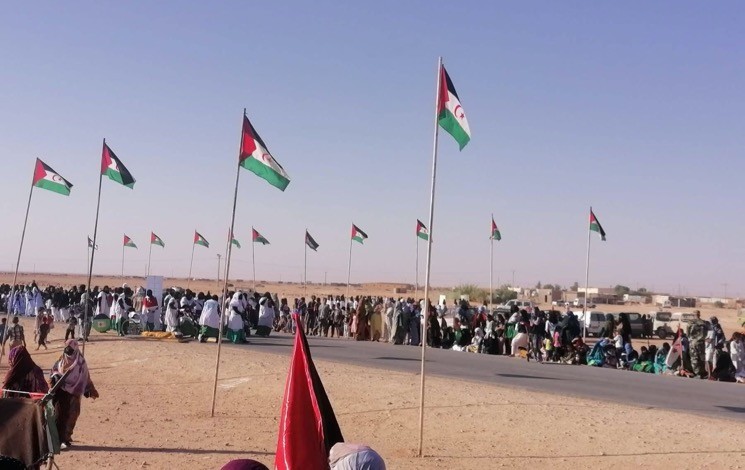
Sahrawi refugees in Tindouf protest against US maneuvers aimed at imposing Moroccan interests
#Western_Sahara #Morocco #saharawi_refugees_in_Algeria #Tindouf #Polisario
AOUSSERD CAMP (Algeria) – Fifty years after the proclamation of the Sahrawi Arab Democratic Republic (SADR), Sahrawi refugees are entering a new decade of uncertainty. Despite hopes placed in future generations, even the third generation born in the camps of far southern Algeria cannot envisage a normal life. The former director of the UNHCR, Werner Blatter, sounds the alarm in an opinion piece: the collapse of humanitarian aid now seriously threatens the survival of these uprooted populations.
On October 31, a major diplomatic turning point was reached. Under pressure from the United States, the UN Security Council for the first time lent its support to an « autonomy plan under Moroccan sovereignty, » described as the « most feasible solution » for this former Spanish territory of 266,000 km², rich in phosphates and fish-filled waters. A closed-door meeting of the Council on this thorny issue is scheduled for this Thursday.
Yet, in the Aousserd camp, thousands of miles away from New York’s meeting rooms, the situation is quite different. Not a single Sahrawi interviewed by AFP wavered from the idea of total independence. Amid modest gray houses with roofs held down by stones, children run around shouting « No to the autonomy plan! » for the attention of guests at the 50th anniversary of the SADR, proclaimed by the Polisario independence movement.
« We will never back down, we will never give up the independence of our country, » 76-year-old homemaker Hadjeb bent Sid Ahmed oueld Hamma told AFP, summing up the general sentiment.
173,000 Refugees Trapped Between the Sand Wall and the Thirst for Independence
According to the UN High Commissioner for Refugees, the five camps set up in southern Algeria house approximately 173,000 refugees, who arrived in waves after Moroccan troops entered Western Sahara in 1976. Heavily dependent on humanitarian aid, they have limited access to food and water, delivered by tanker trucks over dirt tracks.
Habiba bent Ali Elouadjem, 81, still dreams of returning to her « homeland » on the other side of the Sand Wall, a 2,700 km barrier erected by Rabat in the 1980s to protect against Polisario attacks. « If we invoke international law, let it be known that here there is a people and decades of struggle for a just cause, » argues Fatema Bent Khattery Sidi Abedi, a 56-year-old teacher, who describes harsh living conditions marked by sandstorms where « everything disappears under the dust » for sometimes « three days and three nights in a row. »
Secret Negotiations, but Determination Intact
Two rounds of secret negotiations focused on the Moroccan autonomy plan took place in February in Spain between Morocco, the Polisario, Algeria, and Mauritania, in the presence of the US special envoy for Africa, Massad Boulos, according to American, French, and Spanish media.
But on the ground, determination does not waver. Abdelhadi El Goueiri, a 29-year-old mining engineer, explained that he studied « in order to continue our fathers’ path in the struggle for total independence and to free ourselves from colonialism. » Smiling among other women preparing tea, 75-year-old Salima bent Elghifri Ahmed insisted that the refugees « will under no circumstances accept the autonomy plan, whatever sacrifices must be made, whatever pressure from the international community. »
For Ouali Ahmed Sidi Moulai, a camp shopkeeper, « We have paid a heavy price in martyrs for an ideal that admits no compromise: freedom, independence, and dignity. » This 55-year-old man added: « We have an imprescriptible right to self-determination. This is a decolonization issue. »
Rich in resources but torn by a so-called « low-intensity » conflict that resumed in November 2020 between Moroccan forces and Polisario independence fighters, Western Sahara remains considered a non-self-governing territory by the UN. A ceasefire was reached in 1991, along with a promise of a self-determination referendum that never materialized. Fifty years later, the children of the sand still run, shouting their refusal, while the international community seeks a path – which they deem unacceptable – toward autonomy.
Source : AFP via Ouragan