ALGIERS — Just as Algeria found relief from soaring energy prices following Russia’s invasion of Ukraine, the North African nation is now hoping that the conflict-driven rise in oil prices stemming from the war with Iran will provide another economic boost, according to industry analysts.
The country of 47 million people has long depended on its substantial oil and gas reserves—among the largest on the African continent—to fund an extensive system of subsidies. However, since the 2014 price crash, Algeria has struggled to balance its books, Rigzone reported.
To help cover rising expenditures—projected to reach 7.69 trillion dinars ($58.5 billion) in 2026, approximately 5% higher than 2025—the government has taken unprecedented steps, including its first local sale of sovereign Islamic bonds and efforts to secure an African Development Bank loan for infrastructure projects.
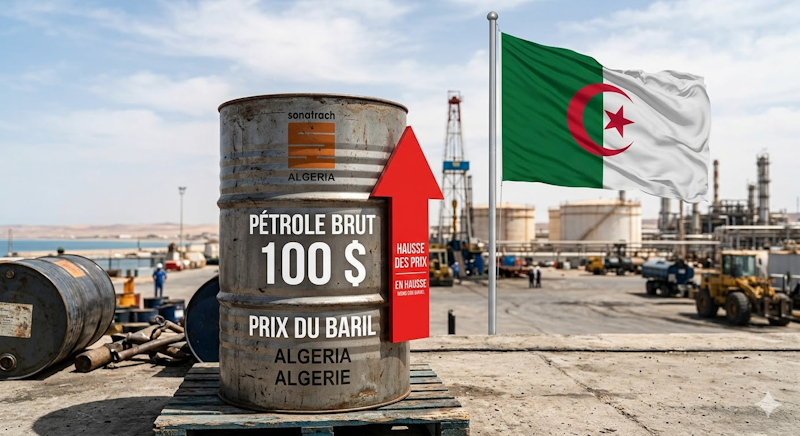
When oil prices surged past $100 per barrel on March 9—the first time since Russia’s invasion—it marked a turning point. Although prices have fluctuated since, they remain more than 50% higher as fears mount that the Middle East conflict will disrupt regional supplies.
Algeria’s budget is calculated based on an oil price of $70 per barrel. Minister of Hydrocarbons and Mines Mohamed Arkab has indicated that prices between that level and $80 per barrel would represent « a balanced price. »
« The rise in prices can only be a good thing, » Mahfoud Kaoubi, an independent economic and financial analyst in Algiers, told Rigzone. « We were facing a real financing problem. »
According to Kaoubi, if oil prices climb further toward the $120-$125 range, the OPEC producer—currently pumping approximately 977,000 barrels daily—would be able to balance its books.
More than 40% of this year’s planned expenditure is allocated to state-employee salaries, pensions, unemployment benefits, and subsidies for essential goods including cereals, fuel, milk, and desalinated water—all considered crucial for maintaining social stability.
In 2022, following Russia’s invasion of Ukraine, European nations turned to Algeria to help secure their energy supplies. The country had available gas following diplomatic disputes with Morocco and Spain over the Western Sahara territory, which had escalated into trade and export disruptions.
Algeria’s foreign exchange reserves began recovering, and the nation recorded trade surpluses with strengthened external accounts. However, the relief proved temporary. According to International Monetary Fund data, foreign reserves fell to $47.1 billion in October from more than $66 billion at the start of 2025, with the IMF projecting these funds would reach critical levels this year.
« Ultimately, the energy price impact of the Iran war—whether it is short or long—is not a panacea for Algeria’s long-term need for economic diversification away from reliance on oil and gas, » said Hamish Kinnear, a MENA analyst at Verisk Maplecroft’s Global Risk Insight team.
Algeria ranks 15th out of 193 countries on the think tank’s Dependence on Fossil Fuel Exports Index, which measures overreliance on such revenue.
« The longer-term picture for Algeria’s oil and gas production alongside its domestic consumption means it is likely that more revenue raising measures will be needed in the years to come, » Kinnear added.
As pressure temporarily eases in Algiers, Kaoubi advised authorities to maintain prudence given global inflation threats. Algeria imports approximately $50 billion annually, including food, vehicles, and machinery.
« What we can get with one hand, we can lose with another, » Kaoubi cautioned. « There is a risk that we see prices rise on the international market, which will impact the cost of imports. »
Algeria petrol prices gaz prices War against Iran energy