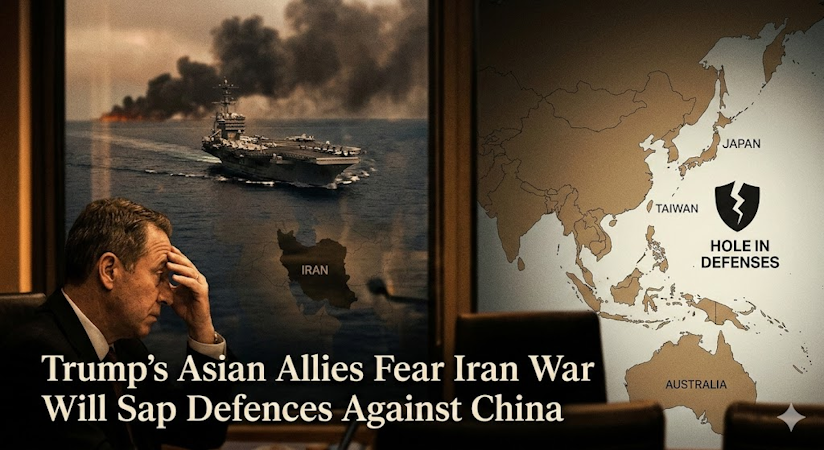
Trump’s latest military strikes on Iran are sending shockwaves far beyond the Middle East. Across Asia, key U.S. allies are asking a quiet but urgent question: Will an Iran war weaken America’s ability to deter China?
In Tokyo, Japanese lawmakers convened emergency meetings this week, pressing officials about evacuation plans, energy reserves, and — more critically — whether Washington might divert ships and missile systems away from East Asia.
That fear isn’t abstract.
Japan and South Korea host major U.S. bases designed to counter China’s growing military power and North Korea’s nuclear threat. Taiwan, which Beijing claims as its own, relies heavily on U.S. arms and deterrence to prevent coercion or invasion.
Taiwanese lawmaker Chen Kuan-ting warned that a prolonged conflict in Iran could destabilize the Indo-Pacific and give Beijing space to increase pressure while Washington is distracted.
The numbers reinforce those anxieties:
• Roughly 40% of U.S. Navy ships ready for operations are currently stationed in or around the Middle East.
• The aircraft carrier USS Abraham Lincoln and multiple missile destroyers have been pulled into the region.
• The only U.S. carrier normally deployed to Asia, USS George Washington, is in maintenance in Yokosuka.
Defense analysts warn the U.S. Navy is already “stretched thin.” A prolonged Iran conflict could force Washington to reduce its naval footprint in Asia to reinforce operations in the Gulf.
Beyond ships, munitions stockpiles are another concern. The Iran campaign is consuming precision weapons that would be critical in any Taiwan contingency. Rebuilding those inventories could take years — potentially weakening deterrence in the Indo-Pacific.
Ironically, some analysts argue Trump’s strikes may hurt Beijing in the short term by weakening two of China’s energy partners, Iran and Venezuela. But the longer U.S. attention and resources remain locked in the Middle East, the greater the strategic risk in Asia.
As one Japanese lawmaker put it: the grand strategy may be to “contain Iran, then shift to China.” The real question is whether enough resources will remain to make that pivot possible.
For U.S. allies in Asia, this isn’t theoretical. It’s about whether the balance of power in the Indo-Pacific can hold — or whether a Middle East war opens a dangerous window for Beijing.
#Geopolitics #IndoPacific #USChina #Taiwan #Japan #USIsrael #USAsia #Iran #Israel
With Reuters