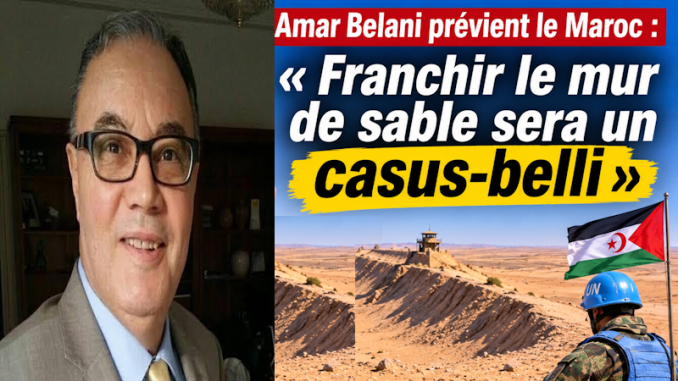
With the 31 January 2027 deadline approaching, the announced end of the UN mission could, according to Amar Belani, open the way to a new Moroccan diplomatic and military offensive. He blames Washington and calls on the international community to weigh the risks of a regional conflagration.
In a new commentary, Amar Belani argues that the final liquidation of MINURSO, which he says is scheduled for 31 January 2027, could mark a turning point in Western Sahara. He describes a scenario in which Rabat would seek to take advantage of the disappearance of the last UN observers to impose a new fait accompli, both politically and militarily.
Bypassing the Polisario Front
On the political front, Belani says Morocco would seek to marginalize the Polisario Front by engaging in talks with Sahrawi interlocutors won over to its position, notably the Sahrawi Movement for Peace and dissidents from the Front. The aim, according to him, would be to stitch together an institutional arrangement based on autonomy under Moroccan sovereignty, then impose it before submitting it to a token constitutional referendum organized across Morocco and the occupied Western Sahara.
He adds that Rabat would then mobilize its American, French and Gulf Arab supporters, as well as pro-Moroccan influence networks, to present this consultative exercise as an expression of the right to self-determination. The goal would be to secure the removal of Western Sahara from the UN list of Non-Self-Governing Territories and to neutralize legal challenges to the occupation, including before the Court of Justice of the European Union.
A major military risk
Belani also fears military escalation. With the disappearance of the last UN observers, Morocco could, in his view, be tempted to cross the sand wall to extend its control to around 20% of the territory east of the wall currently under Polisario Front control. He says the Moroccan armed forces are preparing a rapid operation to impose a new regional fait accompli.
He believes Washington, Paris and other Western capitals would doubtless call for restraint while accepting and endorsing this fait accompli, as has become customary.
Belani warns, however, that if Morocco acts in this way it would bear responsibility for a generalisation of hostilities. Deprived of its positions east of the wall, the Sahrawi army would be forced to turn to new, more sophisticated weapons systems. And any crossing of the border, whatever its nature, would be treated as a casus belli and could lead to armed confrontation.
Washington directly blamed
The commentary also points to the political responsibility of the United States. Belani criticizes Washington’s blind alignment with Moroccan positions, its insistence on imposing autonomy as the only outcome of a decolonization conflict, and the role of its permanent representative at the UN. In his view, this stance helped accelerate MINURSO’s disappearance without providing any mechanism capable of preventing a new escalation.
If Rabat interpreted this development as a green light to change the regional status quo by force, the United States would, according to him, bear heavy political responsibility for the consequences of a full resumption of war and a possible confrontation between Morocco and Algeria. Far from serving a lasting settlement, this alignment risks becoming, according to Belani, one of the main factors of destabilization in the Maghreb.
He therefore calls on the international community to state clearly, on every platform, that Morocco would bear responsibility for a conflagration if it chose the path of force.
#WesternSahara #MINURSO #AmarBelani #Maghreb #UN #Morocco #Algeria #Polisario #Decolonization #Geopolitics #RegionalSecurity #Diplomacy #Autonomy #Referendum
Soyez le premier à commenter