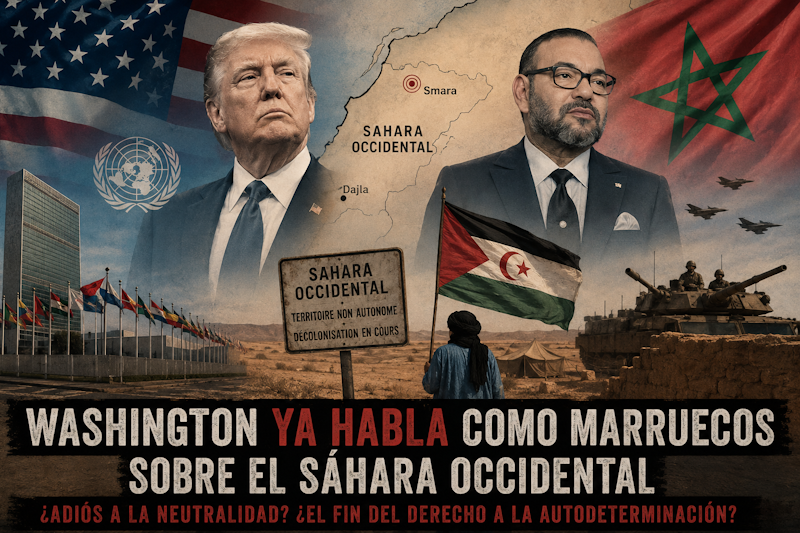
What has happened in recent days probably marks one of the clearest moments of explicit political alignment by the United States with Morocco since Donald Trump’s recognition of Moroccan sovereignty over Western Sahara in 2020.
It is no longer merely a matter of joint military maneuvers within the framework of AFRICAN LION or diplomatic visits to the occupied Sahrawi city of Dakhla. The issue has now gone a step further: the U.S. representation at the United Nations has publicly adopted the Moroccan political discourse on the conflict and has implicitly identified the Polisario Front as an obstacle to peace.
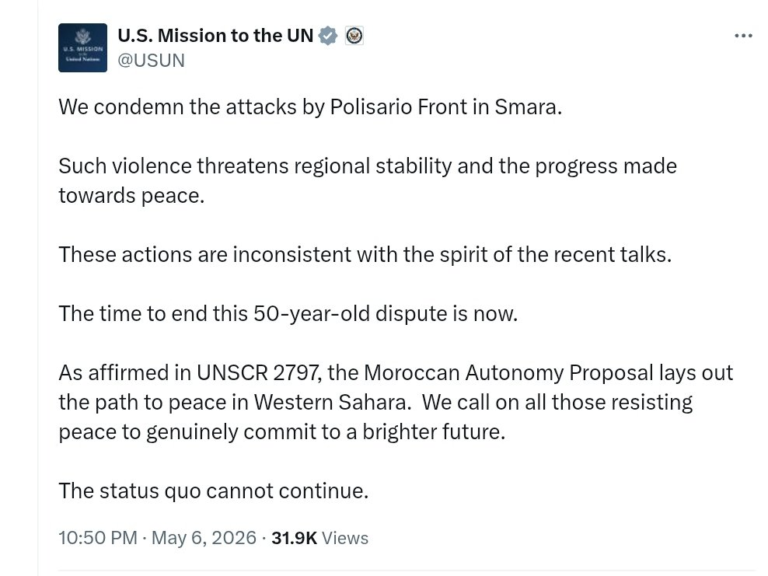
The message issued by the U.S. mission to the UN following the attacks reported in Smara leaves little room for ambiguity. Washington condemns the actions of the Polisario, openly supports the Moroccan autonomy proposal as a “path to peace,” and calls on those who “resist peace” to accept the new political reality.
In fact, the speed with which the U.S. mission to the United Nations reacted ended up producing a political effect that is difficult to ignore: it implicitly acknowledged that the armed conflict in Western Sahara remains fully active.
While Rabat avoided for hours any clear official position on what happened in Smara, Washington quickly condemned the attack and directly linked it to the current political and military situation in the territory. That difference in reaction is significant because it contradicts the Moroccan narrative of “stability” and definitive normalization on the ground.
The U.S. condemnation itself therefore confirms, albeit indirectly, that the war reactivated after the breakdown of the 2020 ceasefire continues to shape the political and security reality of Western Sahara.
This shows that Western Sahara is not, in legal terms, a closed matter. The United Nations still considers the territory to be pending decolonization, and the Sahrawi people’s right to self-determination remains part of the international legal framework.
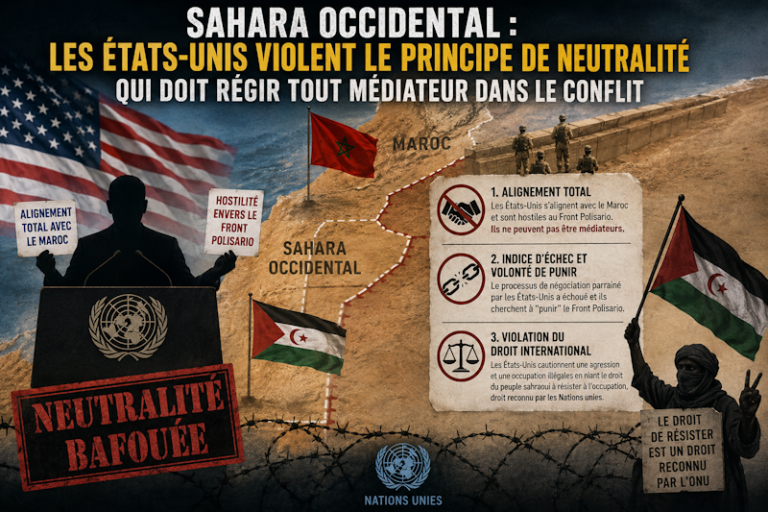
For that reason, the American shift has a much deeper dimension than a simple diplomatic statement. What is at stake is the very idea of international mediation in the conflict.
Spanish professor Carlos Ruiz Miguel sharply summarized that contradiction by saying that these messages “show a total alignment of the United States with one of the parties to the conflict (Morocco) and hostility toward the other party to the conflict (the Polisario Front).” According to his analysis, that position “disqualifies the United States from mediating in a negotiation.”
The issue is not minor. For years, Washington tried to present itself as a player capable of influencing the Sahrawi political process while formally maintaining a certain diplomatic balance. But the images of AFRICAN LION in Dakhla and the recent official messages seem to indicate that this stage is now over.
American discourse no longer revolves around the self-determination referendum promised by the United Nations. Nor does it revolve around a negotiation between two parties on equal political footing. The new framework that is being imposed starts from a different logic: treating Moroccan sovereignty as a practically irreversible reality and reducing the political room for the Polisario within the international arena.
That is precisely where the core of the problem lies.
Because when a major power abandons any appearance of neutrality and openly backs one of the parties in a still-unfinished decolonization process, the issue ceases to be merely diplomatic. It directly affects the credibility of the international framework built around the conflict itself.
The criticisms voiced by Sahrawi sectors and by various analysts point precisely to that drift. Not only because of the explicit support for Moroccan autonomy, but also because of the implicit criminalization of Sahrawi resistance while Moroccan attacks on the territory and allegations related to human rights and civilians continue to go uncondemned.
All of this is happening at a particularly sensitive moment: with the war reactivated since 2020, with AFRICAN LION consolidating the military and strategic dimension of the territory, and with an international community that seems increasingly inclined toward managing the conflict rather than resolving it in accordance with international law.
The problem is no longer only what position the United States adopts.
The question is to what extent some international powers have decided to replace the principle of self-determination with the logic of accomplished facts.
#Western_Sahara #Morocco #Polisario #United_States #negotiations #autonomy