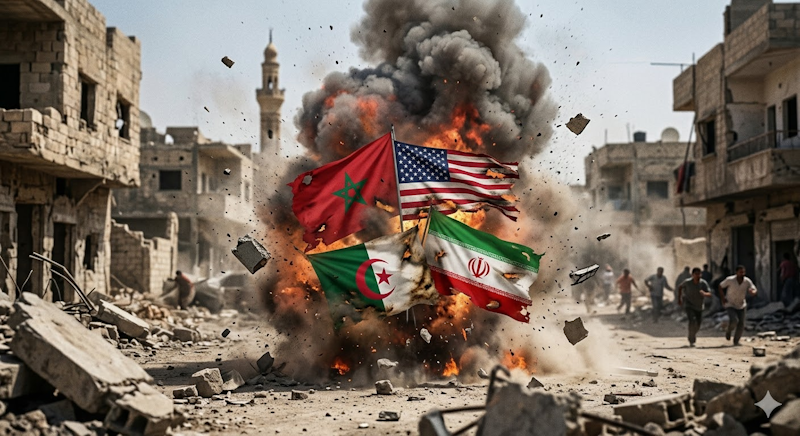
LONDON/ALGIERS/RABAT – As the US-Israeli military campaign against Iran escalates across the Middle East, its shockwaves are reverberating deep into North Africa, fundamentally altering the strategic calculus of the Maghreb’s two dominant powers. For Algeria and Morocco, this is not merely a regional conflict to observe; it is a high-stakes moment of truth that is impacting their politics, economies, and the future of the disputed Western Sahara in opposite ways.
Both nations view the current crisis as a potential tipping point in their decades-long rivalry for regional hegemony.
Rabat’s Opportunity: Cementing Alliances
The Kingdom of Morocco is leveraging the conflict to reinforce its strategic pivot toward Washington and Tel Aviv. Having severed ties with Tehran in 2018 over accusations of arming the Polisario Front, Rabat has fully embraced its role as a key US ally in Africa.
“This position stems from the intersection of Morocco’s historical hostility towards Tehran, its strategic cooperation with Washington, and the sensitive diplomatic context surrounding Western Sahara,” explained Raouf Farah, an analyst with the Global Initiative Against Transnational Organized Crime.
Moroccan officials are keenly aware that the current US administration—which facilitated Morocco’s normalization with Israel in exchange for recognizing its claim to Western Sahara—may be the most favorable partner to secure a final deal on the territory. Analysts suggest Rabat may push for a decisive move during this window, potentially seeking to delegitimize the Polisario Front by linking it to Iranian-backed « terrorist » networks.
However, this stance places the monarchy at odds with domestic sentiment, as Moroccan public opinion remains largely hostile to the strikes on Iran and Lebanon.
Algiers’ Dilemma: Walking a Tightrope
For Algeria, a traditional ally of Tehran and steadfast supporter of Palestinian and Sahrawi self-determination, the crisis demands a complex diplomatic balancing act. Algiers must defend its principles without provoking the current US administration or endangering its substantial energy revenues.
An Algerian diplomatic source described the strategy as a delicate game: “We have our own strategy: diversify our partners, be less dependent on Western supply chains, and avoid any conflict during the remaining three years of Trump’s term… [playing] the US game of transactional diplomacy without compromising our principles.”
Algiers has publicly called for « restraint » and expressed solidarity with Arab nations hit by retaliatory strikes, while carefully avoiding direct condemnation of Iran that could alienate its domestic base or its historical allies. Analysts warn this pragmatic approach risks being perceived as a disconnect between Algeria’s revolutionary rhetoric and its current cautious foreign policy.
The Western Sahara Nexus
At the heart of this geopolitical chess match lies the Western Sahara. As secretive, US-brokered talks continue—with the next round reportedly scheduled in Washington—the war in the Middle East provides a new backdrop for negotiations.
Morocco is expected to exploit the current climate to frame the conflict as a binary choice between pro-US stability and Iranian-backed chaos. Conversely, Algeria views the crisis as a high-risk sequence where maintaining its position on Sahrawi self-determination is paramount, while avoiding diplomatic isolation.
Economic Divergence: Pain vs. Gain
Economically, the rivals are experiencing the fallout in starkly different ways.
- Morocco, heavily dependent on energy imports and maritime trade, is feeling immediate pain from rising fuel and freight costs, threatening social stability during Ramadan.
- Algeria, a major oil and gas exporter, stands to gain substantially from rising Brent crude prices and increased gas demand in Europe, bolstering its foreign exchange reserves and strengthening its hand in trade negotiations with the EU.
As the war intensifies with no end in sight, the Maghreb is not just watching a conflict in the Middle East; it is witnessing a dress rehearsal for a potential reshaping of its own borders and alliances. For Rabat, this is a window of opportunity. For Algiers, it is a tightrope walk over a geopolitical abyss.
With Middle East Eye
#WarIsraelUSonIran #Morocco #Algeria #WesternSahara