Regaining Africans’ trust will require far more than speeches. It will take strong, courageous, and independent actions. Failing that, the legacy left by the founders will continue to be squandered, and African football—rich in talent but poor in governance—will remain trapped in the games of money and politics.
The founding fathers of the CAF—Egyptians, Ethiopians, Sudanese, and South Africans—would never have imagined that their work would end up like this
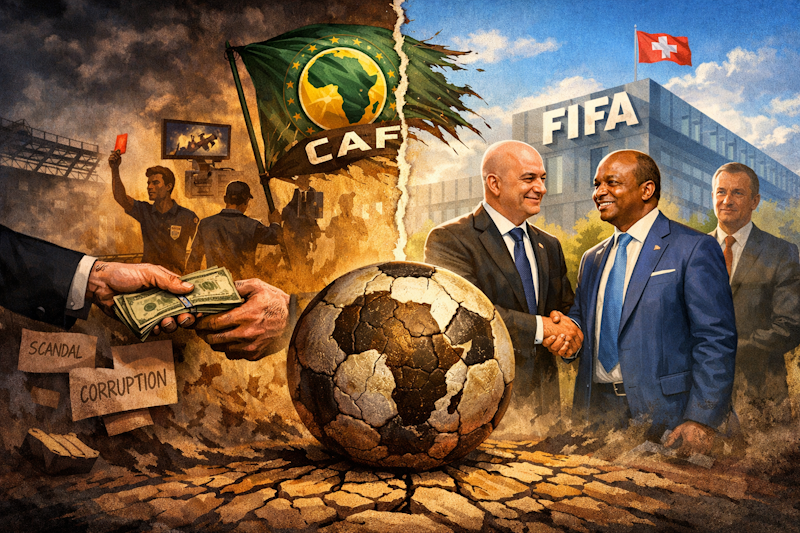
Sixty-nine years have passed since the founding of the Confederation of African Football. Sixty-nine years (March 1957) that were meant to embody emancipation, pride, and the assertion of African football on the world stage. Yet, as it celebrates its 69th anniversary, the institution appears more than ever trapped in the quicksand of corruption, refereeing scandals, poor governance, nepotism, and a blatant disregard for ethics and integrity.
Even today, the major decisions concerning African football are not made on the pitch or in the interest of the continent’s people, but in closed, private rooms where decisions are made about who should be sanctioned, how, and why. Rules are bent according to political and financial interests, as illustrated by certain recent situations, notably in Morocco, where the boundaries between football, power, and influence seem increasingly blurred.
The founding fathers of the CAF—Egyptians, Ethiopians, Sudanese, and South Africans—would never have imagined that their work would end up like this, weakened and dominated by leaders who seem to have forgotten the very purpose of its creation. Worse still, the CAF now appears to be an institution placed at the service of another: FIFA. A dependence, whether accepted or imposed, that is becoming more and more visible.
The decision to shift the Africa Cup of Nations from a biennial format to a four-year cycle starting in 2028 acted as a wake-up call. For many, this reform does not reflect African realities but rather a desire for harmonization dictated by FIFA. Despite Patrice Motsepe’s denials, doubts persist and fuel a deep sense of lost autonomy.
The ostentatious rapprochement between CAF and FIFA, symbolized by Gianni Infantino’s emphatic congratulations during Motsepe’s election, reinforces this unease. This “unity,” promoted on the international stage, is seen by a growing segment of African public opinion as institutional subordination, turning CAF into little more than Zurich’s continental relay.
The 2025 AFCON in Morocco crystallized all criticism: controversial refereeing decisions, media pressure, and external interventions in disciplinary matters. All these elements highlight the weakness of CAF’s real room for manoeuvre. Added to this are accusations of opaque governance, a president seen as insufficiently involved, and the growing influence of leaders perceived as very close to FIFA.
Behind these observations, one essential question remains: Is CAF still an independent institution serving exclusively African football, or has it become merely a satellite of FIFA? For a growing number of observers, the answer is dangerously leaning toward the latter. The continued presence of the Infantino–Motsepe–Lakjaâ trio is even seen as a sign of the programmed demise of CAF’s original spirit.
Regaining Africans’ trust will require far more than speeches. It will take strong, courageous, and independent actions. Failing that, the legacy left by the founders will continue to be squandered, and African football—rich in talent but poor in governance—will remain trapped in the games of money and politics.
#Morocco #CAF #FIFA #AFCON2025 #Corruption #Bribery #Senegal