Passer au contenu

Maghreb Online

Algérie Maroc News

Menu principal
  • Accueil
  • Maroc
  • Algérie
  • Mauritanie
  • Tunisie
  • Libye
  • Maghreb
  • Sahel
  • Afrique
  • Opinions & analyses
  • Monde
  • Sahara Occidental
  • Politique de cookies (UE)
  • Maroc
  • Sport

Morocco AFCON : When African Football Loses Its Soul

Admin 31 janvier 2026
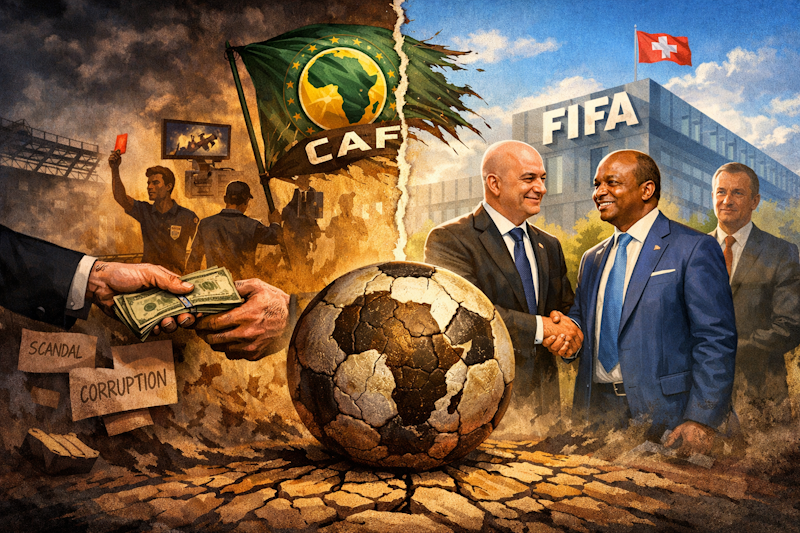
FIFA CAF corruption

Regaining Africans’ trust will require far more than speeches. It will take strong, courageous, and independent actions. Failing that, the legacy left by the founders will continue to be squandered, and African football—rich in talent but poor in governance—will remain trapped in the games of money and politics.

The founding fathers of the CAF—Egyptians, Ethiopians, Sudanese, and South Africans—would never have imagined that their work would end up like this

Sixty-nine years have passed since the founding of the Confederation of African Football. Sixty-nine years (March 1957) that were meant to embody emancipation, pride, and the assertion of African football on the world stage. Yet, as it celebrates its 69th anniversary, the institution appears more than ever trapped in the quicksand of corruption, refereeing scandals, poor governance, nepotism, and a blatant disregard for ethics and integrity.

Even today, the major decisions concerning African football are not made on the pitch or in the interest of the continent’s people, but in closed, private rooms where decisions are made about who should be sanctioned, how, and why. Rules are bent according to political and financial interests, as illustrated by certain recent situations, notably in Morocco, where the boundaries between football, power, and influence seem increasingly blurred.

The founding fathers of the CAF—Egyptians, Ethiopians, Sudanese, and South Africans—would never have imagined that their work would end up like this, weakened and dominated by leaders who seem to have forgotten the very purpose of its creation. Worse still, the CAF now appears to be an institution placed at the service of another: FIFA. A dependence, whether accepted or imposed, that is becoming more and more visible.

The decision to shift the Africa Cup of Nations from a biennial format to a four-year cycle starting in 2028 acted as a wake-up call. For many, this reform does not reflect African realities but rather a desire for harmonization dictated by FIFA. Despite Patrice Motsepe’s denials, doubts persist and fuel a deep sense of lost autonomy.

The ostentatious rapprochement between CAF and FIFA, symbolized by Gianni Infantino’s emphatic congratulations during Motsepe’s election, reinforces this unease. This “unity,” promoted on the international stage, is seen by a growing segment of African public opinion as institutional subordination, turning CAF into little more than Zurich’s continental relay.

The 2025 AFCON in Morocco crystallized all criticism: controversial refereeing decisions, media pressure, and external interventions in disciplinary matters. All these elements highlight the weakness of CAF’s real room for manoeuvre. Added to this are accusations of opaque governance, a president seen as insufficiently involved, and the growing influence of leaders perceived as very close to FIFA.

Behind these observations, one essential question remains: Is CAF still an independent institution serving exclusively African football, or has it become merely a satellite of FIFA? For a growing number of observers, the answer is dangerously leaning toward the latter. The continued presence of the Infantino–Motsepe–Lakjaâ trio is even seen as a sign of the programmed demise of CAF’s original spirit.

Regaining Africans’ trust will require far more than speeches. It will take strong, courageous, and independent actions. Failing that, the legacy left by the founders will continue to be squandered, and African football—rich in talent but poor in governance—will remain trapped in the games of money and politics.

#Morocco #CAF #FIFA #AFCON2025 #Corruption #Bribery #Senegal

Visited 33 times, 1 visit(s) today

À propos de l'auteur

Admin

Administrator

Visitez le site Web Afficher tous les messages
Partagez
Tweet

Post navigation

Previous: Trump’s plan for Western Sahara, according to a Swedish think tank
Next: Bill Clinton et Epstein : une présence controversée au mariage du roi du Maroc en 2002

Histoires connexes

clinton epstein au maroc
  • Maroc

Les projets avortés de Jeffrey Epstein au Maroc

Admin 11 février 2026 0
mohammed VI le mystere
  • Maroc

Mohammed VI – Le mystère : Anatomie d’un règne opaque

Admin 10 février 2026 0
parlement sorcellerie
  • Maroc

Maroc: Polémique au Parlement après des accusations de « sorcellerie » contre le Sénégal

Admin 9 février 2026 0
  • Selon Tebboune, Bourita et Akhannouch ont étudié l’administration en Algérie
  • Jack Lang: The prominent figure of French politics and culture caught up in the Epstein affair
  • Americans as both judge and party in Western Sahara (TV5 Monde)
  • Les américains juge et partie au Sahara Occidental (TV5 Monde)
  • Les projets avortés de Jeffrey Epstein au Maroc

Top 10

  • Maroc : Jabaroot publie une liste de personnes dont…
  • النص الكامل لمقال لوموند الذي أثار غضب المغرب
  • France-Maroc-Algérie-Tunisie-Sahara Occidental :…
  • Ce que le Maroc cache sur la grave maladie du roi…
  • Le roi du Maroc Mohammed VI en état de mort clinique…
  • Projet de résolution du Conseil de Sécurité sur le…
  • Prostitution, Marrakech is Moroccan capital of paid sex
  • Maroc: Selon le hacker Jabaroot, la DST s’est…
  • Maroc : le hacker Jabaroot dévoile la fortune…
  • La crise pousse le Maroc a autoriser la prostitution…

Copyright © All rights reserved. | MoreNews par AF themes.
Gérer le consentement
Pour offrir les meilleures expériences, nous utilisons des technologies telles que les cookies pour stocker et/ou accéder aux informations des appareils. Le fait de consentir à ces technologies nous permettra de traiter des données telles que le comportement de navigation ou les ID uniques sur ce site. Le fait de ne pas consentir ou de retirer son consentement peut avoir un effet négatif sur certaines caractéristiques et fonctions.
Fonctionnel Toujours activé
L’accès ou le stockage technique est strictement nécessaire dans la finalité d’intérêt légitime de permettre l’utilisation d’un service spécifique explicitement demandé par l’abonné ou l’utilisateur, ou dans le seul but d’effectuer la transmission d’une communication sur un réseau de communications électroniques.
Préférences
L’accès ou le stockage technique est nécessaire dans la finalité d’intérêt légitime de stocker des préférences qui ne sont pas demandées par l’abonné ou l’internaute.
Statistiques
Le stockage ou l’accès technique qui est utilisé exclusivement à des fins statistiques. Le stockage ou l’accès technique qui est utilisé exclusivement dans des finalités statistiques anonymes. En l’absence d’une assignation à comparaître, d’une conformité volontaire de la part de votre fournisseur d’accès à internet ou d’enregistrements supplémentaires provenant d’une tierce partie, les informations stockées ou extraites à cette seule fin ne peuvent généralement pas être utilisées pour vous identifier.
Marketing
L’accès ou le stockage technique est nécessaire pour créer des profils d’internautes afin d’envoyer des publicités, ou pour suivre l’utilisateur sur un site web ou sur plusieurs sites web ayant des finalités marketing similaires.
  • Gérer les options
  • Gérer les services
  • Gérer {vendor_count} fournisseurs
  • En savoir plus sur ces finalités
Voir les préférences
  • {title}
  • {title}
  • {title}