The Moroccan state—at its highest level—is responsible for creating the environment that allows such institutional decay. What appeared in the recording is not simply a scandal but a reflection of the mode of governance: controlling every lever of power, ignoring laws, exploiting security agencies, and allowing the DGST to function as an undeclared tool of pressure over journalism.
Tags : Morocco, National Press Council, Hamid El Mahdaoui, Press Ethics Committee, video leaked,
By Qandyl Mohamed – Blogger, Independent Moroccan Human Rights and Political Activist
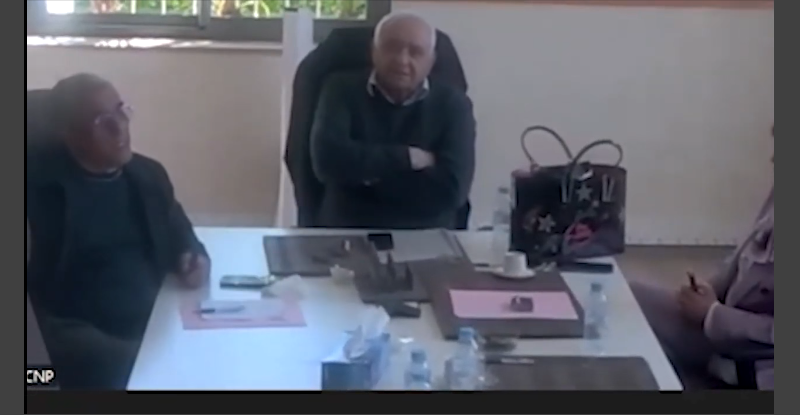
The scandal involving the National Press Council and its Ethics Committee, exposed by journalist Hamid El Mahdaoui, is not just a shocking incident. It is a living testimony to how the Moroccan state is managed from the very top, and how institutions that are supposedly safeguards of governance and justice are transformed into tools serving the regime’s authoritarian interests—far removed from law, integrity, or professionalism.
What the leaked recording reveals is not merely a chaotic meeting inside the Press Ethics Committee, but an accurate reflection of the deep-state mentality that treats journalistic institutions as security appendages rather than independent bodies capable of protecting the profession or the public.
From the very first moments, it is evident that the committee is not a neutral body, but an adversary armed with the tools of power and political pressure—practicing systematic retaliation against anyone who dares expose corruption. The degrading language toward lawyers, the mockery of colleagues, and the total disregard for legal standards are not simple professional lapses; they represent an institutional culture where political and personal loyalties trump professionalism, and where the law is applied according to whims and preconceived biases.
The real danger, however, lies in the fact that these phenomena are neither temporary nor isolated. They are part of a wider structural system of corruption in Morocco. The National Press Council, the committee, and even supervisory bodies are all tools within a network controlled by the deep state. The DGST is not merely a surveillance institution—it effectively influences and directs the functioning of the media sector, shaping decisions and pressuring institutions to serve the regime’s interests without leaving visible fingerprints.
This indirect control explains why every independent voice is crushed, and why revealing the truth becomes a threat to the system itself, not just an internal scandal.
The words of the Council’s president, Younes Moujahid — “We’ll wipe the floor with the lawyers” — are not a passing insult. They are a declaration of an authoritarian mindset that sees itself above the law, treating the legal profession as political adversaries rather than partners in protecting the public interest. This insult was not just an offense to lawyers — it was an attack on justice itself, confirming that every entity meant to uphold the law is now hostage to the whims and vindictive impulses of power. Any attempt to cover this up with official statements or legal threats against El Mahdaoui is not corrective action, but a continuation of the same abusive logic.
What El Mahdaoui exposed was a real earthquake within the media system.
The Council’s reactions—from distorted official statements to threats of prosecution—reveal a clear strategy: punishment for those who expose corruption, and protection for the corrupt.
This is not the behavior of a single committee; it is a direct expression of the logic of the Moroccan regime: every act of transparency is treated as a violation of authority, and every revelation becomes an “institutional threat.”
Institutions are not independent. Laws are ornamental. And bodies meant to protect the profession have become mechanisms of control and extortion.
The Moroccan state—at its highest level—is responsible for creating the environment that allows such institutional decay. What appeared in the recording is not simply a scandal but a reflection of the mode of governance: controlling every lever of power, ignoring laws, exploiting security agencies, and allowing the DGST to function as an undeclared tool of pressure over journalism. Under such conditions, any attempt to “reform” the Press Council or other oversight bodies is doomed to fail unless the regime’s direct and indirect control is confronted.
In the end, what the leak revealed is far larger than a journalistic dispute. It is evidence of deep, systemic corruption affecting the very institutions meant to safeguard rights and the profession.
The law is paralyzed, justice is compromised, journalists are threatened, and citizens come second. Any legal action against El Mahdaoui is nothing more than an escape forward, while the real solution would be for the committee to put down its keys and leave through the back door — its ethical and legal legitimacy expired long ago.
This moment is not just a test for the Council or for El Mahdaoui, but for anyone who still believes that professional and regulatory bodies in Morocco can protect truth and justice. Reality says otherwise. Yet revealing the truth remains a moral and national duty that cannot be avoided, even when confronting a state apparatus that protects itself far more than it protects the law.
The scandal proves once again that truth is not a luxury, but the last line of defense against a destructive authoritarianism — and that silence or neutrality only deepens institutional decay and strengthens the grip of the deep state.
I would like to emphasize that this article is not a defense of Hamid El Mahdaoui — with whom I differ in positions and analysis — but a defense of truth, and of the scandal that exposed the regime’s structural corruption across its institutions.
#Morocco #ElMahdaoui #NationaPressCouncil #VideoLeaked