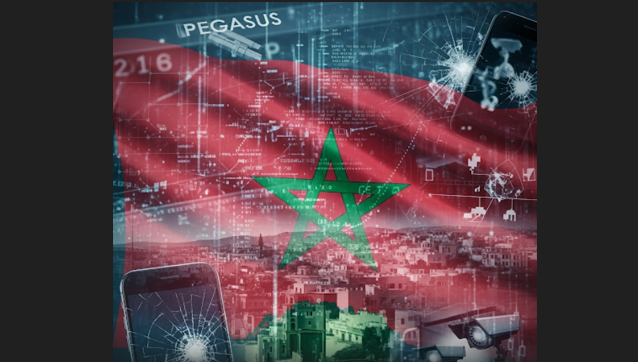
As Moroccan authorities pursue Mehdi Hijaouy, his escape remains a sensitive issue where security and political interests between Rabat and Madrid intertwine, bringing back to the forefront all suspicious cases concerning the Moroccan intelligence agency, foremost among them the Pegasus scandal and Morocco's espionage on several heads of state.
Tags : Morocco, Mehdi Hijaouy, DGED, Pegasus, espionnage, Spain, France, Emmanuel Macron, Pedro Sanchez,
A Violent Earthquake Shakes the Moroccan Security Establishment
Mehdi El Hijaouy, who for several years served as the « second-in-command » of the Moroccan external intelligence agency, and even briefly as its supreme head, sought refuge in Spain, fleeing France, where he was under close surveillance by unknown agents. Upon his arrival in Madrid, Rabat requested his trial by Spanish justice, but he chose not to appear before the National Court. He is now wanted. In Paris, his wife and newborn daughter were pursued in the streets. Last July, Moroccan authorities finally reconciled with French authorities, and Mehdi El Hijaouy feared that this renewed friendship between the governments would harm him. That’s when their Spanish escape began.
El Hijaouy , 52, was well-versed in the methods of the Directorate General for Studies and Documentation (DGED), Morocco’s external intelligence agency. He worked with it for nearly two decades, eventually becoming its deputy director. For a time, he served as its de facto head, as its director, Yassine Mansouri, spent a long period on sick leave due to depression.
El Hijaouy is the son of a well-known general in the Moroccan army. He joined the DGED in 1994, and the service sent him abroad for training on several occasions. He underwent some training in covert activities at the CIA; according to sources familiar with his background, he was educated in the « Action Department » of France’s DGSE (external security), and learned interrogation techniques with the Israeli Shin Bet (internal security) and counter-espionage with the Mossad.
The « number two » participated in or managed numerous operations, many of them in Spain, such as recruiting politicians and journalists to advocate for the Western Sahara’s affiliation with Morocco, and highlighting alleged links with the Polisario Front and terrorist groups. He also encouraged demonstrations at the gates of Ceuta and Melilla to demand their « Moroccan identity. » He also fought with all his might, in cooperation with the Ministry of Islamic Affairs, for control of the Spanish Federation of Islamic Religious Entities, to which hundreds of mosques in Spanish territory are affiliated. But the bulk of their efforts were directed towards neighboring Algeria, in an attempt to ignite separatism in the Kabylie region.
Despite this excessive Moroccan espionage activity in Spain, only once did Spanish authorities stop the DGED. That was in April 2013, when General Félix Sanz Roldán, then director of national intelligence, filed a complaint against Nour-Eddine Ziani, a Moroccan who came to preach in Catalan mosques to convert Muslims to the independence movement then embodied by the converging « Artos For » movement. In addition to « threatening national security, » Sanz Roldán described him as « a very important agent of a foreign intelligence service since 2000. » He was referring to the DGED. He was expelled from Spain the following month.
In Germany, the Netherlands, Belgium, and even on one occasion in France, some collaborators with Moroccan intelligence services were arrested, prosecuted, and even sentenced to relatively lenient penalties. In Spain, this never happened, except for Youssef Al-Aal, who was arrested at the request of the German judiciary through a European arrest warrant issued by a German judge. He was suspected of spying on the Rifian exile for the DGED. He was sent to Frankfurt on January 15.
Morocco has witnessed defections among officials from the Directorate General of Territorial Surveillance (DGST), the Moroccan secret police also deployed in EU countries. Dozens of agents remained abroad, benefiting from leave or business trips. According to press leaks, 160 people did not return to Morocco in 2022. Abdellatif Hammouchi, Director General of Territorial Surveillance, reduced this number to 38. Morocco knew his whereabouts. Once settled in Madrid, El Hijaouy was initially disappointed. But Moroccan authorities knew his location, and in September, they already requested Spanish justice to locate and arrest him with the aim of processing his extradition on three charges, as stated in file 61/2024: membership in a criminal organization, fraud, and encouraging illegal immigration. Rabat often includes immigration in extradition requests because it suspects that Spanish judges are particularly sensitive to this accusation.
The Moroccan request landed on the desk of Luis Francisco de Jorge Mesas, president of the Central Court of Instruction No. 1 of the National Court, who for many years was a judicial advisor at the Spanish Embassy in Rabat. The judge did not order El Hijaouy’s imprisonment and temporarily released him. In his order issued on September 12, he included precautionary measures such as the withdrawal of his passport and the obligation to report to the police station every two weeks.
He was summoned again on November 7, but El Hijaouy did not appear before the National Court. He was given one last chance, on November 21, but he also did not appear. Five days later, the judge ordered his search, arrest, and imprisonment so that he could fulfill the appearance stipulated in Article 12 of the Passive Extradition Law. The police were unable to find him. He is suspected of already being far away, thanks to the help of a network of old friends in various European secret services who provided him with assistance. El Hajjaoui could have attended these sessions with his lawyer, a well-known criminal lawyer, and since he has family ties in Madrid, it is unlikely that the judge would have ordered his arrest with the aim of extradition. But he chose to flee.
In his sole appearance before a National Court judge in September, El Hijaouy denied the charges contained in the file submitted by Moroccan justice. He did not seek political asylum in Spain because his lawyer hinted to him that Madrid’s relationship with Rabat was so good that he would never obtain it. He always asserted to his lawyer and friends in the security forces that the authorities in his country wanted to settle scores with him for two reasons: one political and the other personal.
The political reason is likely his initiative to issue a white paper of about 120 pages in which he proposed restructuring the entire security system in the country, from police forces to defense. He delivered it directly to King Mohammed VI in February 2024 and also forwarded it to Crown Prince Moulay El Hassan. His work is said to have angered the King’s closest aides, who felt bypassed when he recommended a careful reading of it.
Mehdi El Hijaouy’s disappearance raises many questions about his fate amidst the political and security tensions surrounding him.
As Moroccan authorities pursue him, his escape remains a sensitive issue where security and political interests between Rabat and Madrid intertwine, bringing back to the forefront all suspicious cases concerning the Moroccan intelligence agency, foremost among them the Pegasus scandal and Morocco’s espionage on several heads of state. For this reason, Morocco is striving to apprehend El Hijaouy before secrets are exposed. So, how will Morocco deal with this case? What are the reasons for the unexpected visit of Moroccan intelligence director, Abdellatif Hammouchi, to Spain, and is it related to Mehdi El Hajjaoui’s escape?
El Hijaouy’s name linked to the Pegasus case, will this case be reopened?
Mehdi El Hijaouy’s case has highlighted the complexities and challenges in the field of espionage and diplomatic relations between Morocco and Spain. How so?
How did Mehdi El Hajjaoui’s escape reveal the weakness of the Moroccan intelligence agency? El Hijaouy participated in many operations and spent about two decades in the Moroccan intelligence agency. Will he reveal new cases and scandals related to this agency?
Dr. Bouab Kamal, Professor of International Relations at Batna 1 University:
« El Hijaouy’s Defection Reveals a Fundamental Flaw in the Political and Security System and a Collapse of the Principle of Loyalty and Discipline Within Moroccan Intelligence Agencies »
Dr. Bouab Kamal, Professor of International Relations at Batna 1 University, believes that the intelligence agency, by its nature, relies on secrecy, discipline, and strict cohesion, making any defection within it an extremely serious event with exceptional implications. How much more so if the defector is a high-ranking figure like El Hijaouy, who held sensitive positions, most notably deputy director of the Directorate General for Studies and Documentation (external intelligence). His defection reveals a fundamental flaw in the political and security system and a collapse of the principle of loyalty and discipline within intelligence agencies, which in other intelligence contexts is understood as an indication of violent internal conflicts. All these factors put the Makhzen in a state of extreme panic and frenzy, as it realizes that the defector possesses a trove of sensitive information that could lead to serious breaches and threaten the stability of its already fragile system. This defection also represents a severe blow to the state’s reputation, prompting it to do the impossible to regain control and prevent the repercussions of this deep security crisis.
Since El Hijaouy has settled in Spain, there is a high probability that the information he possesses regarding the Makhzen regime’s involvement in stealing military data from the Canary Islands and Melilla, with the support of France, will be exploited. Given that the intelligence structure in the European Union relies on information exchange, the impact of these leaks could extend to other countries affected by Moroccan intelligence activities, such as the Netherlands. Especially since the European Commission proposed in 2015 the creation of a European intelligence agency to enhance security cooperation among member states. The assassination of political opponent Mehdi Ben Barka may also be unveiled, as evidence points to the involvement of the Moroccan external intelligence agency in his liquidation, and plans to pursue Moroccan opponents abroad will be exposed. In addition, multiple scandals related to human rights violations may be revealed, issues that EU countries, as a normative power, cannot ignore or tolerate. The strength of an intelligence agency lies in its ability to contain and proactively read intentions, as the Algerian hawks recently demonstrated by uncovering a French plot targeting national security. The failure of Moroccan intelligence to read El Hijaouy’s intentions to defect reflects a weakness in internal monitoring and analysis systems, and is conclusive proof of the fragility of discipline within the Moroccan intelligence establishment. His defection may also be attributed to his dissatisfaction with the agency’s policies or his fear of internal liquidation.
« El Hijaouy May Be Forced to Disclose Classified Information, and the Pegasus Program Will Return to the Forefront »
Dr. Bouab added that El Hijaouy’s position now appears extremely sensitive, as he is likely to be forced to disclose information related to Moroccan operations and intelligence in general, which could increase pressure on Moroccan authorities and negatively affect their relations with Spain and other EU countries.
The situation becomes even more complicated if this information relates to important strategic policies or relations, such as espionage operations using the « Pegasus » program that targeted prominent figures, including the Spanish Prime Minister and members of his government. Consequently, there is a high probability that he will later be summoned as a witness or as a source of further evidence, which will strengthen or expand international investigations and bring the espionage case back to the political and media arena. These developments could constitute a major condemnation of the Moroccan regime, especially if more details are revealed about the nature and objectives of those intelligence operations. In this context, the « PEGA » committee in the European Parliament, which was formed to investigate the use of the « Pegasus » program to spy on political figures and journalists, is expected to be highlighted once again. The return of this committee to the forefront reflects the increasing European interest in uncovering details related to this type of violation, which doubles the pressure on Morocco and further complicates the diplomatic situation in the region.
« Hammouchi’s Surprise Visit to Spain Reveals Morocco’s Attempt to Coordinate with Spain Regarding This Defection »
Dr. Bouab further stated that the surprise visit by the Moroccan intelligence director to Spain carries significant implications that go beyond the official dimension of the visit. It comes at a very sensitive time after the defection of one of the most prominent officials in the Moroccan intelligence agency, El Hijaouy.
The visit reveals Morocco’s race against time to urgently coordinate with Spanish authorities regarding this defection, and to explore how to deal with the sensitive information that El Hijaouy may have disclosed. It also indicates the need to study the repercussions of this crisis on Moroccan national security, and the possibility that this visit is part of intelligence negotiations related to how to deal with the political and intelligence dimensions that this defection may entail. This defection is like a violent earthquake that has shaken the Moroccan security establishment, causing significant confusion within its ranks. The impact of this defection has extended to Moroccan public opinion, which has begun to question the credibility and efficiency of the security apparatus, raising concerns about the ability to maintain the secrecy and protection of information. If El Hajjaoui discloses dangerous information to Spain and other European countries, pressure on Morocco will escalate, both domestically and internationally. The leaking of such information could harm Morocco’s security interests and affect its intelligence relations with allied countries.
« The fragility of the Makhzen’s apparatus and the King’s weakening health and authority have produced deep structural crises within the system. »
Professor Nour El Sabah Aknouch, a professor of political science and international relations at Biskra University, believes that the subject of Mehdi El Hijaouy’s escape must be placed in its general context, i.e., in light of the fragility of the Makhzen’s security apparatus due to the power struggles and repression among centers of influence. This occurs amidst the King’s weakening health and authority, which has impacted the mechanisms of governance, leading to deep structural crises within the system. Personal disputes have overridden the logic of the state and have begun to manifest publicly, signaling the impending demise of the Makhzen in its structural and strategic sense, especially when it concerns a sensitive apparatus that represents the backbone of the Makhzen system.
Secondly, it appears that what is happening has an internal dimension related to the crisis of succession for the ailing King, and an external dimension connected to the pattern of relations between Madrid and Rabat in terms of the sensitive files and information held by the deep state in both countries. Furthermore, there might be hidden deals and secret commissions that have become a source of disagreement among influential actors in Rabat’s security decision-making, directly threatening the survival and interests of some.
« We expect to soon see other faces from within the deep levels of governance revealing the weakness of the Makhzen’s house. »
Professor Aknouch also explained that the intelligence apparatus in the Makhzen has been a black box since the era of the previous king, employed as a tool to manage the country, monitor opponents, eliminate adversaries, and engineer networks involved in prostitution and drugs inside and outside the kingdom to ensure the stability of the ruling system. It appears that this apparatus has become part of the contradictions of the Alawite scene due to the structural conflicts within it and within the palace in Rabat, owing to the proliferation of corruption and the clash of self-serving interests at the expense of the Moroccan people.
Professor Aknouch further pointed out that Morocco will try to exhaust the issue by playing on the factor of time, as it is accustomed to such scandals which have become, for it, a public policy in the absence of a rational strategy for managing Makhzen institutions that have reached their moral and political limits and now operate with the behavior of warring factions over a dilapidated inheritance rather than with the methodology of good governance. Objectively, we expect to soon see other faces from within the deep levels of governance revealing the weakness of the Makhzen’s house.
« The repercussions of ‘Pegasus’ continue to provoke more controversy and criticism in more than one country. »
The escape of Mehdi El Hijaouy, the former deputy head of the Moroccan external intelligence agency (DGED), to Spain to flee Moroccan authorities, has highlighted the utter failure of the Moroccan intelligence agency. El Hijaouy oversaw sensitive intelligence operations in Spain, including recruiting political and media figures to support the Moroccan position on the Western Sahara issue, organizing media campaigns about the alleged relationship between the Polisario Front and terrorist groups, as well as organizing protests demanding the annexation of Ceuta and Melilla to Morocco. This brings back to the forefront the scandal of Morocco’s espionage using the « Pegasus » program.
In this regard, the writer and journalist Abdel Rahim Al-Touraani confirms that, to this day, the repercussions of « Pegasus » continue to occupy the front pages of newspapers and magazines and top news websites, provoking more controversy and criticism in more than one country.
In 2016, the Arab region was a pioneer in discovering this advanced software after targeting a human rights activist from the UAE.
Since then, the NSO Group has been put in the dock, as it works in the service of governments and authoritarian regimes with the aim of spying on dissidents, journalists, human rights activists, lawyers, and other figures in various fields, contrary to its claim of « helping to combat terrorism and crime. »
Although the Zionist company refrains from mentioning the names of its clients, the newspaper Haaretz had revealed a list of some countries that have concluded deals with NSO to provide them with the « Pegasus » program. The Zionist newspaper published a report in January 2022 confirming that it had obtained a documented list including the names of victims targeted by the « Pegasus » spyware.
Media reports also pointed fingers at the Kingdom of Morocco, accusing it of involvement in spying using « Pegasus » on the phones of a number of journalists and human rights activists. Furthermore, Moroccan intelligence was accused of targeting the phones of prominent figures from the neighboring eastern country, Algeria, the phone of the French President, and also the phones of political figures from the neighboring northern country, Spain.
The Moroccan journalist Ali Lmrabet goes further when he says that the attempt to infiltrate the French President’s mobile phone « requires a green light from the Moroccan Royal Palace, » and that « Moroccan intelligence agencies cannot act without the King’s approval. »
However, the Moroccan authorities, accused by Amnesty International in this regard, expressed their surprise at « Amnesty International’s claims and its reluctance to provide material evidence to support its allegations, » and remained committed to denying the accusation of using the « Pegasus » spyware against the phones of journalists and activists. After the international human rights organization returned in March to accuse Rabat of spying on a Sahrawi activist,
The Moroccan authorities protested again against what they described as « Amnesty’s continued promotion of its arbitrary claims regarding Morocco’s possession and misuse of the ‘Pegasus’ program, targeting civil society activists. »
The Moroccan authorities filed a lawsuit in July 2021 against « Forbidden Stories » and « Amnesty » for « publishing defamatory and false information, » and filed similar lawsuits against the daily Le Monde, the website Mediapart, and Radio France, among other media outlets that collectively accused Morocco of spying using « Pegasus » on the phones of public and foreign figures.
The spotlight on « Pegasus » violations in Morocco against journalists and human rights activists, victims of espionage, did not cease, including journalist Aboubakr Jamaï, Professor Maâti Monjib, lawyer Abdelsadek El Bouchtaoui, human rights activist Fouad Abdelmoumni, journalist Hicham Mansouri, Hassan Banajeh, Mohamed Hamdaoui, Abdelwahed Moutawakil, and Abouchita Masaaf, the latter four being leaders of the Islamist « Justice and Spirituality » group.
Also, the phone of journalist Omar Radi was infiltrated by « Pegasus. » Radi was investigated and prosecuted in court on charges of « espionage » and then « rape, » and was sentenced in July 2022 to six years in prison.
Omar Radi is an investigative journalist who exposed corruption cases involving influential figures.
The « Pegasus » case led some observers to believe that Morocco’s obtaining of information about the Polisario leader’s secret arrival in Spain under a false identity for medical treatment is not unlikely to have been obtained by Moroccan intelligence from an Algerian phone infected with the « Pegasus » program.
Consequently, Moroccan relations with Spain deteriorated, turning into a high-tension diplomatic dispute. Algeria cut its diplomatic ties with Morocco, accusing it of bringing the Zionist enemy to its borders.
Then came the most intriguing news: the private phone of King Mohammed VI himself was infiltrated by Moroccan intelligence using « Pegasus. »
In this regard, journalist Ali Lmrabet believes that it may be an attempt to clear the Royal Palace and the rest of the regime from the actions of the extensive espionage network, as « the King could not have known about this, because he himself was spied on. »
He also suggested the possibility that it was part of « the security agencies closely monitoring the King’s whereabouts to protect him and preserve his image, which has been severely damaged by the vile rumors related to the three Zaïtar brothers close to the Moroccan monarch, especially since public opinion has been following for some time a media campaign against them from outlets close to the agencies. »
In France and other EU countries, Morocco is being accused, especially by media outlets, of being behind the targeting of phone numbers of French, Belgian, and Spanish politicians.
This week, on Tuesday, the head of intelligence, Paz Esteban, was dismissed due to the infiltration of Spanish politicians’ phones, including that of the Prime Minister, and phones of Catalan separatists.
In this regard, José Bautista, a Spanish investigative journalist, raises doubts about Morocco’s involvement, stating that « there is evidence that this may be linked to a long-standing tension with Morocco over a disputed region in North Africa. »
He recalled that last year, the journalistic network « Forbidden Stories » published an investigation showing that Morocco spied on more than ten thousand devices and phones using « Pegasus. » Two hundred of these belonged to Spanish phone numbers, and their owners were politicians, journalists, and human rights activists.
This happened at a time when Spain and Morocco were going through the worst crisis in their diplomatic relations.
No official Spanish confirmation has been issued regarding this espionage story, which would constitute a serious crisis that could disturb bilateral relations and even destabilize the current rapprochement between Rabat and Madrid.
Generally, observers of the situation in Morocco highlight what is described as a « return to the years of lead, » as a human rights activist confirms that « since the ‘Rif Movement’ in 2016, Morocco has been moving at a remarkably unexpected speed towards a ‘return to the years of lead,’ evident in the increasing severity of the repression of peaceful protests, the rampant corruption, the taming of the press, and the imprisonment of dissident journalists, bloggers, and activists.
Undoubtedly, these are clear indicators of a troubled and oppressed social, economic, and political situation, and it is difficult to distance a country dominated by such headlines from the circle of accusation of using « Pegasus » as one of the weapons resorted to by oppressive and tyrannical regimes.
What we are seeing now is truly a farce. The repetition of tragedies and serious crimes of human rights violations is a return to the ‘years of lead,’ and this falls within the framework of ‘history repeating itself,’ spoken of by the German thinker, Karl Marx, for surely the repetition will be in the form of a farce. »
Source : Africa News
#Morocco #DGED #Mehdi_Hijaouy #Pegasus #Spying