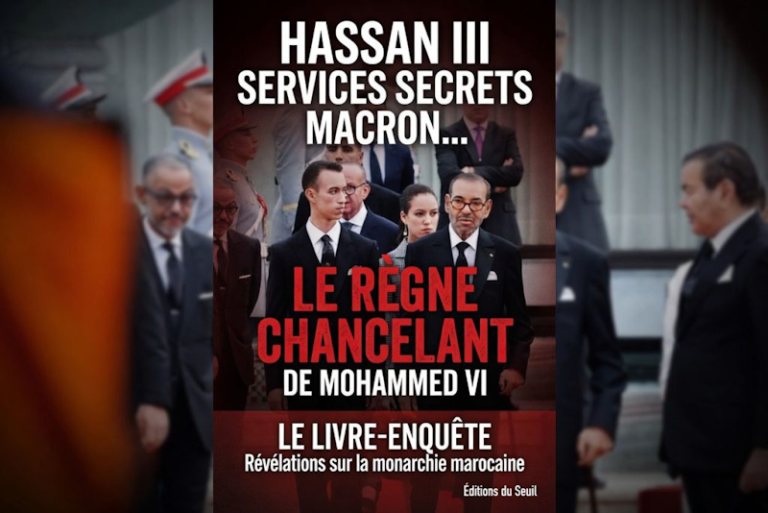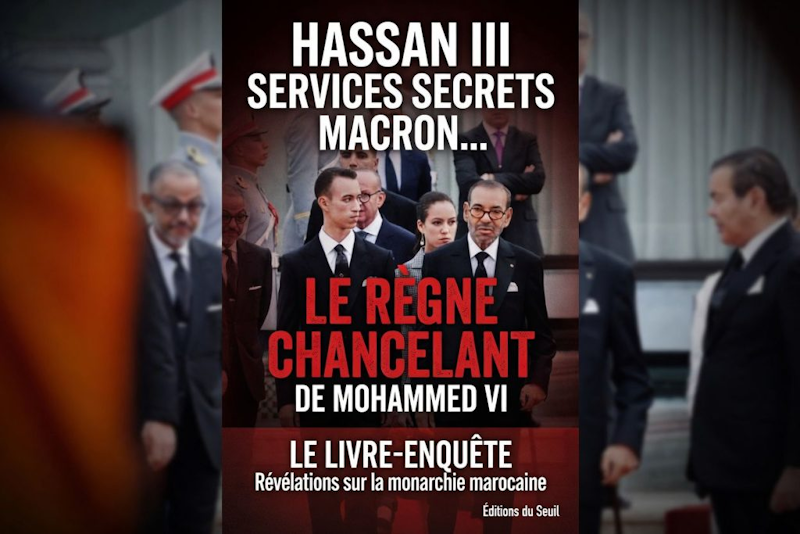
Moroccan journalist Omar Brouksy publishes Morocco: End of a Reign, a highly informed account of the inner workings of the Rabat regime and what awaits the Crown Prince. L’Express reveals its key excerpts.
Welcome to the Moroccan « Deep State. » A shadow power entirely concentrated within a few streets in Rabat, inside what observers call the Makhzen. A Versailles-style royal court composed of influential advisors, heads of secret services, members of the ruling family, and bohemian friends—rarely ministers or industrialists. Omar Brouksy, arguably the best-informed journalist in the Kingdom, is set to publish End of a Reign (Nouveau Monde), an extraordinary narrative on the backstages of power in Rabat. Here, rivalries are intensifying due to a unique dual situation: King Mohammed VI is increasingly ill, suffering from Hashimoto’s disease and chronic obstructive pulmonary disease (COPD), which affects his breathing and complicates physical exertion; for several years, he has spent a significant portion of his time abroad. In this twilight atmosphere—which paradoxically does not hinder diplomatic successes—schemers flourish and appetites are revealed.
For those wishing to understand who governs Morocco, Brouksy’s royal investigation is the perfect continuation of Mohammed VI, the Mystery (Flammarion), the excellent portrait of the monarch by Thierry Oberlé, former senior reporter at Le Figaro. This time, the sovereign appears more in the background, sidelined by his ailments, even if he remains the ultimate decision-maker capable of brutal reprimands—such as when he admonishes Abdellatif Hammouchi, the head of domestic intelligence. The master spy had instigated a hostile press campaign against the Azaitar brothers, German-born boxers who became Mohammed VI’s closest friends, attempting to deflect by claiming media independence. « I didn’t know we had an independent press, » the King quipped ironically. Friendly media would again be utilized to send venomous messages to Emmanuel Macron during a tempestuous relationship following the suspected wiretapping of the French president via Pegasus software; an episode eventually moved past after a grand state visit detailed by Brouksy.
Behind this faltering King, three circles of influence clash. Close friends, primarily the irrepressible Azaitar siblings, have gained importance, behaving like « marquises » of the regime. This is exemplified by the « poodle affair »: in March 2020, Aboubakr Azaitar’s dog went missing in Salé; a flood of police and intelligence agents, including Hammouchi himself, were put on the case. The animal had been found by an unemployed man, who was immediately incarcerated. The King’s top advisors—Fouad Ali El Himma, his former classmate dubbed the « Viceroy »; his private secretary Mounir Majidi; and Yassine Mansouri, head of foreign intelligence—eye each other warily and hatch plots through the press. Meanwhile, the royal family awaits the accession of the successor, Prince Hassan. Brouksy sketches what the inner circle, purges, and reign of Hassan III might look like; it will likely mark the return to grace of his mother, Princess Salma Bennani, a romantic figure marginalized since her divorce and previously humiliated at court, where her manners were ridiculed by an impersonator in small daily shows for the amusement of Mohammed VI’s inner circle. The comedy of power is cruel, perhaps even more so in Morocco than elsewhere.
Excerpts
FAITHFUL TO HIS MOTHER
« [Mohammed VI divorced Salma Bennani in late 2017. Royal advisors ordered her to be ignored—a period difficult for Crown Prince Hassan.] »
In 2021, Prince El Hassan turned 18. He is a young man aware of the complexity of the situation his mother was thrust into. The two are very close, accomplices. Faced with the heir’s desire to study at UM6P, just meters from his mother’s home, the King, though initially annoyed, ultimately offered no resistance.
The Princess’s life has gradually calmed. She seems to have won the battle of time, as well as her son’s trust. They spend almost all their holidays together: Courchevel in winter and the Greek islands in summer. In Morocco, they share evening rituals: cycling or boat rides on the lake. Between a Crown Prince destined for an extraordinary fate and a strong-willed mother, a deep complicity has formed, which will have… political consequences. Princess Salma’s popularity remains intact among both men and women. In January 2025, her patience paid off: she moved closer to the epicenter of power, authorized to settle in the Dar-Essalam royal residence, the former home of Mohammed V. At her side are her daughter Khadija and her son, the Crown Prince. A victory? A symbol.
THE UPCOMING PURGES OF HASSAN III
« [How will the future king govern? Who will he expel from the palace? Expected victims include the Azaitars, but also… certain major advisors of the current monarch.] »
THE MOROCCANS’ PERCEPTION OF THE YOUNG PRINCE REMAINS FRAGMENTED
Who is the future Hassan III? What personality hides behind this slender, expressionless young man? The image Moroccans have of him is fragmented and insufficient to define the sovereign he will become. Rare scenes from official ceremonies suggest a young man who, despite some shyness, is not lacking in character.
Many recall an April 2023 evening in Casablanca when the Minister of Islamic Affairs, Ahmed Toufiq, an aging servile figure, accidentally walked ahead of El Hassan. With a wave of his hand, the Prince rebuked him, putting him back in his protocol place: behind the monarch and the heir. Furthermore, like his father before him, the future king pulls his hand away when dignitaries rush to kiss it in a sign of submission.
Beyond these « flashes » of communication, Hassan III remains an unknown. « Polite, cold, taciturn, perhaps a bit shy, » summarizes an associate of a former European leader. Yet, opportunities to shape his image as a « future statesman » were missed. After the September 2023 earthquake, he could have visited the epicenter; instead, he and his father merely visited a hospital in Marrakech four days later.
For now, his defining trait is his proximity to his mother. In a regime where power is identified with the physical presence and temperament of the ruler, this mother-son bond is significant for the post-M6 power balance. The « honeymoon » period won’t stop Hassan III from conducting purges, starting with the Azaitar clan. « It’s the easiest purge, » notes a senior official. « Their days are numbered the moment Mohammed VI draws his last breath. They are hated by the family, the advisors, and the Services. They’d best be on the first plane to Germany. »
THE MENTOR OF THE NEXT KING
[Industrialist Mostafa Terrab is the target of a virulent press campaign, but the public is unaware of his important role shadowing the future king.]
Crown Prince El Hassan has been entrusted to a US-trained manager: Mostafa Terrab, head of the OCP (OCP Group). Born in 1955 in Fez to a family close to the palace, he is highly credentialed (Ponts et Chaussées, MIT). Since 2006, he has led the OCP, transforming it into a tool for Moroccan soft power and financing the monarchy’s image abroad.
In February 2026, among the millions of documents from the Jeffrey Epstein case released by US courts, certain emails mention Terrab as the « next Prime Minister of Morocco. » In a 2011 email, Epstein described him as « very likable and intelligent. »
Terrab has been tasked with « mentoring » Hassan III at UM6P. Through the « Policy Center for the South, » directed by Karim El Aynaoui (the Prince’s unofficial tutor), Terrab has fostered a close relationship with the future King and his mother. Whether he will be part of the inner circle managing the start of the next reign is a scenario frequently discussed in the salons of Casablanca and Rabat.
DIRTY TRICKS BETWEEN SPIES
“The King’s absences spark rivalries among his inner circle as they vie for effective control of power, particularly within the secret services. A look back at a fifteen-year war.”
In late 2005, a major meeting of Arab intelligence chiefs was held in Riyadh, Saudi Arabia. Each speaker was tasked with presenting a vision of the Islamist phenomenon and its link to terrorism, proposing ways to counter it. Since Ahmed Harrari [Editor’s note: then-Director of Domestic Intelligence] lacked mastery of the subject, his subordinate, Abdellatif Hammouchi, took charge of drafting the presentation. This text would later be described by DST agents as the « banana peel » that caused poor Harrari to slip. The speech, read by Harrari before Arab dignitaries, was quite simply a pamphlet against Wahhabism, describing it as the ideological pillar of global terrorism. The Saudi leaders—the House of Saud, who view Wahhabism as their legitimizing religious doctrine—were outraged and immediately informed their « brother, » King Mohammed VI. Harrari was sacked that very evening and replaced on December 15, 2005, by… Abdellatif Hammouchi.
At age 39, Hammouchi became the best-informed man in the Kingdom, granting him true influence over the King and his entourage, specifically Fouad Ali El Himma, who provided him with unwavering support.
The advent of the Arab Spring in 2011 was a difficult period for both men. While sparing the « good Caliph » by not calling for the fall of the monarchy, young protesters took aim at « friend Fouad, » portrayed as the « evil Vizier, » and the monarch’s private secretary, Mohamed Mounir Majidi, who manages the royal fortune. « No to the incestuous marriage between money and power, » chanted the youth of the « February 20 Movement. » As if these protests weren’t enough, a third man—Mohamed Yassine Mansouri, an influential member of the royal circle and a former classmate of Mohammed VI—emerged to participate in the popular « vendetta » against the King’s friend and the Kingdom’s « top cop. » Mansouri, head of the DGED (the equivalent of France’s DGSE), tasked one of his closest men, Mohamed Khabachi, with leading a media campaign to further tarnish the image of the El Himma-Hammouchi duo.
Debriefing sessions were held in a discreet café in Agdal, an upscale Rabat neighborhood, between Khabachi and Rachid Niny, director of Al Massae, the best-selling Arabic daily at the time. The result: nearly daily columns titled « Hammouchiate » (referring to Hammouchi), signed by Niny, which accused El Himma and the DST chief of knowing about the imminent Casablanca bombings of May 16, 2003, and allowing them to happen.
The King and his friend saw red. That such attacks were instigated by insiders within the inner circle was unforgivable and would not be without… judicial consequences. On April 27, 2011, Rachid Niny was arrested and charged with « endangering the security of the country and its citizens. » He was sentenced to one year in prison, a term he served in full.
A SECRET AGENT ON THE RUN
[A high-ranking official from Moroccan foreign intelligence has secretly defected to France—a sign of a deep crisis also affecting counter-intelligence.]
In late 2024, the No. 2 of the DGED, Mehdi Hijaouy, quietly left the Kingdom. His destination? First France, then Spain; feeling endangered, he vanished elsewhere in Europe. Internal sources claim he holds ultra-sensitive information on influential figures in the King’s close circle.
An international arrest warrant was immediately issued for the former agent on charges of « fraud » and facilitating « illegal emigration » to locate and eventually extradite him. In turn, Hijaouy hired two prominent French lawyers, William Bourdon and Vincent Brengarth—labeled « enemies of Morocco » by the pro-government press. While he remains in hiding, his family and relatives face the full brunt of reprisals from the royal entourage, which uses a discredited Moroccan justice system to take revenge.
Who is Mehdi Hijaouy? Contrary to the pro-police press, which calls him a « minor thug who never held a strategic function, » a striking testimony from Claude Moniquet, director of a Brussels think tank, claims the opposite. On the social network X, Moniquet wrote: « Between 2005 and 2014… I regularly worked with Mehdi Hijaouy… He was then Chief of Staff to Yassine Mansouri, the head of the DGED. On two occasions, Hijaouy organized triangular meetings… in Mr. Mansouri’s own office. »
The Hijaouy case is not an isolated one for the DGED. In 2023, reports circulated that 160 DST agents had « deserted » due to poor working conditions. Hammouchi’s agency was forced to issue a denial, though it admitted to 38 cases of « abandonment of post » in a formal statement.
« To me, this is not a war between intelligence agencies, but rather a deep dysfunction—almost a disease—affecting all security services, » Prince Hicham noted in an interview with El Confidencial. « These agencies have overstepped their powers and adopted reprehensible practices: interference in private lives, fabrication of sex scandals, blackmail, and character assassination. These practices are extremely dangerous and are also condemned by Islam.
THE KING’S SPY
[The head of foreign intelligence, Yassine Mansouri, owes his position to his friendship with Mohammed VI. Under his leadership, Moroccan espionage is suspected of having infiltrated the European Parliament.]
Born in 1962 in Bejaâd, a poor town in central Morocco, young Mansouri grew up in an environment deeply marked by religion; his father was a respected theologian. Like Fouad Ali El Himma, he was chosen at age 14 to be among the « classmates » of the Crown Prince at the Royal College. His life would change overnight. […]
After his classmate’s accession to the throne, Mansouri was appointed director of the MAP, the official press agency. Such a nomination is never trivial. Behind its role as a « news agency » lies another mission: over time, the MAP has established itself as an office for collecting intelligence rather than « info »—both « external » (via embassies, consulates, and diaspora associations in France, Belgium, Germany, or the Netherlands) and « internal » (local administrations, universities, and the provinces of the « Moroccan Sahara »).
On December 22, 2011, the Mauritanian government expelled the MAP bureau chief in Nouakchott, Hafid Bekkali, after local security sources claimed the « journalist » was behaving in a manner « inconsistent with his profession. » In another case in 2008, a Madrid court ruled that links between the Moroccan news agency and the DGED (foreign intelligence) were « sufficiently proven. »
It was not until 2005 that Mansouri was named head of the DGED, where he will likely remain at least until the death of his « classmate. »
In December 2022, the DGED’s reputation was tarnished by « Qatargate/Moroccogate. » Belgian intelligence suspected that Italian MEP Pier Antonio Panzeri received large sums of money from Moroccan agents, including the former ambassador to Brussels, Abderrahim Atmoun. Police found €600,000 in cash at Panzeri’s home. A former associate testified that when they went to collect the money from Atmoun, they used the code: « we are going to pick up ties or suits. »
« The upcoming reign of Hassan III worries his father’s inner circle »
In his investigation into the power of the Cherifian Kingdom, former AFP correspondent Omar Brouksy uncovers the clans tearing each other apart in the shadow of the monarch’s illness.
Omar Brouksy knows the price of independent journalism: in 2021, it was revealed that his phone was targeted by Pegasus software. While Morocco denies these practices, Brouksy’s books remain banned in the Kingdom. In 2021, his publisher revealed that Rabat emissaries had offered €50,000 to another author to intercept one of Brouksy’s manuscripts before publication.
In his new book, Fin de règne (End of a Reign), Brouksy explores the taboos of the court: from relations with Emmanuel Macron to the whims of the Azaitar brothers.
Interview Highlights:
On the title Fin de règne: Brouksy clarifies that it does not mean abdication, which is not part of Moroccan royal culture. Instead, it describes an « atmosphere » where the ruler is absent or diminished, and rivalries sharpen as influencers take more space.
On who manages the Kingdom: Fouad El-Himma, the « Viceroy, » is the most trusted figure who « keeps the house » in the King’s absence. Abdellatif Hammouchi remains the most informed man in the country.
On the Azaitar Brothers: Their emergence is seen as a threat to the Kingdom’s prestige by the traditional elite due to their criminal past in Germany. It was the King’s own inner circle that leaked hostile information about them to the international press (The Economist) to undermine them.
On Princess Salma: Before her divorce, she was mocked daily at the Palace by an impersonator. She was marginalized after the divorce, but has regained a place of influence due to her deep bond with her son, the future King Hassan III.
The Future Hassan III and the Regional Arms Race
[The investigative journalist discusses the personality of the Crown Prince and the deepening tensions between Morocco and Algeria, as both nations significantly ramp up military spending in 2025 and 2026.]
What do we know about the future Hassan III? Will his closeness to his mother impact his first decisions when he takes power?
Omar Brouksy: In Morocco, the King’s power is personal and often emotional. One can assume Prince Hassan will want to surround himself with people he trusts. We know little about him, aside from his attachment to his mother and a nature that seems less shy and more at ease than his father. At the same time, the new King will face constraints; he will need to compromise to ensure state continuity. We can imagine he will replace certain officials, but progressively. This subject is at the heart of the royal entourage’s worries, evidenced by attacks in pro-palace online media against Mostafa Terrab, who appears to be one of the Prince’s mentors.
Mohammed VI has included his son in meetings with Emmanuel Macron. Why?
For several years, he has done more than just include him. When Morocco hosted the Africa Cup of Nations in December, Hassan represented the crown. This was a chance to measure his popularity; he was well-received. Regarding France, Mohammed VI seems to want to signal to his son that the relationship with Paris is unique and that he must be aware of its nature.
Did Morocco wiretap Emmanuel Macron? Rabat denies it.
The information I have is that during the Pegasus affair, Macron asked the DGSE to investigate. Their response was that his phone had indeed been infected by Morocco. What is harder to establish is who took the decision, though the principle is that the King must be informed of all strategic decisions.
How was the reconciliation sealed?
Macron conditioned it on contracts. He obtained €10 billion in contracts during his October 2024 visit for companies like Alstom, Safran, and Veolia.
Escalation: The Arms Race Between Morocco and Algeria
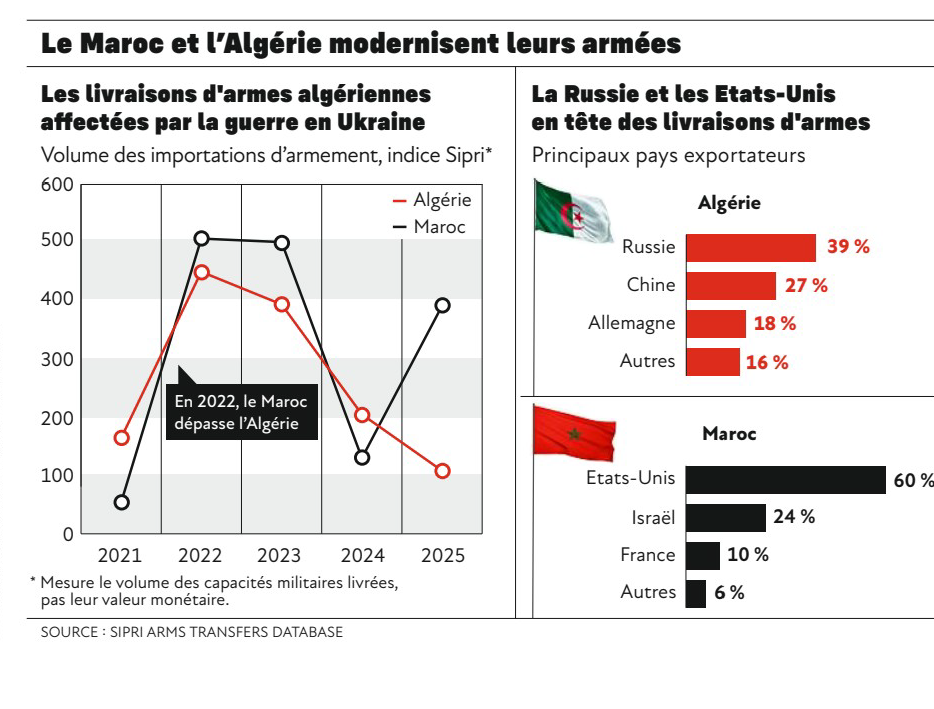
Rabat is preparing for a potential conflict with Algiers. Both powers have vastly increased military spending over the last five years.
At the end of 2025, Algerian public television announced the training of pilots in Moscow for the Sukhoi Su-57, a next-generation Russian fighter. In February 2026, footage confirmed at least two of these aircraft in Algerian skies. Algiers has reportedly ordered 14 at $140 million each, becoming the first in Africa to possess them.
Simultaneously, Moroccan press focused on Rabat’s purchase of American F-35s. Negotiations with Washington are said to be at an « advanced stage. »
The Cards of Deterrence:
Algeria: Acquired Iskander-M missiles and modernized S-400 radar systems.
Morocco: Strengthened aerial capabilities with Patriot missile systems and Apache attack helicopters.
Record Budgets (2026):
Algeria: $25.4 billion (21% of GDP).
Morocco: $15.7 billion (nearly 10% of GDP).
Climate of Suspicion:
Tensions over the Sahara and the 2020 Abraham Accords (normalizing relations between Morocco and Israel) have fueled this race. Israel is now Morocco’s second-largest arms supplier. Furthermore, Morocco is developing its own military industry, launching ten projects with companies like Lockheed Martin and Israel’s BlueBird to manufacture drones locally.
« The scenario of a diplomatic conflict turning into an armed one is not totally ruled out, » concludes Xavier Driencourt, former French Ambassador to Algeria.
Source : L’Express (France), 04/30/2026
#Morocco_King #Mohamed_VI #Lalla_Salma #Hassan_III #End_of_a_reign