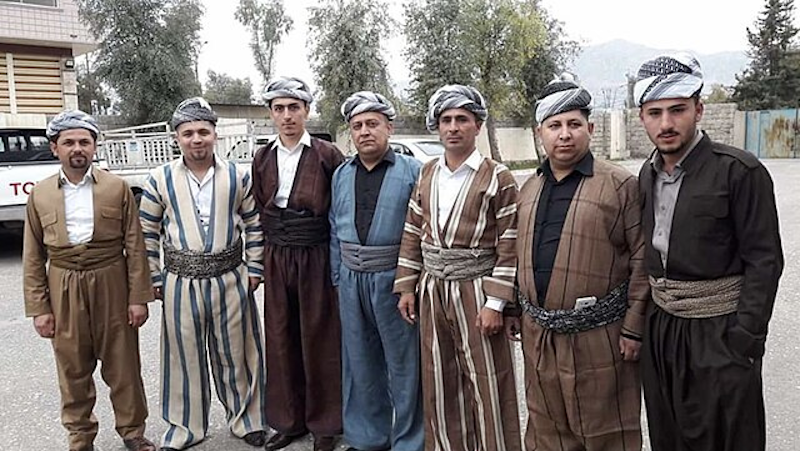
Kurdish people (Photo: Commons Wikimedia)
Kurdish residents in northeast Syria say their recent experience shows Washington may abandon Kurdish allies.
QAMISHLI, Syria — Kurdish residents in northeastern Syria are warning Iranian Kurdish groups against aligning with the United States in a potential confrontation with the Iranian government, saying their own recent experience demonstrates that Washington may ultimately abandon its Kurdish partners.
The warnings come as Iranian Kurdish militias based in northern Iraq have reportedly consulted with U.S. officials in recent days about the possibility of attacking Iranian security forces in western Iran, amid ongoing U.S. and Israeli air strikes against Iranian targets.
Residents in the Kurdish-majority Syrian town of Qamishli say such cooperation carries serious risks.
“I hope that the Kurds of Iran will not ally themselves with America, because they will abandon them,” said Saad Ali, a 45-year-old resident of Qamishli. He added that if Washington were to reach an agreement with Tehran, Kurdish forces could quickly be sidelined. “Do not make our mistakes,” he said.
Syrian Kurdish fighters allied themselves with the United States more than a decade ago during the campaign against the Islamic State group, establishing a semi-autonomous administration in territories captured from the extremist organization.
However, in January, Syria’s newly formed national army under President Ahmed al-Sharaa launched a sweeping offensive that captured most Kurdish-held areas. Kurdish leaders appealed to Washington for support but instead were urged by U.S. officials to merge their forces with the Syrian national army.
Many Syrian Kurds now see the episode as a painful lesson.
“In my opinion, the Kurds in Iran should maintain a firm stance and not engage in wars inside Iran without clear, signed guarantees from the United States regarding the future of Kurdish regions there,” said Amjad Kardo, a 26-year-old Syrian Kurd in Qamishli. “We Kurds in Syria have had a negative experience with the Americans and their abandonment of Kurdish resistance movements.”
An Iranian Kurdish source acknowledged that Kurdish leaders in Iran are concerned about the possibility of a similar outcome. According to the source, Kurdish groups have requested guarantees from Washington, though the details of those requests were not disclosed.
U.S. President Donald Trump said on Thursday that it would be “wonderful” if Kurdish forces crossed from northern Iraq into Iran, but he declined to say whether the United States would provide air support for such an operation. Two days later, he appeared to shift his stance, telling reporters he did not want Kurdish fighters entering Iran.
Ahmed Barakat, head of the Kurdish Progressive Democratic Party in Syria, also urged caution.
“The decision ultimately belongs to them,” Barakat said. “But accepting the invitation of the United States and becoming the spearhead in confronting or weakening the Iranian regime is not, at present, in the best interest of the Kurds of Iran.”
Meanwhile, Israel has reportedly been holding its own discussions with Iranian Kurdish insurgent groups based in the semi-autonomous Kurdish region of northern Iraq for about a year.
The Kurds, an ethnic group of tens of millions, were left without a state after the collapse of the Ottoman Empire and the drawing of modern Middle Eastern borders roughly a century ago. Predominantly Sunni Muslims, they speak a language related to Farsi and inhabit mountainous regions spanning parts of Armenia, Iraq, Iran, Syria, and Turkey.
In Iraq, Kurds administer a semi-autonomous region with their own government. But in other countries where large Kurdish populations live — including Iran, Turkey, and now Syria — aspirations for autonomy or statehood remain largely unrealized.
Source: Reuters
#Kurds #Iran #Irak #Syria #Turkiyë #Armenia