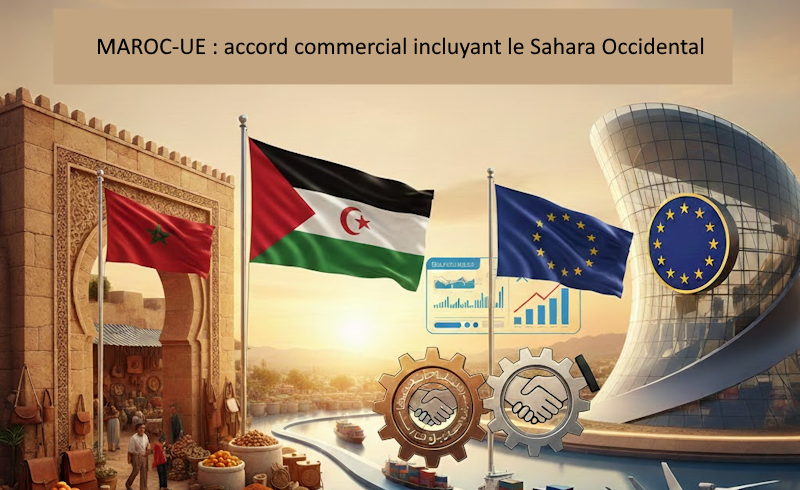
Rather than a new formal agreement, Morocco and the EU favour amending the existing association agreement through an exchange of letters – a procedure already used in previous episodes of this legal and commercial dispute. The stated objective is clear: to maintain “business as usual” and avoid any disruption to trade flows, including for products originating from Western Sahara, to which the EU wishes to continue applying the same tariff preferences.
Tags: Morocco, European Union, association agreement, Western Sahara, Court of Justice of the EU, CJUE
Rabat and Brussels are working to redefine their trade partnership to avoid a disruption of exchanges following the annulment of the agricultural and fisheries agreements.
As of October 5, 2025, the agricultural and fisheries agreements between Morocco and the European Union will be officially annulled following decisions by the Court of Justice of the EU (CJUE). Faced with this sensitive legal turning point, the two parties have discreetly initiated negotiations aimed at preserving the continuity of trade, despite strong criticism from French and Spanish agricultural sectors.
The issue was central to discussions in the European Parliament
The dispute took center stage at the September 10 meeting of the European Parliament’s delegation for relations with the Maghreb countries (DMAG), the first under the presidency of Italian MEP Ruggero Razza. On this occasion, the European Commission, represented by Florian Ermacora, head of the Maghreb unit within the Middle East and North Africa directorate, expressed confidence in establishing a post-annulment legal framework compatible with the CJUE’s requirements.
A targeted revision of the association agreement is being prepared
Rather than a new formal agreement, Brussels and Rabat favor amending the existing association agreement through an exchange of letters, a procedure already used in previous episodes of this legal-commercial dispute. The stated objective is clear: maintaining « business as usual » and avoiding any disruption to trade flows, including for products originating from Western Sahara, to which the EU wishes to continue applying the same tariff preferences.
Compliance with CJUE requirements remains a key point
Continuity of trade must be achieved without creating obligations for the Sahrawi populations, including those living in the Tindouf refugee camps, but by providing them with a « precise, concrete, substantial and verifiable » benefit. To meet this requirement, the European Commission plans to establish a regular monitoring mechanism to assess the actual benefits granted. Among the avenues mentioned are investments in energy and water in Western Sahara, support programs for Tindouf refugees, and initiatives for the Sahrawi diaspora in Europe.
Technical adjustments on product origin are also being considered
Prior to the negotiations, in mid-June, the Commission and the Council of the EU proposed a modification of the protocol concerning the origin of traded goods. This would provide for the provisional, optional, and bilateral application, until December 31, 2027, of specific Morocco-EU rules, temporarily replacing those of the pan-Euro-Mediterranean (PEM) convention, the current reference for product origin.
Tensions persist in the European agricultural sector
French and Spanish agricultural organizations are notably denouncing the continuous increase in exports of cherry tomatoes produced in Western Sahara by the Franco-Moroccan company Azura. Thanks to the favorable climatic conditions in the Dakhla region, these products now arrive on the European market year-round, including during the summer period, once considered a low season for Moroccan exports, fueling strong discontent among European producers.
Diplomatic re-engagement to accelerate discussions
Despite the resumption of dialogue between Moroccan and French agricultural inter-professional organizations in the spring, no significant progress has been made. Political instability in France has also slowed bilateral exchanges. On the Moroccan side, the appointment and return to Brussels of Ambassador Ahmed Réda Chami has allowed the issue to be relaunched at the highest institutional level. Contacts have intensified with the European Commission’s Directorate-General for Taxation and Customs Union, notably during a discreet visit by its Director-General, Gerassimos Thomas, to Rabat at the end of August.
The role of Moroccan employers is evolving
Until recently, negotiations were largely steered by the General Confederation of Moroccan Enterprises (CGEM), driven by its representative in Brussels, Abir Lemseffer, who is also a manager within the Azura group. However, the increased use of the diplomatic channel marks a strategic refocusing by Rabat, as a decisive legal and political timeline approaches for trade relations between Morocco and the European Union.
Source: Africa Intelligence, 24/09/2025
Read also : United States: How a hacker neutralised Morocco’s lobbying on Western Sahara
Read also : Morocco: The DGED Behind the European Parliament Corruption Scandal
#Morocco #European_Union #association_agreement #Western_Sahara #Court_of_Justice_of_the_EU #CJUE