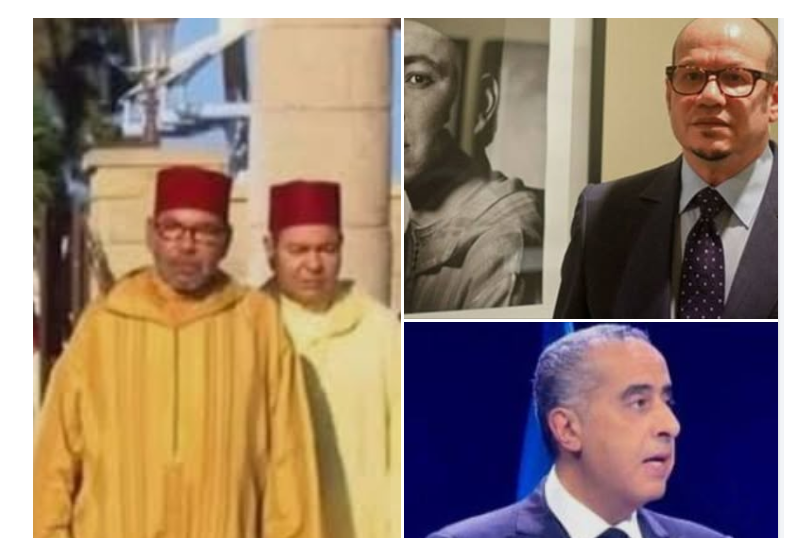
For years, it has been no secret that Fouad Ali El Himma, the King’s closest friend and senior political and security advisor, has become the real center of power. Every thread runs through him; every directive comes from him—even those that are supposed to come from the King himself. On the other hand, Abdellatif Hammouchi represents the iron-fisted security arm of this new Makhzen (the deep state), where security now dictates politics rather than the other way around.
Tags : Morocco, Jabaroot, King Mohammed VI, DGST, DGED, Makhzen, Abdellatif El Hammouchi, Houad Ali El Himma, Generation Z, Genz212,
An analysis of the rise of the security state and the decline of royal authority
The statement released by the Jabarut Group on October 2, 2025, was not a simple leak—it was a political document that tore the veil off the Moroccan regime and exposed the deep fractures within its ruling structure.
The most alarming claim in the statement is that the King has not yet been briefed on the details of the protests, their demands, or even the number of victims.
If true, this fact overturns everything that has sustained the myth of the so-called “executive monarchy” in Morocco, raising a disturbing and fundamental question: Is the King still the one truly governing? Or has the country entered a stage where advisors and security chiefs make the decisions, while the King plays merely a symbolic role?
For years, it has been no secret that Fouad Ali El Himma, the King’s closest friend and senior political and security advisor, has become the real center of power.
Every thread runs through him; every directive comes from him—even those that are supposed to come from the King himself.
On the other hand, Abdellatif Hammouchi represents the iron-fisted security arm of this new Makhzen (the deep state), where security now dictates politics rather than the other way around.
The Jabarut statement clearly indicates that Hammouchi received direct orders from El Himma to deal with the Generation Z protests with “firmness and force,” and that the intimidation plan was a purely security-driven decision, entirely detached from constitutional institutions.
Morocco today no longer appears to be a state ruled by a monarch, but rather a territory controlled by a security mafia operating without oversight or accountability.
Under this logic, the King is no longer the ruler but merely the facade.
Reports reaching him are carefully filtered, and whatever is hidden from him is considered part of the system of control.
The Makhzen is no longer just a support structure for the monarchy as it once was—it has evolved into a parallel authority, even one that supersedes it.
The deep state has seized the levers of power and surrounded the King with a wall of advisors, interests, and loyalties that guarantee their survival regardless of changing circumstances.
As long as the King lacks the courage to dismantle this wall, Morocco is no longer a monarchy but an “securitocracy”—a system ruled by intelligence and repression rather than by law or legitimacy.
The Moroccan regime thus lives a dangerous paradox:
Abroad, the King is still seen as the supreme commander and decision-maker;
Inside the country, however, it is well known that the major policies are cooked in the kitchen of El Himma and Hammouchi, presented to the King already packaged and ready for signature.
The monarchy has ceased to be the source of power—it has become merely the seal of approval.
So when the Jabarut Group claims that the King has not been informed of what is happening, it is in fact describing a deeper reality: the disappearance of the state itself, replaced by a network of political, economic, and security interests that rule in the King’s name—but without the King.
Today, the Makhzen is stronger than the monarchy.
This is not an exaggeration, but a logical result of decades of delegating power to cronies and security agencies while neutralizing the people and emptying politics of any meaning.
Political parties have lost their function, Parliament has turned into a decorative stage, and the judiciary has become a compliant tool.
What remains visible is a bloated security apparatus and a single powerful advisor who concentrates all authority in his own hands—while the Moroccan people pay the price for this structural imbalance through repression, deception, and unprecedented social tension.
Nevertheless, the attempt by some circles—including the Jabarut Group itself—to portray the King as an absent or victimized figure within this security structure is nothing but a naïve or deliberate attempt to absolve the head of the regime from responsibility.
The Moroccan Constitution is explicit in defining the King’s position and powers: he is the Head of State, Chair of the Council of Ministers, Commander-in-Chief of the Armed Forces, President of the Supreme Council of the Judiciary, and Head of the National Security Council.
He is the one who appoints both El Himma and Hammouchi and grants them their authority.
No measure of this scale can be undertaken without his knowledge or consent—whether through direct instruction or deliberate silence.
Depicting the King as a hostage of his own institutions is merely part of the Makhzen’s propaganda strategy to whitewash the palace’s image and shift blame onto the security or governmental layer.
In truth, the King is fully present in the heart of what is happening and remains politically, morally, and legally responsible for all actions carried out in the name of the state.
To claim that “the Makhzen is stronger than the King” is an oversimplification, for in essence, the Makhzen is the monarchy itself—when it hides behind its own apparatus to avoid confronting the street directly.
The most dangerous reality Morocco faces today is not merely the risk of popular unrest, but the absence of any real accountability.
No one knows who gives the orders, who executes them, or who can be held responsible.
When the apparatuses of power become authorities above all other authorities, and when the will of the people is reduced to an inconvenient detail in the equation of governance, the system ceases to know who truly governs.
What the Jabarut statement revealed is not an isolated episode, but rather a sign of a new stage in the internal decay of the monarchy itself.
When the King becomes the last to know, the very meaning of “monarchy” loses its essence.
The system is now ruled by a dynamic of mutual fear:
the security services fear losing their influence,
the King fears dismantling the machinery that sustains him,
and the people are crushed between the two.
The question that must be asked boldly today is: Who really holds power in Morocco?
The King or the Makhzen?
Or have the two become the same entity—a single structure that governs through tyranny and deception?
The answer no longer requires interpretation.
It is enough to see who gives the orders, who enforces them, and who is held accountable to understand that Morocco today lives under a hybrid authority whose visible face is the monarchy, but whose true substance is the Makhzen.
The line between ruler and instrument has disappeared, and the only truly absent force in governance remains the Moroccan people—the rightful source of all sovereignty.
Qandyl Mohamed — Blogger, Human Rights and Independent Political Activist