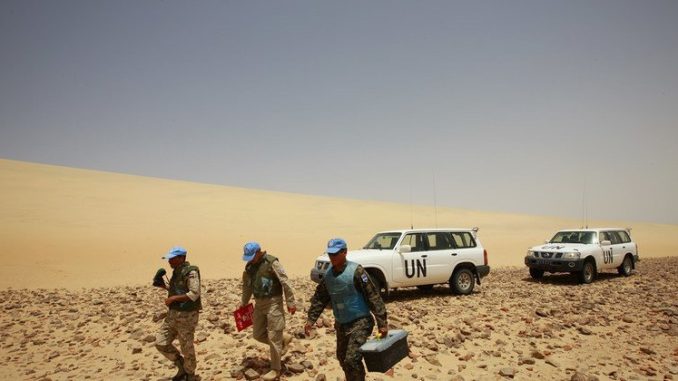
The collapse of MINURSO after 35 years of UN peacekeeping in Western Sahara exposes a historic diplomatic failure. In an analysis published by Dialogue Initiatives, the abandonment of the Baker Peace Plan, US support for Morocco’s autonomy proposal, Russia’s veto at the UN Security Council and the uncertain future of Sahrawi refugees illustrate how geopolitical interests have overshadowed international law, decolonization and the Sahrawi people’s inalienable right to self-determination.
The end of MINURSO was not an unexpected diplomatic accident but the culmination of more than two decades of political miscalculations, broken commitments and international inaction.
In an analysis published on November 22, 2026, Dialogue Initiatives, entitled “The UN and Western Sahara: The Inevitable Conclusion of a Disaster Foretold,” examines the United Nations’ failure to fulfil its commitment to the Sahrawi people’s right to self-determination.
According to the article, the decisive turning point came in 2004, when the Security Council effectively moved away from the Baker Peace Plan in favour of a mutually acceptable political solution, despite knowing that the positions of Morocco and the Polisario Front were fundamentally irreconcilable.
Morocco rejected any referendum offering independence as an option, while the Polisario Front insisted on preserving the Sahrawi people’s right to choose their own future.
For more than two decades, successive UN personal envoys organized meetings and consultations without achieving a meaningful breakthrough.
The situation deteriorated further in December 2020, when the Trump administration recognized Moroccan sovereignty over Western Sahara in connection with Morocco’s normalization of relations with Israel.
Dialogue Initiatives argues that Washington’s October 2026 draft resolution represented the culmination of this diplomatic shift. It sought to:
-Remove the referendum from MINURSO’s mandate.
-Establish Morocco’s autonomy proposal as the sole basis for negotiations.
-Broaden consultations beyond the Polisario Front.
-Initiate measures towards the eventual repatriation of Sahrawi refugees.
Russia’s veto blocked the American initiative, while Washington opposed the Russian alternative proposing a technical extension of MINURSO’s mandate.
The resulting deadlock brought 35 years of UN peacekeeping to an abrupt end.
The article also raises fundamental questions about Morocco’s expanded autonomy proposal, whose details remain undisclosed despite Washington’s attempts to make it the exclusive basis for negotiations.
Why were Security Council members expected to endorse a proposal they had not fully examined? Why should Sahrawi refugees be expected to return before a political settlement guarantees their rights and future?
For Dialogue Initiatives, Russia’s veto provided temporary relief by blocking the proposed measures concerning refugee repatriation, but the fate of thousands of Sahrawi refugees remains uncertain.
MINURSO may disappear, but the Sahrawi people’s inalienable right to self-determination does not disappear with it.
After 35 years of unfulfilled promises, the United Nations faces a fundamental question: has it abandoned conflict resolution in favour of accommodating the geopolitical interests of powerful states?
Source: Dialogue Initiatives, November 22, 2026.
#WesternSahara #MINURSO #UnitedNations #SelfDetermination #SahrawiPeople #PolisarioFront #Morocco #Algeria #Russia #UnitedStates #SecurityCouncil #Decolonization #InternationalLaw #HumanRights #SahrawiRefugees

Soyez le premier à commenter