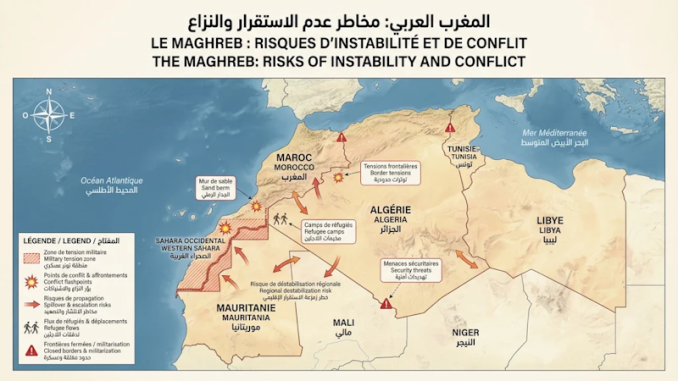
Former minister Sidi Mohamed Ould Maham—a former spokesperson for the Mauritanian government and a close associate of President Ghazouani—has offered an analytical perspective on the situation in Western Sahara. In his assessment, he examines the current balance of power and adopts the Moroccan position, even urging the Sahrawis to accept it, return to their lands, and transform into a political party within Morocco.
This reveals new, undeclared orientations within the Mauritanian regime, stemming primarily from pressures exerted by the United Arab Emirates and certain international powers. These actors seek to entangle Mauritania in the conflict—much as occurred in 1975—and risk pushing the entire region toward an explosion.
Al-Akhbar (Nouakchott) – Former Mauritanian Minister of Culture Sidi Mohamed Ould Maham said that developments on the ground and the outcomes of diplomatic competition, internationally and regionally, between the parties to the Western Sahara conflict are creating many factors that will force the parties to the conflict, willingly or unwillingly, to move toward a political solution in which each party makes painful concessions.
In an article published on his Facebook account, Ould Maham said that five decades of war and conflict in Western Sahara “have proven that we are all losers, for the political and military price paid and still being paid by the two parties to the conflict is exorbitant and heavy, and it has so far been confined between them. What then if, under any circumstance or for any reason, it were to extend to neighboring countries or take on other dimensions and ramifications?”
He noted that, given the declared means of force available to each party, and after MINURSO’s departure from the territory, “it is confirmed that Polisario fighters practically cannot carry out military operations in the strip extending from Amgala in the north toward El Guelta – Mijek – Aguenit – Doughj – Zoug in the south, to Guerguerat in the west, passing through Tichla and Bir Gandouz.”
He explained that the reason for this is “the difficulty of infiltrating this region without passing through Mauritanian territory, which Mauritania will not allow given its neutral position between the parties to the conflict, and because military presence in this region also requires supply and provisioning lines that are impossible to provide along this 850-km strip between Amgala and Guerguerat.”
Ould Maham believed that the nature of the terrain in this particular region does not help the Front’s fighters hide from the Moroccan army’s drones, radars and air sorties, because it is a highly exposed area that offers no terrain behind which these fighters could take cover, while the separation wall provides Moroccan soldiers with better protection conditions and greater monitoring capacity; this is what pushed the Front’s fighters to withdraw from this strip as soon as it announced abandoning the ceasefire in November 2020, according to him.
According to Ould Maham, the area extending east of Amgala to Mahbes, located overall north of the northern Mauritanian border and south of the northern Moroccan wall, over a length of about 350 km, will remain the Front’s most important military presence area, especially in the regions of Mheiriz, Tifariti and Bir Lehlou.
He affirmed that this region has relatively better terrain than the previous one, given its proximity to the Algerian border and the combat infrastructure the Front has in this strip, built over the past fifty years, particularly in the period after the 1991 ceasefire.
However, he noted that “the Moroccans’ air superiority gives the Moroccan army major advantages in control and domination, and the Moroccan army will not take much trouble if it decides to clean up this region, close it and confine the line of contact or the engagement area to the region east of Mahbes, opposite the Algerian border with the Sahara, whose length does not exceed forty kilometers from north to south and whose width is less than 10 km between the east of the wall and the Algerian border west of Tindouf.”
He added: “All these data on the ground and the outcomes of diplomatic competition internationally and regionally between the two parties create many factors that will force the parties to the conflict, willingly or unwillingly, to move toward a political solution in which each party makes painful concessions and in which they share together, alongside the two brotherly neighbors, the bill of the peaceful solution. This will allow Morocco to invest its military superiority and what it has achieved practically on the ground, and will enable the Sahrawis, who are living through a struggle among their leaders that can no longer be hidden and who face internal opposition with a different assessment, after five decades of armed action, to move the arena of conflict inward and onto Saharan lands instead of refugee camps and dispersal. It also offers them the possibility of converting and investing their armed struggle into a popular political action open to all Sahrawis and gives them a chance to determine their fate according to a political roadmap that takes into account the realities of the neighborhood and is at the same time capable of securing the world’s support.”
#WesternSahara, #Mauritania, #UAE, #AbuDhabi, #Morocco, #Algeria, #Polisario, #Diplomacy, #Geopolitics, #BorderSecurity, #WestAfrica, #MauritanianNeutrality, #AbrahamAccords, #MINURSO, #EconomicCorridors, #PortLogistics, #Tindouf, #Guerguerat, #Dakhla, #AmarBelani

Soyez le premier à commenter