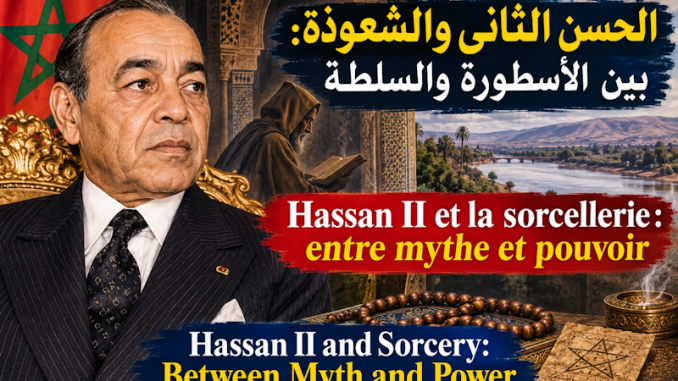
There is one aspect of the late Morocco’s King Hassan II’s personality that Westerners found difficult to understand: his attachment to certain beliefs associated with sorcery and the occult.
The daily life of the late King Hassan II, among his relatives, entourage, court and harem, was not free from practices and behaviours strongly influenced by sorcery. Beyond the image of a king who held the reins of power with an iron fist and a modern monarch steeped in Western culture, particularly French culture, another side of Hassan II emerges: that of a man who was sometimes interested in magic, sorcery and various superstitious beliefs.
History teaches us that those in power have always resorted to superstition, sorcery and magic, alongside the use of force, political cunning and strategic planning, in order to remain in control.
Although the late Hassan II was rational and « Cartesian » in his dealings with the West and his approach to contemporary affairs and economics, he demonstrated on several occasions, at different periods of his reign, that he did not rely exclusively on reason. On more than one occasion, he reportedly turned to the power of sorcery and magic, particularly when dealing with matters whose future seemed impossible to predict through reason, political skill or planning.
Numerous accounts have been preserved in collective memory, reported by people who lived inside the palace or were close to the king and familiar with what went on behind the walls of the royal court.
Many Westerners, particularly the French, were perplexed by the personality of the late Hassan II, which they considered almost schizophrenically dual. He appeared to surpass every other Moroccan in his embodiment of modernity. No one in Morocco seemed more modern than him. He spoke an elegant French that even many French people could not master, and had fully absorbed the culture and knowledge of his time. Yet, at the same time, he sometimes appeared more conservative than the most deeply conservative individuals, attached to ancient traditions and customs that defied rational understanding, including belief in numerous superstitions, faith in sorcery and recourse to magic.
More than one source has confirmed the late king’s interest in the mysterious worlds of magic and sorcery, as well as his search for fqihs, fortune-tellers, astrologers and sorcerers. Some of them actively sought to offer their services and supposed abilities to the royal court, influential figures and the highest-ranking officials.
Politicians, businessmen and senior officials turn to sorcerers when competition and power struggles intensify or when the ruler’s anger becomes apparent. It should be noted that magic and sorcery are not phenomena exclusive to Morocco or its rulers; they are worldwide phenomena. Even the most powerful rulers and leaders throughout history have resorted to them. Napoleon and Hitler, to mention only two examples, were reputed to have sought the assistance of magic and sorcery. Even the eye depicted on the American dollar was originally intended to ward off the evil eye of the envious, in a country considered more pragmatic and rational than most others.
The Alaouite Kings Do Not Cross the Oued Massa
Among the strange beliefs that the late Hassan II reportedly took care to observe was the prohibition against crossing the Oued Massa. It was believed that crossing the river could bring harm to the king or a member of the royal family.
According to this belief, if an Alaouite king crossed the river at any time of the year, this act could set in motion a chain of misfortunes affecting the king, his family or his close entourage for the remainder of that year.
The late Hassan II was never known to have crossed the Oued Massa. During his visits to southern Morocco, whenever the royal motorcade reached the bridge over the Oued Massa, located on the road connecting Aït Melloul and Tiznit, the king would leave his convoy and board a helicopter. The aircraft would head towards the sea, travel a considerable distance from the river’s mouth, and then return inland to land on the opposite bank. This was done to avoid crossing the river, whether the king was travelling south from the north or north from the south.
« Tbaroud »
At the beginning of the late Hassan II’s reign, a belief circulated that his body was protected by a supernatural force that shielded him from all harm, including injuries caused by bladed weapons or firearms. This protection was attributed to what was known as « tbaroud ».
« Tbaroud » was described as a form of magic involving amulets and a special mixture whose recipe was kept secret. Only a very small number of fqihs knew its composition, passing the knowledge down among themselves to prevent it from becoming widely known.
Its preparation involved a series of rituals, the ingredients, proportions and methods of which were known only to a select group of initiated fqihs. Many religious scholars regarded it as a form of black magic, whose secrets were held by the most skilled sorcerers.
In certain exclusive circles, it was said that the « tbaroud mixture » was prepared on a particular night during Ramadan, at a precise moment known only to those well versed in the « science of Demyati » and the « arts » of black magic. It was claimed that anyone who benefited from this formula could not be harmed by any bladed weapon or firearm, whether a sword, dagger, cleaver, bullet or rocket launcher.
According to those familiar with black magic, the effectiveness of « tbaroud » did not depend solely on the mixture itself, its recipe, or the conditions, rituals and timing of its preparation. It also required amulets and talismans prepared by masters of black magic, which the beneficiary had to carry after the mixture had been applied to his body.
Others, however, believed that « tbaroud » was merely a rumour deliberately spread among the population to reinforce the sacred status of the sultan and portray him as God’s representative on earth, enjoying divine protection and preservation. The purpose was to discourage anyone from even contemplating harming him or attacking his person, since he was supposedly divinely protected in spirit and physically shielded by « tbaroud ».
Until the two coup attempts of 1971 (Skhirat) and 1972 (the attack on the royal aircraft), ordinary citizens regarded the king as a superhuman figure. This perception changed following revelations about the events that took place at Skhirat Palace on July 10, 1971. Some people who were present claimed to have witnessed the late Hassan II raising his hands under threat, with a machine gun pointed at him by an ordinary soldier. The soldier subsequently recognised the king and allowed him to escape from those who were searching for him in order to kill him.
Many ordinary Moroccans then understood something that had previously seemed unimaginable: royal palaces could be stormed, the king could be threatened, and he was no more immune to danger than any other human being, whether king or ordinary citizen.
Driss Ould El Kabla
Al-Hiwar Al-Moutamaddin, No. 2618, April 16, 2009. Section: Satirical Writings.
#HassanII #Morocco #Sorcery #Witchcraft #Occultism #BlackMagic #MoroccanHistory #MoroccanMonarchy #RoyalPower #AlaouiteDynasty #Marabouts #Jinn #Baraka #Superstition #PopularBeliefs #GreenMarch #WesternSahara #RoyalPalace #PoliticalHistory #PowerAndMyth

Soyez le premier à commenter