By Qandyl Mohamed – Moroccan Blogger, Human Rights Activist, and Independent Political Critic
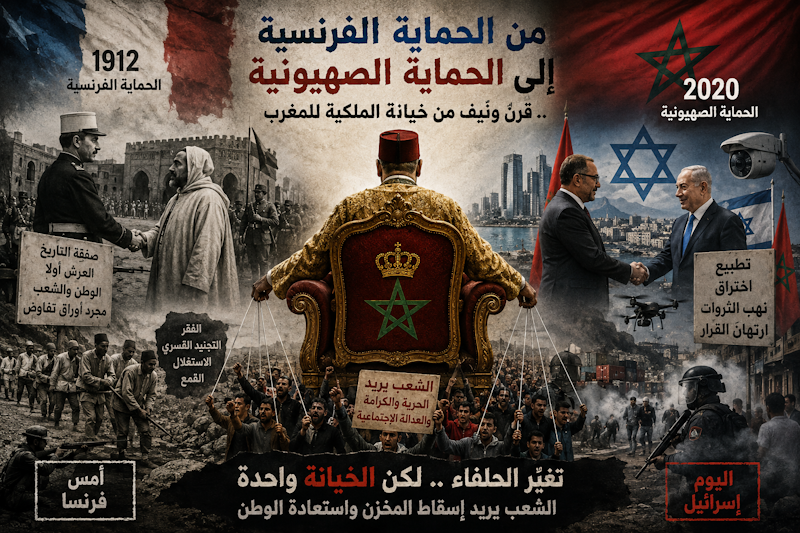
The betrayal of Morocco was never an isolated incident in the history of the monarchy, nor merely a series of political mistakes imposed by regional or international circumstances. Rather, it has been a continuous and consistent pattern connecting every phase of royal rule from the beginning of the twentieth century until today. From the very moment the country was opened to French colonialism in 1912, a clear equation was established: the throne came first, while the nation, the people, and sovereignty became mere bargaining chips to be traded whenever the stability of the regime was threatened.
Thus, modern Morocco was born not as a state liberated through an independent popular will, but as an entity reshaped under the supervision of colonial powers and guaranteed jointly by the palace and the Makhzen.
What was called the “French Protectorate” was, in reality, a historic deal in which the country’s independence was buried in exchange for preserving the traditional structure of power.
The Moroccan people were never party to that arrangement; they were its greatest victims. Millions of Moroccans were pushed into poverty, forced conscription, and exploitation, while the Makhzen elites adapted themselves to colonial rule and reproduced their influence under its banner. Since that time, the logic of governance became unmistakably clear: any foreign power capable of guaranteeing the survival of the throne was welcome, regardless of the national cost.
Then came the so-called “independence,” presented to Moroccans as a historic liberation while in truth it was merely the recycling of colonialism under a local façade. The Aix-les-Bains Agreement was not a national victory, but rather a massive maneuver aimed at neutralizing the armed resistance and the Liberation Army.
There, in the calm French resorts, Morocco’s future was decided far away from the blood of resistance fighters who were battling in the mountains and villages. An agreement was reached on a Morocco that would continue serving French economic and military interests in exchange for granting absolute authority to the palace. It was therefore no surprise that, immediately after this so-called independence, campaigns began to eliminate genuine resistance figures, because their very existence threatened the original deal upon which the modern Makhzen state had been built.
Under the late Hassan II, betrayal entered a deeper and more organized phase.
The man who portrayed himself as the “Commander of the Faithful” and defender of the Palestinian cause was, in reality, cultivating some of the most dangerous secret relations with Israel and its intelligence agencies. The scandal of the 1965 Casablanca Summit is not merely a historical detail; it remains a political and moral disgrace that cannot be erased by time. Opening the doors of Arab summits to the Mossad and recording the meetings of Arab leaders and military officials for Israel’s benefit was not “diplomatic cleverness,” as some attempt to portray it, but a fully fledged act of betrayal that contributed to strengthening Israel before the 1967 defeat. While Arab peoples were chanting for Palestine, the Moroccan regime was operating in the shadows with the mentality of a political broker willing to sell everyone in exchange for securing its position with the West.
Domestically, the situation was no better.
The so-called “Years of Lead” were not merely isolated excesses, as Makhzen propaganda attempts to market today, but rather the very essence of Makhzen rule itself. Kidnappings, torture, secret prisons, political assassinations, the impoverishment of the people, the crushing of dissent, and the transformation of the country into a plantation of collective fear were all necessary tools for the survival of a regime fully aware that it lacked genuine popular legitimacy. The Makhzen did not fear external enemies nearly as much as it feared the awakening consciousness of Moroccans themselves.
Then the issue of Western Sahara was weaponized as one of the greatest instruments of political blackmail in modern Moroccan history. The matter was transformed from a complex political issue into a tool for silencing the population and equating patriotism with loyalty to the throne. Anyone criticizing corruption, authoritarianism, or the looting of wealth was automatically accused of treason. In this way, the self-proclaimed “state” became a massive propaganda machine deliberately conflating the nation with the regime, while wealth continued to be monopolized by a narrow circle tied to the palace and the Makhzen apparatus.
The year 2020 ultimately exposed the final face of this long trajectory of dependency. Normalization with Israel was not a sudden event, but the natural outcome of decades of secret relations, security coordination, and gradual infiltration.
The only new element was the collapse of the masks. After more than a century of seeking protection through France and the West, the Makhzen officially entered the phase of seeking protection through the Zionist project itself, in exchange for an alleged American-Israeli recognition of Moroccan sovereignty over Western Sahara. The doors of the country were opened wide to Israeli influence politically, militarily, economically, culturally, religiously, and in intelligence affairs. Thus, in the eyes of many Moroccans who reject normalization, Morocco moved from French protection to Zionist protection, while the people were expected to applaud in the name of “realism” and “higher national interests.”
The most dangerous act committed by the royal Makhzen system has not merely been the repression of opponents, the looting of wealth, or the submission to foreign powers, but rather its continuous attempt to falsify the collective consciousness of Moroccans. It has sought to convince them that the throne is the nation, that the Makhzen is the state, and that rejecting this reality amounts to chaos and treason. Yet the truth this quasi-regime has tried to bury for more than a century is that nations cannot be built through fear, through allegiance to foreign powers, or through transforming a country into a private corporation ruled by a protected minority backed by wealth, security apparatuses, and foreign alliances.
The names of allies have changed over the decades — France, the United States, Israel — but one constant has remained unchanged: the monarchy’s fear of its own people and its permanent readiness to sell everything in exchange for survival.
What Moroccans need today is not more hollow slogans, nor more campaigns of intimidation presenting them with imaginary foreign enemies at every stage while the roots of destruction are left to grow within the instruments of governance themselves. A state that impoverished its people, silenced dissent, and tied the country’s future to the calculations of foreign capitals cannot convince the people that it is the guardian of the nation. The time has come for Moroccans to distinguish between Morocco as a land, a people, and a history, and the system that monopolized speaking in its name for decades. The homeland is not the palace, nor the Makhzen, nor the security apparatuses ruling through iron, fear, fire, and privilege. It is the millions of Moroccans deprived of their right to freedom, justice, and dignity in the name of “stability” and “sacred institutions.” Any people unwilling to identify the true source of its crisis will remain trapped in the same cycle, regardless of how faces and rhetoric may change.
#Morocco #Makhzen #France #Israël #Protectorate