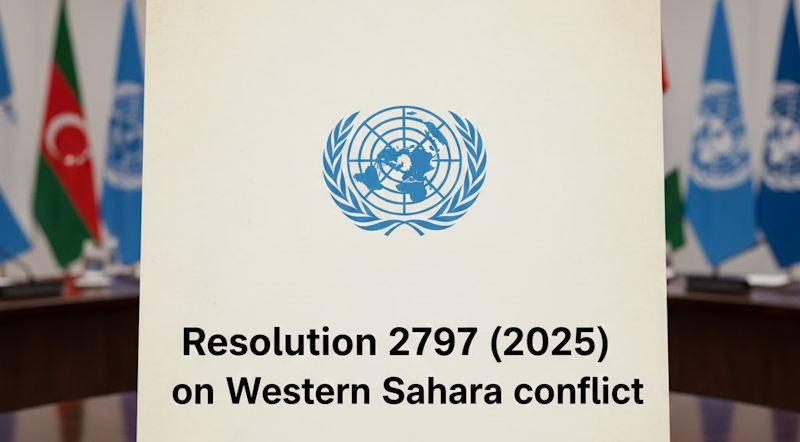
Resolution 2797 (2025) is consistent with the purposes and principles of the United Nations Charter and with the established positions of the relevant UN organs, particularly the General Assembly and the International Court of Justice (ICJ)
Tags : Western Sahara, Polisario Front, Morocco, Resolution 2797 (2025), autonomy,
MEMORANDUM TO THE SECURITY COUNCIL AND THE GENERAL ASSEMBLY
POLISARIO FRONT’s Views on UN Security Council Resolution 2797 (2025)
November 17, 2025
Under the presidency of the Russian Federation, the UN Security Council held a public session on October 31, 2025, during which it adopted Resolution 2797 (2025). The resolution extends the mandate of the United Nations Mission for the Referendum in Western Sahara (MINURSO) until October 31, 2026.
On October 22, 2025, the United States, as the country responsible for drafting the resolutions (« penholder ») on MINURSO, distributed an initial draft to the members of the Security Council. This draft included several elements that reflected the national position of the United States. These elements represented a serious attempt to depart from the principles of international law that underpin Western Sahara’s status as a decolonization issue, as well as from the established bases upon which the Security Council has addressed this issue. The majority of Council members firmly opposed this unilateral approach.
During the deliberations on the initial US draft and subsequent versions, the majority of Security Council members insisted that the text must be balanced, reflect the positions of both parties, the POLISARIO Front and Morocco, and confirm that any solution must be mutually acceptable and provide for the self-determination of the people of Western Sahara, in accordance with the United Nations Charter.
Many members also warned against any resolution text that might predetermine the outcome of the political process or contradict the positions of member states and previous Council decisions. Even concerning the characterization of the Moroccan « proposal » and the question of sovereignty, numerous member states proposed constructive amendments to the initial draft and subsequent drafts presented by the « penholder. »
As a result of the firm and consistent stance of the POLISARIO Front since the beginning of the deliberations, as well as the positions of key countries such as Algeria, China, Pakistan, and the Russian Federation, among others, the United States introduced some substantive and formal changes to its drafts. These changes are reflected in the final text of Resolution 2797 (2025).
Eleven members voted in favor of the resolution (Denmark, France, Greece, Guyana, Panama, Republic of Korea, Sierra Leone, Slovenia, Somalia, United Kingdom, and the United States of America). China, Pakistan, and the Russian Federation abstained. Algeria did not participate in the vote.
Resolution 2797 (2025) reaffirms all previous Security Council resolutions on Western Sahara. It reiterates the Council’s commitment to assist the two parties in achieving a just, lasting, and mutually acceptable political solution, consistent with the purposes and principles of the United Nations Charter, and which guarantees the self-determination of the people of Western Sahara.
It is important to emphasize that Morocco, with the strong support of certain powers, attempted to achieve three main objectives through the initial US draft:
- To obtain Security Council recognition of its « sovereignty » claims over Western Sahara;
- To establish its « proposal » as the sole basis for negotiations;
- To transform MINURSO’s mandate into an instrument to secure a solution aligned with its expansionist position, based on the first two objectives, within a maximum period of three months.
A detailed reading of the final text of Resolution 2797 (2025), adopted by the Council, clearly demonstrates that Morocco has achieved none of these three objectives. This result is due to the firmness of the Sahrawi people and their sole and legitimate representative, the POLISARIO Front, as well as the firm positions of member states genuinely committed to the letter and spirit of the United Nations Charter.
1. The question of sovereignty
The Security Council does not recognize any Moroccan « sovereignty » over Western Sahara. The term « Moroccan sovereignty » is only mentioned in the preamble, in the context of possible elements of a solution, and not in any operative paragraph. This does not constitute a Council position on the question of sovereignty.
Several states have made this clear in their explanations of vote. For example, Denmark and Slovenia stressed that their vote in favor of the resolution does not imply recognition of « Moroccan sovereignty » over Western Sahara and that the adopted text cannot be interpreted as a decision on the question of sovereignty.
In this regard, Resolution 2797 (2025) is consistent with the purposes and principles of the United Nations Charter and with the established positions of the relevant UN organs, particularly the General Assembly and the International Court of Justice (ICJ). Since Western Sahara was inscribed on the list of non-self-governing territories in 1963, the General Assembly and its subsidiary organs have consistently addressed it as a question of decolonization under Chapter XI of the Charter, affirming the inalienable right of the Sahrawi people to self-determination and independence, in accordance with General Assembly Resolution 1514 (XV) and other relevant resolutions.
In its Advisory Opinion of October 16, 1975, on Western Sahara, the ICJ concluded that no links of territorial sovereignty existed between Western Sahara and Morocco. The Court affirmed the applicability of Resolution 1514 (XV) to the decolonization of Western Sahara through the free and genuine expression of the will of the people of the territory.
2. The status of the Moroccan « proposal »
Resolution 2797 (2025) does not establish the Moroccan « proposal » as the sole basis for negotiations. It is referred to as « one basis » — not the basis — for talks, whose ultimate goal is a definitive and mutually acceptable political solution, which « explicitly provides for the self-determination of the people of Western Sahara. » The earlier text of the initial US draft, which referred to a solution providing for « genuine autonomy, » was removed during consultations.
Contrary to the intention reflected in the initial draft to present the Moroccan « proposal » as the « sole framework » for negotiations, the final text urges the two parties to enter into conversations without preconditions and leaves the door open to other ideas, suggestions, and proposals that may support a definitive and mutually acceptable solution.
The Moroccan « proposal » cannot serve as a basis — much less the sole basis — for a just and lasting solution consistent with the United Nations Charter and the right to self-determination of the people of Western Sahara, at least for five reasons:
- Morocco does not exercise sovereignty or possess an administration mandate over Western Sahara. It is considered an occupying power, in accordance with General Assembly resolutions 34/37 of November 21, 1979, and 35/19 of November 11, 1980, among others. Consequently, Morocco cannot unilaterally grant « autonomy » or any « territorial status » to Western Sahara without violating the international status of the territory and the relevant United Nations resolutions on decolonization.
- The « proposal » undermines the inalienable right of the Sahrawi people to self-determination by predetermining the outcome and limiting it to a single option: « autonomy. » This would amount, in practice, to Morocco deciding for the Sahrawi people, which is incompatible with the right to self-determination recognized in international law and UN resolutions.
- The « proposal » excludes the option of independence, which is both a legitimate aspiration of the Sahrawi people, led by the POLISARIO Front, and one of the options provided for in General Assembly resolutions 1514 (XV) and 2625 (XXV).
- The « proposal » is extremely dangerous because it would reward Morocco for the illegal use of force to occupy Western Sahara, in violation of the UN Charter and the Constitutive Act of the African Union. Accepting such a proposal would set a dangerous precedent in Africa and the rest of the world.
- In accordance with the UN Charter and the law of decolonization, the political room for maneuver of the Council is legally limited by peremptory norms (jus cogens), including the right to self-determination. It cannot legally violate this fundamental right. Article 24(2) of the UN Charter requires the Council to act in accordance with the purposes of the Charter — including self-determination — and its decisions cannot derogate from jus cogens norms.
3. The MINURSO mandate
The Security Council decided to extend the mandate of the United Nations Mission for the Referendum in Western Sahara (MINURSO) for 12 months, in accordance with the recommendation of the Secretary-General in his report (S/2025/812), and without modifying or restricting its mandate. This clearly contrasts with the initial US draft, which proposed a three-month extension with the option to transform or even terminate the Mission depending on the outcome of the negotiations.
General implications of Resolution 2797 (2025)
In conclusion, Resolution 2797 (2025) confirms that the question of Western Sahara cannot be resolved without the free exercise, by the Sahrawi people, of their inalienable right to self-determination. This principle constitutes the core of the resolution. It also represents a clear response to the efforts of Morocco and some of its allies to achieve a resolution that would settle the conflict in favor of its expansionist position in a short period.
The Security Council has made it clear that any just, legal, and realistic political solution must meet three conditions:
- It must be consistent with the purposes and principles of the UN Charter;
- It must guarantee the self-determination of the people of Western Sahara, meaning the free and authentic choice of the Sahrawi people regarding their political future is the sine qua non condition for any solution;
- It must be acceptable to the Sahrawi people and their sole and legitimate representative, the POLISARIO Front; therefore, no solution can be imposed on the Sahrawi people or implemented without their freely expressed consent.
Despite this, the Moroccan authorities appear to continue to act in accordance with the initial draft presented by the « penholder, » rather than based on the final text of Resolution 2797 (2025), adopted by the Security Council on October 31, 2025. This is likely due to the fact that the final resolution does not support the narrative disseminated in their official communications. Consequently, the public celebrations and demonstrations organized to present the result as a « great victory » are based on a misrepresentation of the resolution’s actual content.
Furthermore, the Moroccan authorities persist in the unfounded belief that they have achieved their expansionist goals and definitively resolved the Western Sahara issue. This belief is not supported by the terms of Resolution 2797 (2025). The conflict will remain unresolved until the Sahrawi people have freely and democratically exercised their inalienable, non-negotiable, and imprescriptible right to self-determination and independence.
The POLISARIO Front submitted its Proposal to the UN Secretary-General on April 10, 2007, which was taken into account by the Security Council in its Resolution 1754 (2007) and subsequent resolutions. It also presented an Expanded Proposal (S/2025/862) to the Secretary-General on October 28, 2025, as additional evidence of its firm commitment to achieving a just and lasting peace.
Despite the reservations noted in its communiqué of October 31, 2025, the POLISARIO Front remains willing to participate positively in the peace process led by the UN and to engage in direct negotiations with the other party in good faith and without preconditions, in accordance with the relevant UN resolutions, including General Assembly Resolution 1514 (XV), and based on the spirit and content of its Expanded Proposal.
In accordance with General Assembly Resolution 2625 (XXV), among others, every state has the duty to promote the application of the principle of equal rights and self-determination of peoples, and to refrain from resorting to any measure of force which deprives peoples of their right to self-determination, freedom, and independence. Consequently, states must strongly condemn the Moroccan « proposal, » as it seeks to deprive the Sahrawi people of their inalienable right to self-determination and to « legitimize » the illegal occupation of Western Sahara by Morocco, a territory that is still undergoing decolonization.
The Security Council has made it very clear that any just, legal, and realistic political solution must guarantee the self-determination of the people of Western Sahara. Member States are urgently called upon to adopt a strategy and use their influence constructively to support the United Nations in creating the necessary conditions for the Sahrawi people to freely and democratically exercise their inalienable right to self-determination. This is the only viable path to achieving a just and lasting peace in our region.
#WesternSahara #Polisario #Morocco #Resolution2797