Sahrawi refugees in Tindouf protest against US maneuvers aimed at imposing Moroccan interests
Tags : Western Sahara, Polisario Front, Morocco, UNO, Security Council, MINURSO, United States, autonomy plan,
By: Salah Lakoues
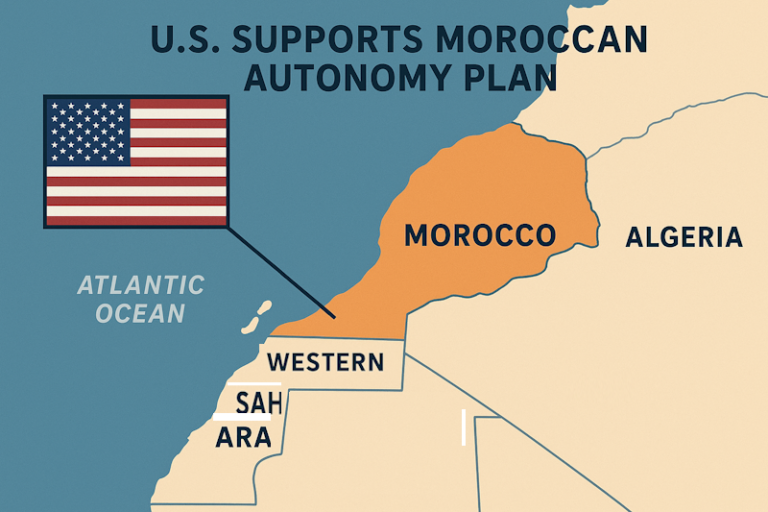
Under the guise of diplomatic efficiency, the United States, the « penholder » in the Security Council on the Western Sahara issue, is seeking to impose a predefined political solution that betrays the spirit of international law. By unequivocally supporting the Moroccan autonomy plan, Washington is marginalizing the Polisario Front, ignoring the voice of the Sahrawi people, and further removing the prospect of an inclusive regional peace.
A Diplomacy Under American Guardianship
The recent presentation by the United States of a draft resolution on Western Sahara has triggered a diplomatic shockwave. In its capacity as « penholder, » Washington holds the pen that drafts the final text submitted to the United Nations Security Council. But instead of assuming this role with neutrality, the United States has chosen the path of an imposed solution.
The American text consecrates the Moroccan autonomy plan of 2007 as « the only credible basis » for settling the conflict. It even sets an imperative deadline, limiting the renewal of MINURSO’s (United Nations Mission for the Referendum in Western Sahara) mandate to three months. This approach transforms a peace mission into a simple instrument of political validation, in disregard of the original UN mandate: to organize a referendum on self-determination.
Such an orientation breaks with the tradition of consensus and consultation that, despite its slowness, guaranteed the legitimacy of Security Council decisions. By dismissing the path of dialogue and marginalizing the Sahrawis themselves, Washington is sending a clear signal: the question of Western Sahara will no longer be arbitrated on the basis of law, but on the basis of the balance of power.
The Return of the Monopoly of Force
This unilateral approach reflects a return to the monopoly of force, long denounced by Russia, China, and several countries of the Global South. By imposing a solution without consultation, the United States is making the UN an instrument for executing its regional policy, rather than a forum for mediation.
For the Polisario Front, this initiative constitutes a « serious and unprecedented deviation. » Its representative in New York sees it as a violation of the international status of the territory and a challenge to the fundamental principle of self-determination enshrined in the UN Charter. Algeria, for its part, firmly rejects the draft, denouncing an attempt to circumvent the UN process and impose a solution contrary to historical Council resolutions.
The American position, however, benefits from the active support of France and the United Kingdom, who see this approach as a means of stabilizing the Maghreb according to a logic of Western alignment. But this « stability » looks more like a facade of peace, obtained by constraint rather than by dialogue.
A Multilateralism Emptied of Meaning
The risk extends beyond the Saharan issue alone. By confirming the primacy of geopolitical interests over the rights of peoples, the Security Council is transforming into a mere registry for the will of the great powers.
This deviation weakens the credibility of the UN, already severely tested by the paralysis in the face of the wars in Ukraine and Gaza. It fuels the feeling, in the Global South, that multilateralism is nothing more than a facade masking Western domination. American diplomacy, by arrogating the role of sole arbiter, confirms the views of those who denounce a UN with variable geometry: intransigent when it concerns others, complacent when it concerns Washington’s allies.
The Shadow of the « Unipolar World »
This evolution directly echoes the warnings of Vladimir Putin at the Munich Conference in 2007, when he denounced the danger of a world governed by a single center of power.
« The monopoly of force, without respect for international law, weakens global stability and breeds chaos, » the Russian president declared at the time. His words find a particular resonance today: the handling of the Saharan file illustrates precisely this deviation where the use of power replaces the search for compromise.
The refusal to recognize the diversity of political trajectories and the sovereignty of peoples is no longer the sole preserve of the post-Soviet period; it is now manifesting at the very heart of the UN system. Western Sahara thus becomes a laboratory of global imbalance, where two visions of the world clash: that of pluralism and that of control.
A Maghreb Held Hostage
The regional consequences of such an orientation are considerable. By marginalizing the role of Algeria, a central actor and concerned neighbor, the United States is helping to freeze all Maghreb rapprochement.
For years, Algiers has been advocating for a negotiated solution, based on international law and the recognition of the Sahrawi people as a stakeholder. This approach, faithful to the Algerian doctrine of non-alignment and non-interference, aims to preserve the stability of the Maghreb and promote a long-hindered regional integration.
However, by circumventing these principles, the American resolution risks exacerbating bilateral tensions, compromising regional cooperation, and fueling the divisions that already weaken the North African space.
This position distances peace from the Maghreb, even though peace should be the priority objective of sincere, direct, and inclusive negotiations between all concerned parties. By substituting diplomatic pressure for consultation, Washington is choosing a balance of power that could, in the long term, increase mistrust and polarization.
Algeria and the Global South Facing the Recomposition of the World Order
In this context, Algeria stands out as one of the last defenders of an approach based on international law and balanced multilateralism.
A non-permanent member of the Security Council since 2024, Algiers advocates for an expansion of African representation and for the reaffirmation of the sovereign role of peoples in the resolution of conflicts. Its refusal of any imposed solution in Western Sahara is consistent with this historical coherence: that of a country born from the struggle against domination and deeply attached to the principle of self-determination.
More broadly, the Global South observes with concern the deviation of an international system where major decisions are made without it. Faced with this observation, new poles are emerging: the expanded BRICS, where Russia, China, India, and several regional powers are redefining global economic and political balances.
This movement reflects a common aspiration for a multipolar world, based on mutual respect and cooperation among equals. In this sense, the handling of the Saharan file becomes a revealing factor: it highlights the inability of the UN system to adapt to the new reality of the 21st century.
For a Peace Based on Law, Not on Constraint
Western Sahara is not just a territory awaiting a political solution. It has become a symbol of the imbalance of the international system. By imposing a single model, by circumventing the principle of self-determination, and by restricting the role of regional actors, American diplomacy runs the risk of transforming a frozen conflict into a lasting fracture.
Yet, as the founding spirit of the United Nations recalled, peace cannot exist without justice. And justice, in this specific case, necessarily requires respect for the right of the Sahrawi people to freely decide their future.
No lasting stability can be built on the negation of peoples. What is at stake in Western Sahara goes beyond the borders of the Maghreb: it is the credibility of the international system and the possibility of a truly balanced world order.
The American management of the Saharan file reveals a crisis of confidence in multilateralism. By transforming the Security Council into a simple vector of power diplomacy, Washington runs the risk of eroding the most symbolic institution of global cooperation.
Between law and force, a choice must be made: either respect for the universal principles that founded the UN, or a drift towards an increasingly fragmented international order, where peoples, like that of Western Sahara, are nothing more than variables of adjustment.
#WesternSahara #Polisario #Morocco #UN #UnitedStates