Tags: Morocco, Algeria, United States, cannabis trafficking, Sahel, Haftar, terrorism,
Morocco, a narco-state supplying terrorist groups in the Sahel
By Larbi Ghazala
Between cannabis trafficking, psychotropic drugs transiting through Libya, and Sahelian criminal networks, Morocco positions itself as a central player in a criminal continuum aimed at weakening Algeria and destabilizing the entire region. And yet, Washington turns a blind eye to this strategic ally, in violation of its own anti-narcotics and anti-terrorism laws, allowing a system to prosper that indirectly funds jihadist groups.
Algeria is facing an asymmetric and sluggish war, conducted from its land borders through at least three neighboring countries. A war without a classic declaration or battlefield, but whose weapons are drugs, smuggling, transnational trafficking, and, in parallel, a continuous flood of fake news and recurring social media attacks. The « war objective, » however, is clear: to weaken both the economy and national security.
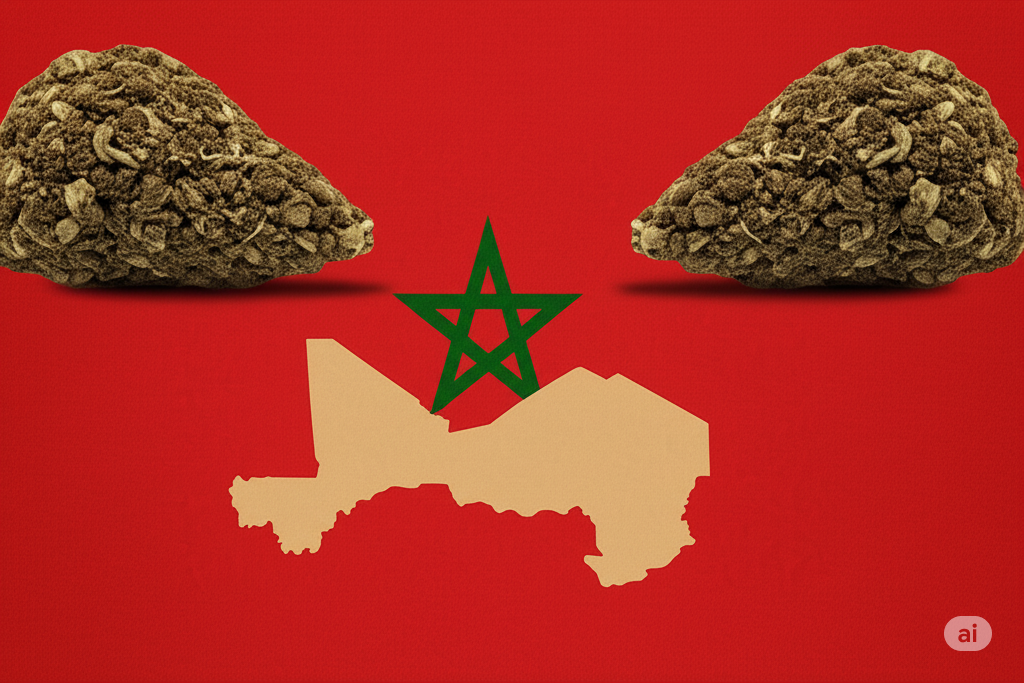
To the West, Morocco, the world’s leading producer of cannabis resin, continues to flood its neighbors to the North and East. Towards Europe, via Spain, but also towards Algeria, despite the record seizures made each year¹. To date, 80% of the world’s cannabis supply comes from the Cherifian Kingdom, but no international sanctions, directly or indirectly, target this producing country².
To the Southeast, around Tamanrasset, In Guezzam, or Illizi, Sahelian smugglers play a central logistical role. It’s not cannabis that transits in large quantities here, but cocaine from Latin America and psychotropic drugs that have landed in Libya, transported through the roads of Mali, Niger, and sometimes Mauritania. These flows strengthen the financial capabilities of the region’s terrorist groups, even as their primary source of income – ransoms from kidnappings – has gradually dried up³.
To the East, Libya remains a breach. The chaos that still reigns there, particularly in the areas held by Marshal Haftar and his clan, offers a gateway to cross-border criminal networks. Today the Libyan border is a point of passage for the psychotropic drugs that are flooding Algeria, but also for illegal emigration, along the same pipeline as certain drug trafficking⁴.
The trail of psychotropic drugs leads to India: officially shipped to Libya, these products are unloaded in the ports of eastern Libya. One can speak of a possible diversion after shipment, but the recurrence of the phenomenon is a cause for concern: how can one believe that the local authorities, on Haftar’s side, could be unaware of it? Their passivity raises the question of a tacit complicity in this asymmetric war being waged against Algeria.
A connivance that is part of the continuity of the close relations that the Haftar camp maintains with Morocco, both diplomatically and in terms of security. The relay of this influence materializes through Aguila Salah, president of the Libyan Assembly and a true straw man for Haftar, regularly put forward during the diplomatic « shows » organized in Rabat under the guise of national reconciliation. Behind the staging, the objective is clear: an open Moroccan entryism into Libya, with the recurring pretext of the Skhirat agreements, which have become the permanent alibi for the Cherifian agenda in this neighboring country.
Across these three fronts, a single common thread emerges: trafficking transformed into a hybrid weapon, funding the coffers of terrorism and establishing a deadly continuum where organized crime, economic destabilization, and security threats merge, not only against Algeria but also against the entire Sahel and, beyond, as far as West Africa.
But in the face of this diffuse offensive, Algeria seems to be reproducing an already known pattern: that of the 1990s, when it fought jihadist terrorism alone, isolated and deprived of any external support due to the international arms embargo. At the time, it was a constraint it suffered.
Today, it is a choice that raises questions: why maintain such a posture of isolation when bilateral, regional, or multilateral cooperation mechanisms exist and could lighten the burden of this asymmetric war? We can also question the apparent lack of a strategy regarding India, the country of origin for the psychotropic drugs that are flooding Algeria. No coordinated effort of diplomatic pressure, intelligence sharing, or financial flow monitoring seems to be formally expressed to curb this trafficking.
In a context where every link in the transnational chain is known, this passivity raises questions about the overall effectiveness of Algerian policy in the face of the asymmetric war it is suffering.
The comparison becomes even more striking when we observe Western postures. The United States, absorbed by the fight against fentanyl ravaging its society, continues to spare Morocco, the world’s leading cannabis producer, by ostentatiously turning a blind eye to the extent of its role in global trafficking. How can the United States turn a blind eye to an ally like Morocco, whose massive cannabis trafficking funds the coffers of jihadist terrorism in the Sahel?
And yet, for infinitely less than that, the Trump administration has sanctioned countries like Cuba, Panama, or Guinea-Bissau. The height of cynicism: at the same time, Rabat and its lobbying relays are striving to make the Polisario out to be a terrorist organization, by recycling fake news without the slightest proof.
A glaring American paradox: by sparing Morocco, Washington tramples on its own laws. The Kingpin Act (1999), aimed at sanctioning states involved in large-scale drug trafficking, has never been applied to the world’s leading cannabis producer. The Foreign Assistance Act (1961), which prohibits all aid to countries linked to trafficking or terrorism, is contradicted by the billions injected into military and security cooperation with Rabat.
The Patriot Act (2001), which mandates the tracking of financial flows that fuel terrorism, is also ignored, even though Moroccan cannabis revenues benefit the Makhzen as much as they do jihadist groups in the Sahel. The logic of the Trafficking Victims Protection Act (2000) is also flouted: the drug, psychotropic, and illegal migration networks form a tolerated transnational criminal continuum. Finally, post-9/11 counterterrorism, a pillar of American national security doctrines, is rendered meaningless: how can one genuinely fight the drug-terrorism link while turning a blind eye to Morocco, a true narco-state?
While Washington turns a blind eye, France also shows indulgence, particularly through the posture of its Interior Minister, Bruno Retaillaut, who proclaims making security his number one priority. Yet, he never mentions the origin of the cannabis that is poisoning the country and gangrening hundreds of neighborhoods, even though 80% of this drug comes from Morocco.
Announcements of security measures are regularly made, but France never criticizes or targets the Cherifian Kingdom. Conversely, Algeria regularly finds itself under fire from criticism, sometimes for much more marginal reasons. The fact that the extraditions of kingpins are done from Morocco, only when the Kingdom agrees to cooperate, implicitly confirms a troubling reality: the country also acts as a sanctified fallback base for these traffickers, facilitating the maintenance and circulation of criminal networks, as long as they spend money in Morocco, while allowing trafficking to Europe and Algeria to prosper.
By sparing Morocco, Paris and Washington preserve their immediate interests but close their eyes to a trade that feeds the terrorism they claim to be fighting. A cynical calculation where short-term gains take precedence over regional security and genuine solutions.
Par Larbi Ghazala
1) APS – Saisies record de cannabis et psychotropes en Algérie, 2023
2)Le Monde – Les États-Unis et le fentanyl, 2024
3) ADF Magazine – Trafic de drogue et terrorisme au Sahel, 2024
4) Voyage.gc.ca – Frontière libyenne et trafic, 2024
Source: Fil d’Algérie, 18 août 2025