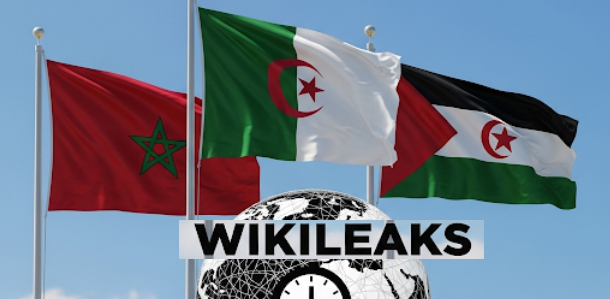
Tags: Western Sahara, Morocco, Front Polisario, Algeria, Wikileaks,
The conflict in Western Sahara, which began around forty years ago, is far from being resolved, according to telegrams obtained by WikiLeaks and revealed by Le Monde.
The conflict in Western Sahara is nowhere near a solution. The positions are too far apart, the rivalries too deep, and the mutual accusations too numerous between the two main protagonists: Morocco, which occupies Western Sahara in defiance of international law, and Algeria, without whose support the Polisario Front — which advocates a referendum to decide the fate of the former Spanish colony (independence or integration into Morocco) — would struggle to survive.
The Algerian Position, According to WikiLeaks
The Algerian stance is clearly expressed in a report from a 3.5-hour meeting held in May 2007 between Algerian President Abdelaziz Bouteflika and Frances Fragos Townsend, President Bush’s homeland security advisor — a document obtained by WikiLeaks and published by Le Monde.
“If I could solve the problem, I would,” says President Bouteflika. “But I cannot speak on behalf of the Sahrawis.” What’s needed, he says, is for Morocco and the Polisario to find a solution — and they can do so “with help from the Americans.”
On another occasion, Bouteflika confided that the French, due to their colonial history in the Maghreb, are incapable of playing a constructive role in the conflict. He added, “France has never really accepted Algerian independence,” and is trying to settle old scores with Algeria “by supporting Morocco.”
Bouteflika’s View of the King of Morocco
One year later, in February 2008, during a meeting with a U.S. diplomat, the tone shifted. The Algerian president denounced the “autonomy plan” proposed by Rabat as a substitute for a self-determination referendum. According to him, the plan offers nothing more than the illusion of autonomy. “Algerian provinces have more autonomy from Algiers than the Sahara has from Rabat,” Bouteflika argued.
As the conversation progressed, Bouteflika became more candid: he said he understood that Moroccans feel threatened by the idea of an independent Western Sahara, but claimed they were the primary cause of the situation. Instead of taking a more “elegant” approach by accepting an independence they could have “controlled” or “supervised,” they wanted an Anschluss, like Saddam Hussein with Kuwait.“If they hadn’t been so clumsy,” Bouteflika told his guest, “the Moroccans could have gotten what they wanted.”
In November 2009, in a meeting with the commander of U.S. Africa Command (AFRICOM), General William Ward, Bouteflika reiterated his opposition to the autonomy proposal.
“You can’t defend one principle for Palestine and a different one for Western Sahara,” he said.
His negative judgment of King Mohammed VI didn’t help matters. While Bouteflika expressed appreciation for the king’s brother, Prince Moulay Rachid — “We joked and had a pleasant conversation” during a meeting in Seville, Spain — he said the dynamic with King Mohammed VI was entirely different.
“He is not open and lacks experience,” Bouteflika complained, adding that no dialogue was possible between them.
The Harsh Judgments from the Moroccan Side
On the Moroccan side, mistrust was no less intense. King Mohammed VI rarely confided in American diplomats, but his inner circle did — and their assessments were severe.
In their view, the key to the Western Sahara issue is not in Tindouf (where the Polisario is based), but in Algiers.
During a meeting in June 2009 with Christopher Ross, the UN Secretary-General’s personal envoy, Moroccan officials said that power in Algeria remained in the hands of dogmatic generals, who were immobile and “petrified” by Rabat’s autonomy plan.
Should Morocco Wait for a New Generation in Algeria?
Some of the king’s advisers believed that waiting for a generational change in Algeria might help resolve the conflict. But Mohamed Yassine Mansouri, head of Morocco’s external intelligence services, disagreed.
In a memo from spring 2008, he expressed concern that a generational shift might complicate the situation even further:
“The generation that created the problem is best placed to resolve it,” he told his American counterpart.
In a June 2009 cable, Mansouri revealed that Rabat had asked French President Nicolas Sarkozy to ensure France was not seen as excessively pro-Moroccan on the Western Sahara issue, as had been the case in the past.
He also noted that the Bush administration had been perceived as “too favorable to Morocco.” To President Obama’s diplomatic team, the intelligence chief warned:
“It would not be wise to abandon your real friends in favor of oil.”
— Jean-Pierre Tuquoi
Source : Le Monde
Be the first to comment on "WikiLeaks: When Algerians and Moroccans Confide About Western Sahara"