In foreign affairs, an independent Western Sahara would support Third World independence movements and nonaligned goals, such as a new world economic order. Algeria's aid to the Polisario would likely give it considerable influence over a Western Saharan government, though relations could become strained if Algeria pressured the Polisario into unfavorable settlement terms. Libya's aid would also give it some influence, but this would be limited by a desire not to offend Algeria and distrust of Qadhafi.
Tags : Western Sahara, Front Polisario, Morocco, Mauritania, independence, autonomy,
An Intelligence Assessment
This report, dated March 1981, analyzes the potential for an independent or autonomous Western Saharan state. Information available as of December 31, 1980, was used in its preparation.
Key Judgments
The Polisario Front and Morocco are unlikely to achieve a decisive military victory in their conflict over the Western Sahara. The high costs of the war will probably lead both sides to consider a political settlement.
A compromise could lead to an independent Western Saharan state (fully or partially) or a union/federation with Mauritania. Mauritania previously administered the southern third of the territory and shares strong ethnic and cultural ties with the Polisario.
An independent Western Saharan state, regardless of its exact boundaries, would likely be a socialist Arab republic, modeled after « progressive » African and Arab states. The government would probably be dominated by the Arab nationalist faction of the Polisario Front, led by Secretary General Mohamed Abdel Aziz. Other factions, including Marxist and pro-Libyan elements, would be represented but less influential. Islam would be the official religion, but policies would likely be moderately religious, similar to other North African regimes.
Any independent Western Sahara would require substantial foreign aid for food and fuel imports. If it included the phosphate-rich Bu Craa region, it could eventually become self-sufficient with significant foreign economic, technical, and managerial support to repair and expand its war-damaged phosphate industry. A state without the phosphate region would not be economically viable, though iron ore exploitation and a fishing industry could gradually reduce its need for foreign aid.
The economic and political challenges facing an independent Western Sahara raise doubts about its political stability. Its survival would largely depend on its ability to secure enough foreign support to meet the population’s basic needs. Factionalism within the Polisario Front and inexperienced leadership could also lead to ongoing power struggles.
In foreign affairs, an independent Western Sahara would support Third World independence movements and nonaligned goals, such as a new world economic order. Algeria’s aid to the Polisario would likely give it considerable influence over a Western Saharan government, though relations could become strained if Algeria pressured the Polisario into unfavorable settlement terms. Libya’s aid would also give it some influence, but this would be limited by a desire not to offend Algeria and distrust of Qadhafi.
Due to its need for foreign support, an independent Western Sahara would likely try to balance its relations with Communist states and the West. It would probably establish relations with the United States and avoid close alignment with the USSR. Initially, however, its attitude toward Washington would be cool due to US military support for Morocco, and significant improvement would depend on US willingness to provide substantial economic and technical assistance.
If a Saharan state federated with Mauritania, the combined entity’s political and foreign policy would almost certainly reflect the « progressive » Arab nationalist views shared by the dominant Polisario faction and Mauritanian President Haidalla. Including Polisario representatives in the Mauritanian government would strengthen Haidalla against domestic critics but would also introduce another divisive issue into Mauritania’s fragile political system and planned return to civilian rule. A combined state without the Saharan phosphate deposits would be economically weaker than Mauritania, which is already heavily reliant on foreign aid.
Background
The Western Saharan conflict, like many Third World disputes, stems from decolonization. It is primarily a result of the conflict between Saharan nationalists’ desire for self-determination and Moroccan territorial claims, further complicated by the long-standing rivalry between Morocco and Algeria. Spain’s decision to grant independence to its Saharan colony in early 1976 led to a war between the Algerian- and Libyan-backed Polisario Front and Morocco (and until August 1979, Mauritania).
Morocco has historically claimed the former Spanish Sahara, as well as parts of Mauritania and Algeria, as its territory. While Morocco has dropped most other claims, it continues to insist that the northern part of the former Spanish colony is an integral part of Morocco. Mauritania also made claims to the Spanish Sahara in the 1960s. The UN General Assembly supported the right of the Saharan people to self-determination and urged Spain to organize a referendum under UN auspices, in consultation with Morocco, Mauritania, and other interested parties.
In August 1974, Spain announced a referendum for early 1975. However, Algeria, Morocco, and Mauritania feared a Spanish-organized referendum would either maintain Spanish control or create a Spanish puppet state. In October 1974, King Hassan called for direct talks between Spain, Morocco, and Mauritania, threatening « other methods » if Spain refused. The International Court of Justice ruled in October 1975 that while there were administrative and historical ties between Western Sahara and Morocco and Mauritania, these did not legitimize either country’s territorial claims.
King Hassan interpreted the Court’s ruling as a recognition of Morocco’s claim and launched an unarmed march of 350,000 civilians into the Spanish Sahara in November 1975 to « recover » the territory. Although the march was recalled after three days, it led to the Madrid tripartite agreement on November 14, 1975, which transferred the territory to Morocco and Mauritania by February 20, 1976. Moroccan and Mauritanian troops gradually occupied most of the territory, and the last Spanish troops left in mid-January 1976. The territory was placed under a regional administration set up by Spain, with the participation of Morocco and Mauritania, and the cooperation of the Jemaa (the Spanish Sahara General Assembly). Morocco claims that the Jemaa’s ratification of the tripartite agreement in February 1976 endorses Moroccan control and fulfills UN self-determination requirements.
Algeria initially supported Moroccan and Mauritanian efforts to end Spanish sovereignty, but condemned the Madrid agreement after Morocco’s invasion and backed the Polisario Front. While Algeria advocates self-determination, its main goal in supporting the Polisario is to weaken Morocco, its regional rival, and establish an independent Western Saharan state under Algerian influence. This would also give Algeria access to the Atlantic, facilitating its exploitation of iron ore deposits near Tindouf.
Algerian assistance enabled the Polisario Front to become a significant fighting force. After November 1975, the Polisario attacked Moroccan and Mauritanian forces from bases near Tindouf. In 1976 and 1977, the Front focused on Mauritania, its weaker opponent. Mauritania, unable to resist the guerrillas, lost the will to fight. In July 1978, military dissatisfaction with the war led to a coup, ending Mouktar Ould Daddah’s rule and bringing a government committed to ending Mauritania’s involvement. A Polisario-declared cease-fire after the coup was formalized by a peace treaty in August 1979.
After the peace treaty, the Front concentrated operations within Morocco. Morocco’s counterguerrilla capabilities declined until early 1980, but have since reversed due to improved airpower and tactical flexibility for field commanders.
The Polisario Front originated from the Saharan Liberation Front, formed in Rabat in 1968 by Saharan students with conservative Islamic views. A political demonstration in El Aaiun in June 1970, which was violently suppressed by Spanish police, reportedly inspired the group to form a guerrilla organization.
Resources
A Saharan state, whether encompassing the entire Western Sahara or a smaller non-phosphate-rich area, would require foreign support, at least initially. A state with phosphate deposits would be vulnerable to world price fluctuations for its sole export and heavily dependent on food and fuel imports. Foreign capital would be needed for imports and to repair and expand the phosphate industry. However, with its small population and potential phosphate earnings (around $140 million per year at 1980 prices), such a state could survive and develop.
A state without the phosphate-rich Bu Craa area would not be economically viable. However, foreign support might gradually decrease through the exploitation of iron ore reserves at Agracha and the development of a fishing industry. Significant progress in these areas would require substantial foreign investment.
If this truncated part of the Sahara were politically linked to Mauritania, the combined state would only be marginally better off. Approximately 80% of Mauritania’s population lives at one of the lowest standards of living globally. Mauritania’s iron ore industry has stagnated due to weak world demand and guerrilla damage. While Mauritania’s financial condition has improved since withdrawing from the war, its government heavily relies on foreign donors for budgetary support.
Around 80,000 Western Saharans live in Western Sahara, with possibly an equal number of refugees in Algeria or Mauritania. Additionally, about 10,000 Europeans live in El Aaiun, Semara, and Dakla. Drought and civil strife since the late 1960s have forced many Saharans to settle in towns or seek refuge in neighboring countries. Many refugees would likely return to Western Sahara after independence, mostly settling in the north. With a low literacy rate, an independent Western Sahara would face a critical shortage of technical and managerial skills.
The Western Saharan population, composed of Arab, Berber, and Negro peoples, is divided into various ethnic groups within a complex, stratified society. The most important groups are the Reguibat, Tekna, and Delim tribes. The Reguibat, Arabized Berbers speaking Hassaniya Arabic, are the largest group and form the core of the Polisario Front. They are nomadic herdsmen inhabiting the eastern half of the country and parts of Algeria, Morocco, and Mauritania. The Tekna, of mixed Arab and Berber origin, speak a Berber dialect and are seminomadic, inhabiting northern Western Sahara and southern Morocco. The Delim, more ethnically Arab than the Reguibat or Tekna, speak Hassaniya Arabic and were the backbone of Spanish native police and military forces in southeastern Western Sahara.
Western Sahara almost completely lacks basic infrastructure. Spain focused primarily on developing the region’s phosphate reserves rather than long-term economic development. Morocco’s main interest has been in establishing military control and enhancing its naval capabilities by upgrading port facilities at El Aaiun and Boujdour, though these efforts have been modest.
The desert climate makes constructing and maintaining modern transportation facilities extremely difficult. Roads, mostly along the coast, are hard to maintain due to shifting sand dunes. The country has no rail lines, although Morocco has reportedly considered building a rail link between Marrakech and El Aaiun.
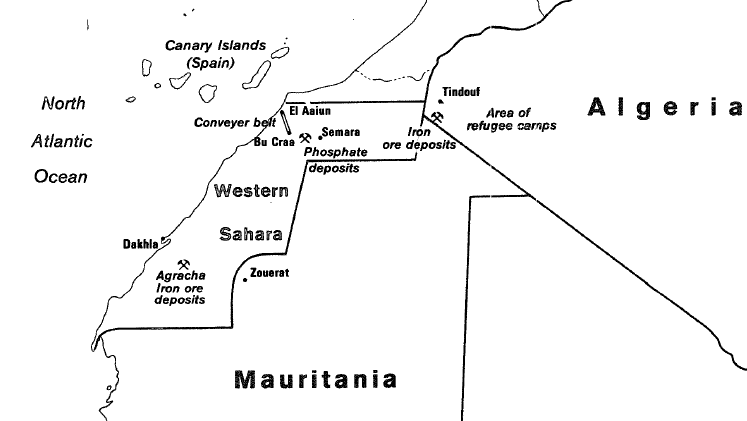
The rich Bu Craa phosphate deposit has estimated reserves of 2 billion tons. In the early 1970s, Spain invested over $500 million in mining, processing, and transportation facilities for Bu Craa. A 98-kilometer conveyor system was built instead of a railroad to transport phosphate from the mine to a treatment plant at El Aaiun on the coast.
The mine currently has an annual production capacity of 3 million tons, which could reach 10 million tons within five to 10 years with necessary investments. However, production at Bu Craa has been halted since 1978 due to Polisario guerrilla attacks damaging the conveyor system and powerlines. Restoration would require substantial foreign funds and expatriate technicians. Other phosphate deposits, though likely not as rich as Bu Craa, are either unevaluated or undeveloped.
If production can be restored to 3 million tons annually, it could generate around $140 million per year at 1980 phosphate prices ($47 per ton). This would be more than enough to cover necessary consumer imports, as well as equipment and technicians for the phosphate industry. While the area’s gross domestic product cannot be estimated, phosphate production and export alone could yield a per capita income of perhaps $1,000 to $1,500, ranking it among higher-income less developed countries.
The Sahara will remain dependent on imported foodstuffs regardless of the political outcome. Less than 1% of its land is arable, and barley is the only significant crop, dependent on sparse rainfall. Some small-scale irrigated farming exists east of El Aaiun in the Saguia el Hamra Valley, where cereals, fruits, and vegetables are grown. However, the nearly total desert wasteland of Western Sahara prevents anything more than subsistence farming and cattle herding by seminomadic people.
Fish are abundant along the 1,110-km coastline, but a Saharan state would struggle to protect these resources from foreign fishermen or raise capital to exploit them itself. Even Morocco currently cannot enforce fishing restrictions in its territorial waters. A viable fishing industry would require a modern fleet, patrol boats, and refrigeration and canning facilities, none of which could be financed internally. The Sahara could presumably generate substantial income by licensing foreign fishermen.
There are indications of other mineral wealth besides phosphates. Extensive high-quality iron ore deposits are near Tindouf, Algeria, close to the Saharan border, and preliminary exploration at Agracha in southern Spanish Sahara has been encouraging. A UN report also suggests the presence of titanium, vanadium, bauxite, copper, zinc, manganese, and uranium. Oil shale deposits north of the Moroccan border likely extend into Western Sahara, but there is no domestic energy production currently. Spain and Morocco encouraged oil exploration, and Morocco granted prospecting licenses to British Petroleum and Phillips Petroleum as late as 1978, but all efforts have been unsuccessful. Western Sahara will be entirely dependent on imported fuel for the foreseeable future.
Political Orientation
An independent state, whether comprising the entire Western Sahara or a smaller portion, would likely be modeled after « progressive » African and Arab states. The interim constitution adopted at a Polisario congress in September 1976 declared Arab socialism and social justice as its political objectives. While Islam was declared the state religion and source of laws, an independent Western Saharan government, similar to Algeria’s regime, would probably emphasize moderation in religious affairs and discourage extremism. The National Action Program, also adopted in 1976, highlighted the Arab and African characteristics of the Saharan people and called for a fair wealth distribution to eliminate rural-urban disparities. It also stressed family care as the societal nucleus, social and political equality between men and women, and compulsory, free education and access to medical facilities.
A Western Saharan state federated with Mauritania would likely resemble the current Mauritanian state: nominally an Islamic republic but under military council control. Given Mauritanian President Haidalla’s increased emphasis on Islamic justice, Islam would play a significantly more important role in a Mauritanian-Western Saharan federation than in a separate Western Saharan state. If Haidalla played a major role in the federated government, he would likely support policies favoring the Moorish sector of society at the expense of the black community.
The policies of an independent Western Sahara would almost certainly reflect the views of the Polisario Front leadership. However, limited information is available on the political affiliations and aspirations of key figures in the Front. Most Polisario leaders appear primarily focused on achieving independence and have been reluctant to discuss details of a new state’s administration and policies until the conflict with Morocco is won.
#WesternSahara #FrontPolisario #Morocco #Mauritania