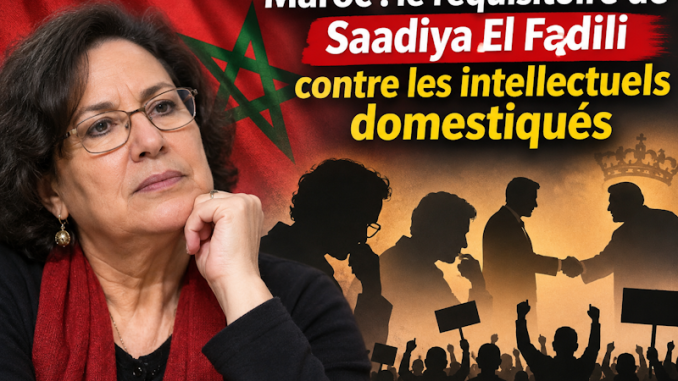
In an opinion piece entitled “Morocco: Our Intellectuals Between Struggle, Silence and Betrayal,” Saadiya El Fadili delivers a scathing criticism of what she considers the moral abdication of Morocco’s intellectual elites. She denounces the mechanisms of co-optation, repression and self-censorship that, in her view, turn some intellectuals into instruments of political legitimacy at the expense of the people’s rights and aspirations.
What is the responsibility of intellectuals in a society confronted with social injustice and restrictions on freedom? Can they remain silent when citizens’ rights are threatened? These are the central questions raised by Saadiya El Fadili in her critical examination of the relationship between Moroccan intellectuals, the people and the ruling establishment.
Intellectuals as the Living Conscience of the People
According to Saadiya El Fadili, being an intellectual is not about accumulating vast amounts of knowledge, possessing an exceptional memory or specializing in a particular academic discipline.
Rather, it involves the ability to analyze events logically, think critically and take appropriate positions at the right time.
In her view, intellectuals must embody the living conscience of the people, challenge established conventions and actively participate in public debates.
Instead of remaining confined to their ivory towers, they must engage with the everyday concerns of ordinary citizens and contribute to the defense of their rights.
When Silence Becomes Betrayal
El Fadili argues that intellectual neutrality in the face of injustice amounts to an abandonment of historical responsibility.
“If the intellectual’s silence on issues affecting the people is a betrayal, speaking on behalf of the authorities can only constitute high treason,” she writes.
The author considers the alignment of intellectuals with political power particularly damaging because their analytical abilities enable them to articulate popular demands, formulate coherent positions and help citizens defend their rights.
When intellectuals abandon the people and join the ruling establishment, she argues, society risks losing its moral compass and its ability to mobilize against injustice.
Seduction, Corruption and Repression: The Instruments of Power
Saadiya El Fadili identifies several mechanisms through which the authorities allegedly seek to neutralize critical voices.
The first involves attracting intellectuals through financial benefits, prestigious positions, privileges and social recognition. The objective, according to the author, is to turn them into mouthpieces for official narratives or, at the very least, to purchase their silence.
When such methods fail, she argues, the authorities may resort to other instruments, including restrictions, imprisonment, smear campaigns and the distortion of intellectuals’ opinions to undermine their credibility.
El Fadili also highlights the economic vulnerability of intellectuals, particularly those facing unemployment, financial insecurity and low wages.
Such circumstances, she suggests, can make them more susceptible to political co-optation.
The Policeman Inside the Intellectual’s Mind
One of the most striking passages in El Fadili’s commentary concerns self-censorship.
She describes a process through which sustained political pressure eventually leads intellectuals to internalize fear and surveillance.
The intellectual ends up installing an imaginary policeman inside their own mind, armed with a baton and responsible for drawing the red lines that must never be crossed.
The paradox, she notes, is that intellectuals may eventually discover that the restrictions they impose upon themselves are even more severe than those imposed by the authorities.
For El Fadili, this internalization of fear represents one of the most dangerous mechanisms for neutralizing critical thought.
Three Types of Moroccan Intellectuals
Saadiya El Fadili identifies three categories of intellectuals within Moroccan society:
- The silent intellectual, who withdraws from public affairs either out of fear of the consequences or because of the belief that meaningful change is impossible.
- The committed intellectual, who remains faithful to their principles and often pays the price of their engagement in isolation, sometimes amid the indifference of the very people they defend.
- The co-opted intellectual, who abandons former convictions in exchange for political influence, financial advantages and social prestige.
El Fadili directs particularly harsh criticism at the third category, expressing astonishment at how some intellectuals who previously experienced political repression have subsequently joined the establishment they once opposed.
In her assessment, these individuals have not merely changed sides but have discarded their former principles altogether, replacing them with what she describes as the cloak of power, money and prestige.
The Breakdown of Trust Between the People and Intellectual Elites
Beyond individual trajectories, El Fadili expresses concern about the broader social consequences of such political and moral reversals.
According to her analysis, repeated instances of intellectuals abandoning their principles have contributed to the erosion of public confidence in Morocco’s intellectual elites, including those who remain committed to independent and critical thinking.
Deprived of credible contemporary role models, some citizens may seek refuge in an idealized vision of the distant past or become vulnerable to extremist ideologies.
The author draws a connection between intellectual disengagement, the disorientation of younger generations and the emergence of radical behavior.
Her argument raises broader questions about the responsibility of intellectual elites in addressing social marginalization, political alienation and despair.
When the Makhzen Seeks Legitimacy Through Intellectuals
According to Saadiya El Fadili, the Moroccan ruling establishment, commonly referred to as the Makhzen, does not merely seek to silence its critics.
It also seeks, she argues, to exploit the intellectual and symbolic capital of prominent thinkers to strengthen its credibility and political legitimacy.
The co-optation of former opponents therefore carries political significance that extends beyond their personal interests.
El Fadili also suggests that the authorities may temporarily tolerate or encourage certain critical voices when doing so serves their strategic interests against competing ideological movements, before restricting those same voices once their objectives have been achieved.
A Wake-Up Call for Morocco’s Intellectual Conscience
Through her uncompromising commentary, Saadiya El Fadili raises a fundamental question: what remains of the intellectual’s mission once independence and critical thinking have been abandoned?
Her article constitutes an appeal to Morocco’s intellectual elites to assume their moral and historical responsibilities and preserve their independence in the face of political, economic and social pressures.
For El Fadili, the natural place of intellectuals is alongside ordinary citizens. Their historical mission is to illuminate the path for future generations rather than place their knowledge and abilities at the service of political power.
Between struggle, silence and betrayal, Saadiya El Fadili challenges Moroccan intellectuals to confront their responsibility for the present and future of their society.
Source: Saadiya El Fadili (السعدية الفضيلي), opinion piece entitled “Morocco: Our Intellectuals Between Struggle, Silence and Betrayal,” originally written in Arabic.
#Morocco #SaadiyaElFadili #Makhzen #MoroccanIntellectuals #MoroccanElites #IntellectualBetrayal #FreedomOfExpression #SelfCensorship #PoliticalRepression #CriticalThinking #IntellectualFreedom #PoliticalCooptation #HumanRights #SocialJustice #Corruption #MoroccanOpposition #IntellectualIndependence #MoroccanSociety #PoliticalPower #FreedomOfThought

Soyez le premier à commenter