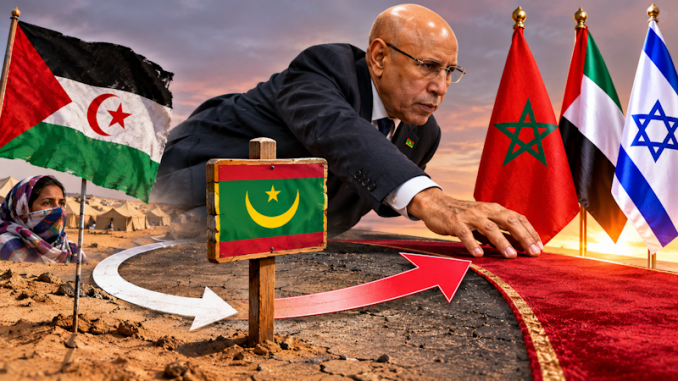
The recent remarks by Sidi Mohamed Ould Maham, former Mauritanian minister and former chairman of the ruling Al-Insaf party, raise questions about Nouakchott’s true intentions. Under the guise of military realism, his argument echoes several Moroccan positions: the marginalisation of the Polisario Front, the abandonment of armed struggle and the political consolidation of the military balance of power. He advocates mutual concessions but details only those demanded of the Sahrawis. Not a word about Morocco’s concessions.
This statement comes as Mauritania is already restricting the freedom of movement of Polisario forces in border areas, where certain crossings had previously been subject to coordination. These measures, coupled with the growing Emirati economic presence, lend credence to the shift in Mauritania’s “neutrality” under pressure from Abu Dhabi, to Rabat’s advantage.
An alignment openly assumed with Moroccan “realism”
In a post published on his Facebook page on 23 November 2026, Sidi Mohamed Ould Maham, who is also close to President Mohamed Ould Cheikh El Ghazouani, delivered an analysis that borrows heavily from Rabat’s theses. He states that five decades of war in Western Sahara have made “everyone a loser” and that Polisario fighters can, in practice, no longer carry out military operations in the strip stretching from Amgala to Guerguerat. According to him, any infiltration into this zone would require crossing Mauritanian territory, which Nouakchott would not allow “given its neutral position.”
The former minister argues that Moroccan air superiority, drones and the sand wall make any Polisario action in this region almost impossible, and that the solution can only be political, based on “painful concessions” on both sides. But as Amar Belani notes in his commentary, he specifies only the concessions demanded of the Sahrawis: transforming armed struggle into popular political action and accepting that their fate be decided “on a map that respects the realities of neighbourhood.” No mention of the concessions Morocco should make.
A neutrality under constraint
Officially, Mauritania has for decades maintained a position of “positive neutrality” in the Western Sahara conflict. But on the ground, this posture is changing. In recent months, Nouakchott has closed certain parts of its north-eastern border and strengthened control over informal crossing points once used for infiltration or smuggling. For some observers, this strict security approach above all reflects a change of position: Mauritania, now more attentive to keeping its distance from the parties to the conflict, is increasingly adopting an “active neutrality” that guarantees its stability and avoids any potential involvement.
This shift is also explained by economic factors. The United Arab Emirates, a major player in the Rabat-Abu Dhabi-Tel Aviv axis, have strengthened their influence in Mauritania through investments in ports and mines. In February 2025, the Mauritanian Minister of Economy discussed with his Emirati counterpart the status of the project portfolio financed by the Emirati government in the country, as well as investment opportunities in transport, agriculture and mining. Mauritania’s economic dependence on the Emirates is described as “heavy” by some sources, with Abu Dhabi being its main trading partner.
Lagouira: a bargaining chip?
Added to these considerations are the ambitions attributed to Mauritania regarding La Güera (Lagouira), whose geographical location is of major strategic and economic interest to Nouadhibou. Lagouira and Nouadhibou are located on the same peninsula of Cape Blanc, and the development of the former could create direct competition with the main economic hub of northern Mauritania. A port, cold storage facilities, fish-processing units and ship services at Lagouira could attract the same investors as Nouadhibou.
For Nouakchott, the challenge is to preserve the future of its port economy. Morocco’s maritime development in the south, with the Dakhla Atlantique project, gives weight to this perspective. In this logic, prospects of territorial, port-related and commercial gains weigh on Nouakchott’s repositioning. They shed light on what Mauritania hopes to obtain from Rabat in return for a shift in its purported “positive neutrality.”
An Israeli dimension in the background
This repositioning could also have an Israeli dimension. Efforts to restore diplomatic relations with Israel reportedly reached an advanced stage before the war in Gaza, and Nouakchott is reportedly now waiting for more favourable political circumstances to take that step. Mauritania broke off relations with Israel in 2010, after the Israeli operation in Gaza. In July 2025, reports indicated preparations for a restoration of diplomatic ties at a meeting at the White House, but Nouakchott denied any planned meeting between President Ghazouani and the Israeli Prime Minister. Normalisation remains deeply unpopular in Mauritania, where public opinion is historically pro-Palestinian.
Conclusion
Behind the rhetoric of “positive neutrality,” a strategic rapprochement with the Rabat-Abu Dhabi-Tel Aviv axis is thus gradually taking shape, with the Sahrawi question serving as one of its indicators. Sidi Mohamed Ould Maham’s remarks, in line with Moroccan positions, the restriction of Polisario movements at the borders, the Emirati economic presence and speculation about Lagouira all converge on the same reality: Nouakchott seems to be gradually abandoning its posture of strict neutrality for an assumed realism, at the risk of further weakening the Polisario Front’s position and redrawing regional balances to Rabat’s advantage.
#Mauritania #موريتانيا #WesternSahara #Polisario #Nouakchott #Rabat #AbouDhabi #TelAviv #Israël #Lagouira #Nouadhibou ##Maghreb #Sahel #Normalization

Soyez le premier à commenter