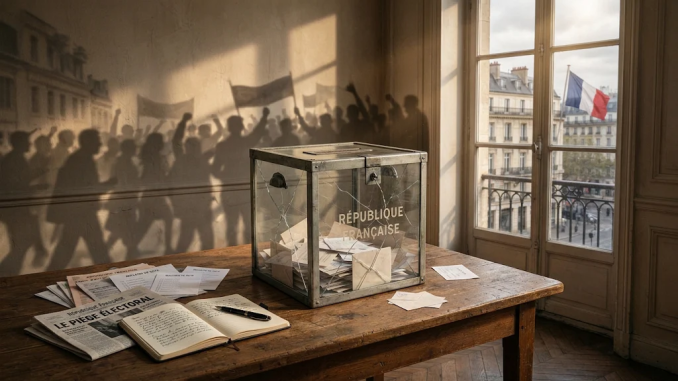
Kamel Daoud warns that France’s growing political polarisation bears disturbing similarities to Algeria’s electoral trauma in 1991. Between protest voting, abstention and the rejection of political extremes, French democracy could find itself facing a dangerous dilemma.
France is not Algeria in the 1990s. Yet certain political mechanisms, social divisions and electoral reflexes are beginning to evoke a scenario that Algerians remember painfully. In a column published on November 20, 2026, writer and journalist Kamel Daoud draws a parallel between France’s current political climate and the trauma caused by the interruption of Algeria’s electoral process in January 1992.
At the heart of his analysis lies the risk that voters, disillusioned with traditional political parties and unable to find a credible alternative, could become trapped between two radical political forces.
The trap of protest voting
Against a backdrop of growing political polarisation, some French voters appear increasingly tempted by protest voting. The objective is no longer necessarily to support a political programme, but rather to punish the incumbent government, even if that means bringing to power a political movement they themselves consider dangerous.
Kamel Daoud also warns against blank ballots and abstention, which he views as forms of political surrender. In France, blank ballots are counted separately but are not included in the total of valid votes cast. Consequently, they cannot directly influence the distribution of seats or determine the winner.
The author argues that this situation could strengthen political forces capable of mobilising their supporters most effectively, while disillusioned citizens risk marginalising themselves from the democratic process.
Algeria in 1991: a choice between two dead ends
The historical parallel dates back to Algeria’s legislative elections in December 1991. Following the political opening that came in the wake of the fall of the Berlin Wall, Algeria witnessed the emergence of dozens of political parties.
However, the electoral landscape quickly became dominated by a confrontation between the National Liberation Front (FLN), the former ruling single party, and the Islamic Salvation Front (FIS), an Islamist movement.
Democratic parties, often lacking financial resources, a nationwide presence and strong grassroots organisations, struggled to compete against these two dominant forces.
In the first round of legislative elections on December 26, 1991, the FIS secured a commanding majority of seats, while the FLN and other political formations were left far behind. The second round was cancelled following military intervention and the resignation of President Chadli Bendjedid in January 1992.
The interruption of the electoral process plunged Algeria into a decade of violence and civil war.
From political polarisation to violence
In the years that followed, Algeria’s political and intellectual elites became divided, notably between supporters of a policy of eradicating armed Islamist groups and advocates of dialogue and reconciliation.
This divide failed to prevent violence. Terrorist groups continued their attacks, while institutions, civil liberties and the rule of law were severely weakened.
For Kamel Daoud, this experience serves as a warning. He does not claim that France is necessarily heading towards civil war, but argues that political tensions, threats of violence and increasingly confrontational rhetoric are already contributing to a form of democratic paralysis.
France facing a leadership crisis
Daoud’s column portrays France as a country grappling with a leadership crisis, the rise of populism and political strategies increasingly driven by personal ambitions.
Threats to leave the country should certain candidates win, declarations of street resistance against others, and the proliferation of alarmist rhetoric illustrate, in the author’s view, a climate of distrust that goes beyond ordinary electoral debate.
The danger would be a deeply divided France: rural areas increasingly attracted to the far right, major cities more inclined towards the far left, and a section of the population retreating into fatalism or abstention.
Algeria’s trauma returns to haunt exiles
For Algerians who fled their country during the 1990s, France’s political tensions are reviving painful memories. Political violence, fear of chaos and the collapse of democratic prospects are ghosts that are beginning to resurface.
Daoud describes a form of « electoral karma »: democracies that people failed to preserve in their homeland may become, in their country of exile, a fragile inheritance they fear could once again disappear.
For some exiles, France represents far more than a geographical refuge. It embodies a political space, a promise of freedom and a democratic horizon.
A blank ballot will not save democracy
Kamel Daoud’s conclusion is unequivocal: despite disappointment and disillusionment, citizens must participate in the electoral process. Blank ballots, abstention and fleeing the country are not, in his view, solutions to the crisis.
The stakes go beyond the victory of a candidate or a political party. They concern France’s ability to withstand extremist forces, restore public trust and prevent political polarisation from turning into an irreversible fracture.
France is not condemned to repeat Algeria’s history. Yet the experience of 1991 serves as a reminder that a weakened democracy, confronted with an electoral choice perceived as unbearable, can descend into a crisis whose consequences extend far beyond the ballot box.
For an Algerian exile watching France become increasingly divided, the question is existential: if democracy yields to extremism, where will there still be a refuge?
#Algeria #France #Black_decade #terrorism #elections #white_vote

Soyez le premier à commenter