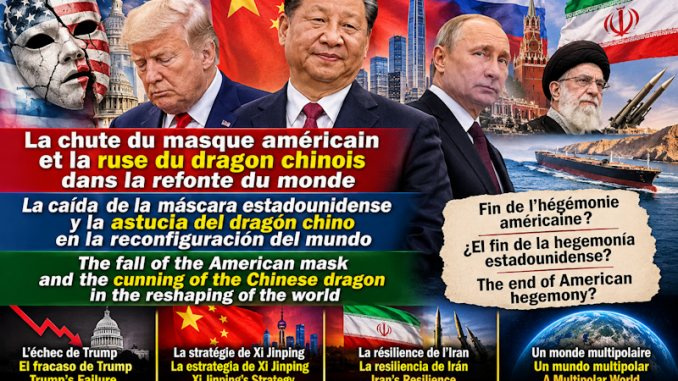
The historic trilateral summit that brought together Chinese President Xi Jinping and his American and Russian counterparts, Donald Trump and Vladimir Putin, in the Chinese city of Shenzhen was no mere diplomatic formality on the sidelines of the 2026 APEC forum. It was the official announcement of the end of the era of solitary American hegemony and the beginning of a new world order whose contours China is quietly and shrewdly shaping.
First: Trump’s predicament and his attempt to escape the quagmire of defeat
Donald Trump entered the Shenzhen summit burdened by unprecedented domestic and foreign setbacks, searching for a way out that would save face after his aggressive policy collided with a hard reality:
- Failure of a military solution in Iran: After months of military escalation and a naval blockade, Washington and Tel Aviv were unable to topple the Iranian regime or break its will, forcing Trump to sit down to negotiate from a position of necessity, not victory.
- Congressional losses and domestic pressure: The summit came in the wake of the Republican Party losing its majority in the midterm elections, which constrained Trump at home and pushed him to seek an “external deal” to market as a diplomatic achievement.
- The trust crisis and a record of reversals: Washington’s adversaries know that Trump’s record is full of volatility and failure to honor international commitments (such as his earlier withdrawal from nuclear and trade agreements). His verbal promises no longer fool the powers of the East, which now demand strict, tangible, on-the-ground guarantees.
Second: Xi Jinping’s cunning and his grip on the initiative
Chinese President Xi Jinping demonstrated clear strategic superiority in managing international balances and thwarting Trump’s maneuvers:
- The victory of symbolism and location: Choosing Shenzhen (China’s technology capital) to host the summit put Washington and Moscow in the position of guests at Beijing’s table, cementing China’s image as a “peacemaker and champion of multilateralism” in contrast to American protectionism and tariffs.
- Defeating the “reverse Kissinger triangle”: At the start of his term, Trump tried to break the Russian-Chinese alliance in order to isolate Beijing, but Xi Jinping’s cunning and the depth of the strategic partnership with Putin forced Trump to back down and sit with both at the same table.
- Refusing to trade away Iran: Beijing understands that Tehran is a cornerstone of energy security and of Asian connectivity projects, so China refused to bargain away Iran’s interests in exchange for temporary trade concessions from Washington.
Third: Iran’s battlefield victories and the collapse of the option of returning to war
The developments of 2026 proved that Iran achieved a strategic resilience that shattered the prestige of America’s and Israel’s “absolute deterrence”:
- Control of the global energy artery: Tehran succeeded in imposing a maritime deterrence equation in the Strait of Hormuz, making global oil supplies hostage to the lifting of the blockade imposed on it.
- Depletion of the Western arsenal: Any attempt by Trump to return to all-out war would amount to political and economic suicide, because defensive munitions stockpiles are depleted and any new shock would send energy prices soaring and topple global financial markets.
- Breaking Russia’s isolation: For Putin, merely sitting at the Shenzhen summit officially proclaimed the failure of years of Western sanctions and attempts at isolation, without Moscow making any free concessions on Ukraine.
Fourth: What do international reports and studies say about the reality of the crisis? (official documentation)
Reports issued by major international institutions and bodies in November 2026 confirm the scale of the economic and strategic catastrophe that drove Washington to the negotiating table:
- International Energy Agency (IEA) report – November 2026: The agency’s executive director warned that the Strait of Hormuz crisis resulting from the war on Iran is “the greatest threat to energy security in history,” explaining that global markets have lost about 2.8 billion barrels of supply since the conflict began, forcing countries to draw on their strategic reserves and incur heavy losses.
- International navigation observatory data (ShipFinder) – November 2026: It documented a sharp drop in active vessel traffic through the Gulf and the Strait of Hormuz of more than 20.3% from peak levels, with freight and maritime insurance costs doubling to record levels that weigh on global trade.
- Studies by the Wan Chai Institute for Strategic Research and Al-Majalla magazine – November 2026: Geopolitical analyses confirmed that Trump’s electoral setback and his inability to break the Russian-Chinese partnership or settle the war with Iran are the real motive behind convening the Shenzhen summit as a diplomatic “lifeline” for Washington’s administration.
- Estimates by the Al Jazeera Centre for Studies and the Stockholm International Peace Research Institute (SIPRI) – 2026: They explained that China’s refusal to enter nuclear arms control negotiations on Trump’s terms, and its insistence that the American and Russian arsenals be reduced first, entrench the world’s actual shift to a multipolar order in which the powers of the East control the rules of the game.
The mask has indeed fallen. The 2026 Shenzhen summit is not a triumph of Trump’s maneuvers but a death certificate for the era of American hegemony, and a clear declaration that the new world order is being written today with the rationality of Xi Jinping, the resilience of Iran, and the breaking of Russia’s isolation.
Driss Jirari
#ShenzhenSummit2026 #Shenzhen #APEC2026 #XiJinping #Trump #Putin #Iran #StraitOfHormuz #NewWorldOrder #Multipolarity #AmericanHegemony #China #Russia #BRICS #IEA #Geopolitics #EnergySecurity #PoliticalEconomy
Soyez le premier à commenter