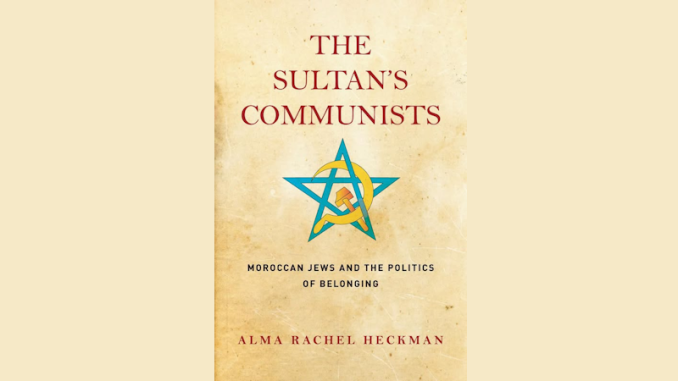
Starting with this series, I will attempt to introduce the chapters of this fascinating book, which sheds light on Moroccan Jews from a historical perspective while emphasizing the communist narrative of their relationship with Moroccan Jews—a narrative that official history has attempted to erase. It also highlights the paradox of using communist symbols to whitewash a repressive past, while promoting normalization with Israel and emphasizing their role in building bridges with Western international institutions, Moroccan Jews in the diaspora, and Jews in Palestine, in an attempt to reinforce a contested political legitimacy.
Enjoy reading!
The introduction to the book “The Sultan’s Communists: Moroccan Jewish Communists and the Struggle for National Liberation” offers a historical and political analysis of the experience of Jewish communists in Morocco during the twentieth century. It focuses on the paradox that led some of the most prominent left-wing opponents of the monarchy to become national figures celebrated by the Moroccan Makhzen.
1. Jewish Communists: From Rejection to Official Celebration
The introduction revolves around four key figures:
– Edmond Amran El Maleh: A writer, communist activist, and nationalist who participated in the struggle against colonialism, despite distancing himself from the dominant trends within the Jewish community. At the age of 60, he began writing several literary works, including An Unsteady Journey. In one of his statements, he declared that “Moroccan Jews do not engage in politics.” He also preferred not to translate his works into Hebrew, in order to prevent their exploitation by Zionism.
– Abraham Serfaty: A Jewish communist who embraced a “Jewish-Arab” identity to affirm his Moroccan belonging. He was arrested and tortured because of his opposition to the regime. His sister, Alfen Serfaty, was also subjected to torture as a systematic method of repression, which led to her death in 1974. The late Serfaty documented his own experience of torture. We will publish his account at a later date.
– Simon Levy: A former communist activist who later devoted his efforts to protecting and promoting Moroccan Jewish heritage, emphasizing the inseparable nature of Moroccan and Jewish identities.
– Sion Assidon: A communist activist and member of the leadership of Servir le peuple (Serve the People). He was arrested and attempted to escape from Kénitra Central Prison. Upon his release in 1984, he devoted all his political and activist efforts to supporting the Palestinian cause. He founded the Moroccan branch of the BDS movement, which seeks to boycott products from the Zionist entity and institutions associated with it. He also recently joined the Moroccan Front for Supporting Palestine and Opposing Normalization, before dying under mysterious circumstances in 2025.
These four figures shared three characteristics: Jewish identity, communist commitment, and Moroccan patriotism. They faced rejection from significant sections of the Jewish community and repression by colonial authorities and, subsequently, the independent Moroccan state. The paradox, however, lies in the fact that the Moroccan monarchy later rehabilitated them and celebrated them as symbols of Moroccan Jewish heritage and national tolerance.
2. Moroccan Jews Between Colonialism, Zionism, and Communism
The introduction emphasizes that Moroccan Jews did not constitute a homogeneous group, but rather were characterized by diversity in their origins, affiliations, and political orientations, including Amazigh, Arab, and Sephardic Jews.
Their population reached approximately 250,000 in 1945, before the community experienced mass emigration, particularly to Israel, during the 1950s and 1960s.
However, the book rejects reducing their history to emigration or portraying them merely as passive victims of colonialism, Zionism, and Arab nationalism. They actively participated in political life and joined various movements, including communism, Zionism, and pro-French political currents.
The author chooses to focus on those who remained in Morocco after independence, examining their political experiences and their questions regarding citizenship, belonging, and identity.
3. The Moroccan Communist Party as a Space for Jewish Patriotism
The Moroccan Communist Party (PCM) was an essential framework that enabled Jews to express their patriotism and participate in the struggle against French and Spanish colonialism.
Several factors contributed to the attraction of some Jews to the left:
- The rise of Nazism, fascism, and antisemitism.
- The Spanish Civil War and the spread of antifascist activism.
- The policies of the Vichy regime and the persecution of Jews.
- The declining confidence in French colonial authorities.
- Communism’s adoption of a broader conception of Moroccan citizenship that transcended religious affiliation.
Thus, for these activists, communism was not merely an ideological choice, but also a political means of asserting their national belonging and challenging conceptions that linked Moroccan identity exclusively to Arabness and Islam.
4. Moroccan Identity, Coexistence, and the Monarchy
The concept of “Moroccan identity” occupies a central place in the author’s analysis.
Jewish communists embraced a conception of national identity based on the idea that Jews were an integral part of the Moroccan nation. They rejected subordinating their national belonging to French or Spanish colonial policies, or to the Zionist project.
This conception was based on the reference to the precolonial period, portrayed as an era of coexistence between Muslims and Jews under the authority of the Sultan.
An important political contradiction emerges here: despite their opposition to Hassan II’s authoritarianism and policies, Jewish communists did not challenge the legitimacy of the monarchy itself. The Sultan, and later the King, continued to represent, in their eyes, a symbol of national unity and the protection of Jews.
Consequently, whether intentionally or not, they contributed to strengthening the monarchy’s legitimacy as an institution unifying Moroccans regardless of their affiliations.
5. The Paradox of the “Sultan’s Jews” and the Appropriation of Opposition
According to the author, the most significant turning point occurred at the end of the twentieth century, particularly with the death of Hassan II in 1999 and the accession of Mohammed VI to the throne.
Figures who had been imprisoned, tortured, or forced into exile because of their political opposition were subsequently honored by official institutions and presented as models of Moroccan tolerance and religious pluralism.
The author interprets this transformation as a political process from which the various parties involved benefited:
- Jewish opposition figures regained national and historical recognition.
- The monarchy strengthened its image as a protector of pluralism and Jewish heritage.
- The Moroccan state gained symbolic and international capital in the fields of human rights and religious tolerance.
Thus, the former Jewish opposition became an element of the Makhzen’s symbolic legitimacy, which explains the title of the book: “The Sultan’s Communists.”
6. The Broader Historical Context: Colonialism and the Global Israeli Alliance
The introduction goes back to the nineteenth century to explain that the formation of Moroccan Jewish identity was not independent of European imperial rivalries.
European consular protection contributed to the creation of multiple legal and political affiliations among some Moroccan Jews. The Alliance Israélite Universelle (AIU), founded in 1860, also played a major role in reshaping Jewish identity through the dissemination of French-language education.
Although the organization proclaimed the advancement of Jewish welfare as its objective, its educational project also conveyed a colonial conception of civilization and progress. It contributed to distancing certain segments of the Jewish population from their local languages and cultures, placing them in a position of tension between Moroccan society and European culture.
This helps explain the complexity of Moroccan Jewish belonging, as they sometimes found themselves caught between multiple identities without being fully accepted by any of them.
Analytical Conclusion
The central thesis of the introduction is that the experience of Moroccan Jewish communists reveals a dialectical relationship between communism, patriotism, Jewish identity, and the Moroccan monarchy.
Joining the Communist Party was not merely an expression of class struggle or international solidarity, but also a strategy for asserting Moroccan citizenship and resisting religious, national, and colonial exclusion.
The historical paradox, however, lies in the fact that this struggle for a pluralistic and democratic Morocco ultimately resulted, for its most prominent representatives, in their symbolic reintegration into the discourse of the monarchical state, which repurposed their life stories to highlight its tolerance and historical legitimacy.
From a critical Marxist perspective, the introduction raises a question that goes beyond the history of the Jewish minority: How can a state, even when it represses its opponents, subsequently appropriate the symbols of their resistance and transform their militant legacy into symbolic capital serving the reproduction of its own legitimacy?
In my view, this is one of the most important critical keys to reading the book: not merely examining the history of Jewish communists’ integration into the national movement, but analyzing the contradiction between their emancipatory project and the consequences of the Makhzen’s instrumentalization of their political memory.
Hassan Saib
#TheSultansCommunists #MoroccanJews #MoroccanCommunism #AbrahamSerfaty #EdmondAmranElMaleh #SionAssidon #SimonLevy #Makhzen #MoroccanMonarchy #MoroccanHistory #PoliticalRepression #HistoricalMemory #JewishMoroccanHeritage #Colonialism #HassanII #MohammedVI #PoliticalAppropriation

Soyez le premier à commenter