#Western_Sahara #Palestine #Gaza #Morocco #Israel #occupation
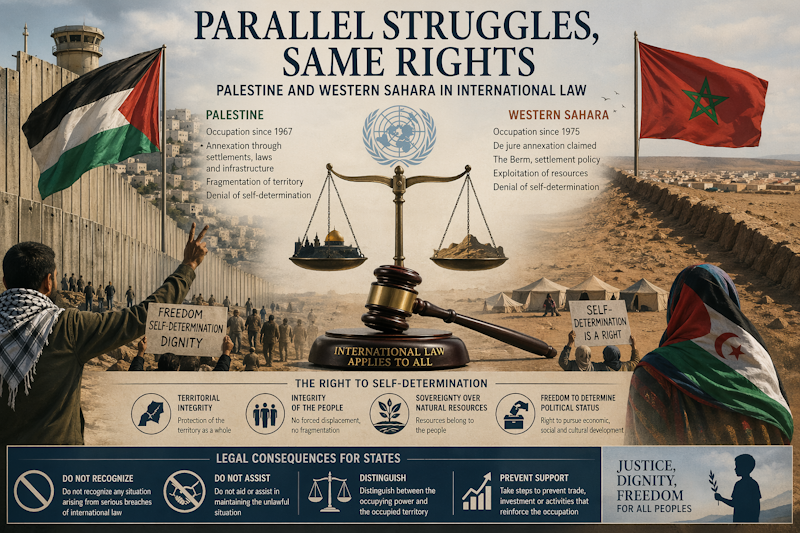
The cases of Palestine and Western Sahara, while historically and politically distinct, reveal striking commonalities when examined through the lens of international law. Both territories share a legacy of colonization followed by prolonged occupation, and in both instances, the occupying powers—Israel and Morocco—have been accused of violating fundamental principles of international law. Central among these are the prohibition on acquiring territory by force and the right of peoples to self-determination.
This article explores these shared elements, drawing particularly on the 2024 Advisory Opinion of the International Court of Justice (ICJ) concerning Israel’s policies in the Occupied Palestinian Territory (OPT), and applying its reasoning comparatively to Western Sahara.
Annexation and the Prohibition of Force
One of the key legal issues in both contexts is annexation. According to the ICJ, annexation occurs when an occupying power seeks to establish permanent control over a territory. This can take two forms: de jure annexation, through formal declarations of sovereignty, or de facto annexation, through actions that create irreversible facts on the ground.
In the Palestinian case, the ICJ concluded in 2024 that Israel’s long-term policies—such as settlement expansion, infrastructure development, exploitation of natural resources, and the extension of domestic law—amount to annexation. These measures, whether formal or not, aim at consolidating sovereignty over occupied land and therefore violate the prohibition on the use of force and the principle that territory cannot be acquired through war.
A comparable pattern emerges in Western Sahara. Following Spain’s withdrawal in 1975, Morocco asserted sovereignty over the territory despite an ICJ opinion rejecting its historical claims. Morocco’s position has consistently been that Western Sahara is an integral part of its national territory, reflecting a de jure annexation. This claim has been reinforced through concrete actions on the ground, including the construction of the “Berm” (a system of defensive walls), settlement policies, and the exploitation of natural resources.
In both cases, the occupying powers have pursued strategies—legal, political, and territorial—that consolidate control while disregarding international norms. Whether through formal declarations or incremental practices, these actions violate the same foundational rule: territory cannot be acquired by force.
The Right to Self-Determination
At the heart of both conflicts lies the denial of the right to self-determination. Recognized as a cornerstone of modern international law and a peremptory norm, this right guarantees that peoples may freely determine their political status and pursue their economic, social, and cultural development.
In Palestine, the ICJ has repeatedly affirmed this right. Its 2024 opinion highlights how Israeli policies undermine its core components: territorial integrity, unity of the population, sovereignty over natural resources, and political autonomy. The fragmentation of the West Bank, the separation of East Jerusalem, restrictions on movement, and the expansion of settlements have effectively prevented Palestinians from exercising meaningful self-determination.
Similarly, in Western Sahara, the Sahrawi people have long been recognized as entitled to self-determination. Yet this right has remained unfulfilled since Morocco’s occupation began in 1975. The division of the territory by the Berm, the displacement of large segments of the population into refugee camps in Algeria, and restrictions on political expression within the occupied territory all contribute to the erosion of this right.
In both contexts, natural resources also play a crucial role. The exploitation of resources by the occupying power—without the consent of the local population—violates the principle of permanent sovereignty over natural resources, further undermining self-determination.
Ultimately, the denial of self-determination in both Palestine and Western Sahara is not incidental but systemic. It is embedded in policies that fragment populations, restrict freedoms, and prioritize territorial control over the rights of the people concerned.
Legal Consequences for the International Community
The violations identified in both cases are not merely bilateral issues; they engage the responsibility of the entire international community. The rights at stake—particularly the prohibition of territorial acquisition by force and the right to self-determination—are obligations erga omnes, meaning they are owed to all states.
In its 2024 Advisory Opinion, the ICJ emphasized that all states have a duty not to recognize as lawful situations arising from serious breaches of international law. This includes refraining from diplomatic, economic, or trade relations that would legitimize or support the unlawful situation. States must also avoid providing aid or assistance that contributes to maintaining such conditions.
Although these conclusions were articulated in relation to Israel and the OPT, the same reasoning can be applied to Western Sahara. Morocco’s continued occupation, like Israel’s, results from and perpetuates violations of fundamental norms. Therefore, other states are equally obliged not to recognize Moroccan sovereignty over Western Sahara or to support activities that reinforce its control.
Conclusion
The cases of Palestine and Western Sahara illustrate how prolonged occupation and annexation can systematically undermine the right to self-determination. Despite their different historical trajectories, both situations reveal a common pattern: the persistence of territorial control in defiance of international law and the suppression of the political aspirations of the affected peoples.
By applying the legal reasoning of the ICJ across both contexts, it becomes clear that these are not isolated conflicts but part of a broader challenge to the international legal order. The responsibility does not rest solely with the occupying powers; it extends to all states, which are bound to uphold the principles at stake.
Ultimately, these cases force a critical reflection on the future of both the Palestinian and Sahrawi peoples. As long as occupation continues and the right to self-determination remains unrealized, the legal and moral questions they raise will persist at the center of international debate.