#UnitedStates #Israel #Iran #Maghreb #Algeria #Morocco #WesternSahara
Of the three Maghreb countries, Morocco stands most firmly on the side of the American and Israeli attacks against Iran. More surprising is the position of Algeria and Tunisia, which, breaking with their traditional stance, are seeking to curry favor with U.S. President Donald Trump.
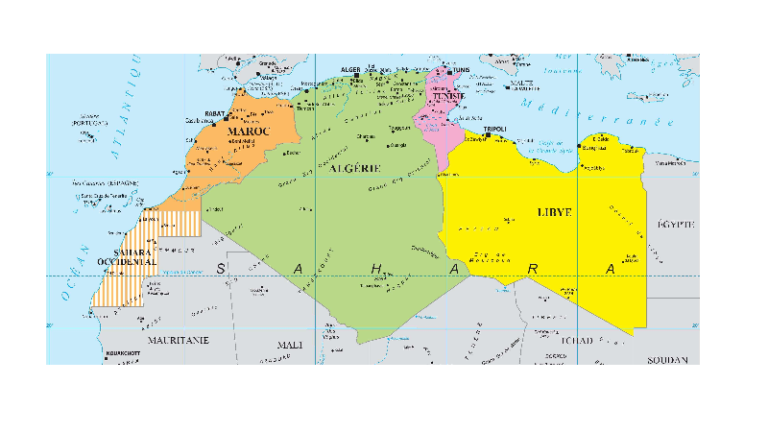
The war against Iran by Israel and the United States comes as negotiations on Western Sahara are underway under the auspices of the United States and its President Donald Trump. Washington, which has already recognized Morocco’s sovereignty over this territory, supports Rabat in this conflict. Beyond this initial constraint, Morocco’s position is conditioned by the strategic and economic partnership it has engaged in with the Trump administration on the one hand, but also with Israel since the normalization of bilateral relations in 2020.
These parameters explain why Rabat condemned Iranian missile fire against Gulf countries without expressing any reservation about the operation launched against Iran. Morocco’s attitude appears all the more coherent given that in June 2025, during the so-called « Twelve-Day War » which had already pitted Israel, then the United States, against Iran, Rabat did not issue any official statement.
A Longstanding Hostility Toward the Islamic Republic
Morocco’s hostility toward the Islamic Republic of Iran is longstanding. The first rupture between the two countries dates back to 1980, when Ayatollah Ruhollah Khomeini’s Iran recognized the independence movement of the Polisario Front. The second occurred in 2018, when Morocco broke off diplomatic relations with Iran, accusing it of supplying weapons to the Polisario Front. It is therefore not surprising that in March 2026, Moroccan political authorities described Iranian strikes on Gulf countries as « abject, » considering this aggression a « flagrant violation of the national sovereignty of these states, unacceptable for their security, and a direct threat to the stability of the region. »¹
This position is not shared by all Moroccan political groups. Some, such as the Party of Justice and Development (PJD) or the Federation of the Democratic Left (FGD), issued statements condemning the attack on Iran. Others called for action, such as the National Action Group for Palestine, which wanted to organize a sit-in to « denounce the American Zionist aggression against Iran. » However, gatherings were prevented by the authorities, as was the March 2 demonstration in Tetouan, organized by the Moroccan Front for Support of Palestine and Against Normalization with Israel, which brings together NGOs and political parties.
[Figure like] Salim al-Awa, who previously led the Moroccan Union of Religious Scholars (MUR), the true ideological matrix of the PJD, before presiding over the International Union of Muslim Scholars (IUMS), expressed an unambiguous position: « I am with Iran because they are Muslims and because they are oppressed. I am against the criminal aggressors and their allies. »² Even though they come from a paradoxical figure who has always defended the separation of political and religious power in a country where the king is Commander of the Faithful, these statements explicitly challenge Morocco’s official position in the anti-Iran camp.
Washington and Tel Aviv, the King’s Best Allies
But Rabat authorities pay little heed to these voices and embrace their stance of solidarity with the Gulf countries, with which they have strong ties. The benefits Morocco derives from its partnership with the United States and Israel explain its failure to condemn their bombings. In 2020, Donald Trump recognized Moroccan sovereignty over Western Sahara, paving the way for other states, such as Spain and France, to change their positions on this issue. It is also the Trump administration that is holding multiple meetings in 2026 to resolve the conflict by favoring the Moroccan option of autonomy under Moroccan sovereignty. It also supported Rabat during the historic January 31, 2026, vote on UN Security Council Resolution 2797, recognizing the Moroccan autonomy plan as the main reference for a solution to the conflict.
The counterpart to this support was Morocco’s signing of the Abraham Accords in 2020. Since then, the Trump administration has considered this country an actor for stability in the Maghreb and Africa, deemed worthy of reward. Morocco has been invited by Donald Trump to join the Peace Council and is also expected to participate in the international stabilization force in Gaza by sending soldiers on the ground.
These gestures toward Morocco are not limited to the Sahara issue: customs duties imposed on Maghreb countries are significantly lower for Morocco (10%), compared to 30% for Algeria and 25% for Tunisia. Another sign of distinction: Donald Trump is considering moving the headquarters of the United States Africa Command (AFRICOM) from Stuttgart to Rabat, which regularly hosts the multinational exercise African Lion, led by AFRICOM. These various gains, added to U.S. investments in Western Sahara³, cannot be jeopardized by the war against Iran.
Especially since Morocco is engaged in cooperation with Israel, as evidenced by the purchase of a Barak MX air defense system⁴, or the installation of a drone factory by the Israeli group BlueBird Aero Systems in the province of Benslimane, near Casablanca, which will enter service in April 2026. This dual partnership benefiting Morocco naturally places it in the anti-Iran camp. Faced with its detractors, Rabat does not hesitate to highlight its mediating role in serving the Palestinians, whether to release funds held by Israel for the Palestinian Authority, or to allow humanitarian aid to enter Gaza, with little success so far.
Algeria’s Diplomatic Reversal
If Morocco’s attitude is in line with the Abraham Accords, Algeria’s position confirms a break with its diplomatic principles and towards Iran. On March 1, Algerian Foreign Minister Ahmed Attaf expressed « Algeria’s total solidarity with the brotherly Arab countries that have been victims of military attacks. » However, Algiers did not deplore the death of Supreme Leader Ali Khamenei, whereas during the « Twelve-Day War, » it had reacted to Israeli bombings on Iranian soil by referring to « an aggression that would not have been possible without the impunity enjoyed by the aggressor. » On June 13, 2025, Algeria had also called on the UN Security Council to « fully assume its responsibility to protect international peace and security. »
Of course, this rupture with Tehran is not a first. There was a major period of coolness between the two countries from 1993 to 1999. At the time, Algiers accused Iran of supporting and financing armed Islamist groups during the context of the Black Decade and broke off relations with Tehran. But President Abdelaziz Bouteflika restored them in 2000. His Iranian counterparts Mohammad Khatami and Mahmoud Ahmadinejad had visited Algiers in 2004 and 2007. In 2026, Ali Khamenei was even expected there for an official visit, the date of which remained to be determined.
In recent years, Algeria had defended Iran’s right to acquire nuclear technology for peaceful purposes. Relations had returned to the level of closeness seen in 1980. During the Iran-Iraq war (1980-1988), Algiers had implemented its diplomacy by playing a major role in the release of the hostages from the U.S. embassy⁵, describing Iran as a « friendly third country. » Today, however, it does not condemn Israeli and American attacks.
The Gas Card?
Concerned with appeasing Donald Trump, Algeria believes that this war might perhaps offer it the opportunity to position itself as an economic actor. If the conflict in the Middle East persists, Algiers could benefit from its geographical proximity to Europe and be tempted to increase its oil production to export its oil to countries facing supply difficulties. According to information from Attaqa, a media outlet specializing in energy affairs, reported by Algérie 360 on March 2, 2026, the country could also position itself as a strategic gas alternative to meet growing demand in the context of the war in Iran and Ukraine. Its liquefied natural gas sales intended for the Old Continent could intensify, through the Trans-med and Medgaz gas pipelines that run under the Mediterranean. However, this prospect is debatable given the state of the gas and oil sector and its productivity.
Algiers also hopes to emerge from its diplomatic and strategic isolation, to which its doctrinal rigidity and inability to adapt to geopolitical changes have largely contributed. Since 2021, the country has fallen out with most of its neighbors: Morocco in 2021, Spain in 2022 over the recognition of Moroccan sovereignty over the Sahara, and France in 2024 for the same reason. The same year, Algeria was at odds with the United Arab Emirates⁶. On its southern flank, Algeria, traditionally influential in Sahel countries, has been rejected by the new governments emerging from military coups — Mali, Burkina Faso, and Niger — while these states have regrouped within the Alliance of Sahel States (AES), which is contributing to the reshaping of the region’s geopolitics. Finally, by gradually moving away from Russia, its historic partner, Algiers is struggling to exert influence in the Libyan conflict.
Aware of this isolation, the country has decided to move closer to Washington. This choice explains its non-participation in the vote on the UN Security Council resolution on Western Sahara autonomy, as well as its failure to condemn the bombings by Israel and the United States.
« Restrained » Diplomacy for Tunisia
As with Algiers, a change in posture towards Iran is the order of the day for Tunisia. President Kaïs Saïed had indeed moved closer to Tehran in the last two years. The two countries expressed their desire to engage in technological cooperation in the field of artificial intelligence (AI). The head of state also traveled to Tehran in May 2024 following the death of Iranian President Ibrahim Raïssi. During the « Twelve-Day War » against Iran, Tunis had denounced an attack on the sovereignty and security of the Islamic Republic, a flagrant violation of the UN Charter and all international laws and customs.
The statement from the Tunisian Ministry of Foreign Affairs on March 1, 2026, is radically different: it does not mention the assassination of leader Ali Khamenei, does not condemn either Israel or the United States — who are not even named — and merely calls for wisdom and a return to the negotiating table.
But unlike Algeria, which prohibits any protest demonstration against the bombings of Iran, Tunisian anger was able to be expressed in the center of the capital on the ninth day of the war. Participants were able to wave Iranian flags and Palestinian flags, as well as portraits of Ali Khamenei. On the other hand, Tunis gave guarantees to Washington by arresting seven members of the Global Sumud Flotilla campaign, which organized a boat departure to break the siege of Gaza in the summer of 2025, and was preparing to do so again in April 2026. They were accused of « money laundering » as part of the fundraising for the flotilla.
In a statement issued on March 17, several organizations, including the Tunisian Human Rights League, denounced an « abusive » use of these accusations in cases of a political nature. For these groups, the objective is not limited to preventing ships from departing for Gaza but aims more broadly to weaken the movement supporting the Palestinian cause. They also accuse the regime of « having been content for years with speeches and slogans on the rights of Palestinians, without taking concrete measures to support them. »
These arrests confirm the embarrassment of the Tunisian executive. In recent years, its diplomacy was somewhat modeled on Algerian diplomacy. Furthermore, the sovereignty championed by President Saïed does not allow him to fall out with Donald Trump, given that the Tunisian army is partially funded by the United States. Finally, the country benefits from financial aid from certain Gulf states, particularly Saudi Arabia. Suffice it to say that Carthage has little room for maneuver and no longer has the diplomatic and geopolitical space to assert any singularity. Like Algeria, Tunisia no longer has the means to engage in diplomatic dissent.
Khadija Mohsen-Finan
Khadija Mohsen Finan, Political scientist, lecturer (University of Paris 1), and associate researcher at the Sirice laboratory (Identities, International Relations, and Civilizations of Europe). Latest publications: *Tunisia: The Learning of Democracy 2011-2021* (Nouveau Monde, 2021), and (with Pierre Vermeren), Dissidents of the Maghreb (Belin, 2018). Member of the editorial board of Orient XXI.
Source : Orient XXI, March 24, 2026