This Saturday, February 28, the United States and Israel launched strikes on several Iranian cities, marking the beginning of a military operation that Jerusalem says has been in preparation for months. This escalation highlights the arsenal Tehran has at its disposal to retaliate: Shahed kamikaze drones, long-range missiles, and a submarine fleet.
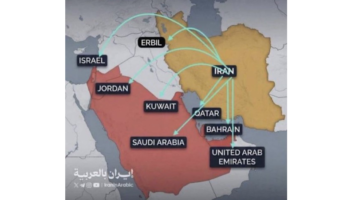
The operation, described as « massive and ongoing » by US President Donald Trump, began this weekend. Iran’s Islamic Revolutionary Guard Corps immediately retaliated, targeting six American military bases in Dubai, Bahrain, the United Arab Emirates, Qatar, Jordan, and Iraq, according to the Iranian news agency Fars. An « initial wave » of drones and missiles was also sent towards Israel, where several explosions were reported.
In an eight-minute statement, the White House chief said he wanted to « raze Iran’s missile industry and annihilate its army, » while acknowledging that « the lives of brave American heroes could be lost. »
Shahed Drones Worry Even the United States
Iranian drones pose a « credible threat » to American vessels deployed in the region, particularly aircraft carriers, Cameron Chell, head of the Canadian manufacturer Draganfly, a supplier to the US military, warned on Fox News in late January.
« If hundreds of drones are launched in a short period of time, some will almost certainly succeed, » he cautioned. Iran primarily uses its Shahed drones, « kamikaze » long-range attack aircraft designed for single use, equipped with a warhead. « Iran’s strength lies in these low-cost, high-volume systems, » the manufacturer added, emphasizing that « modern defense systems were not originally designed to counter this type of saturation attack. »
According to him, US surface vessels operating near Iranian coasts are « prime targets, » their slow speed and easy radar identification making them particularly vulnerable.
Missiles Capable of Striking 2,500 km Away
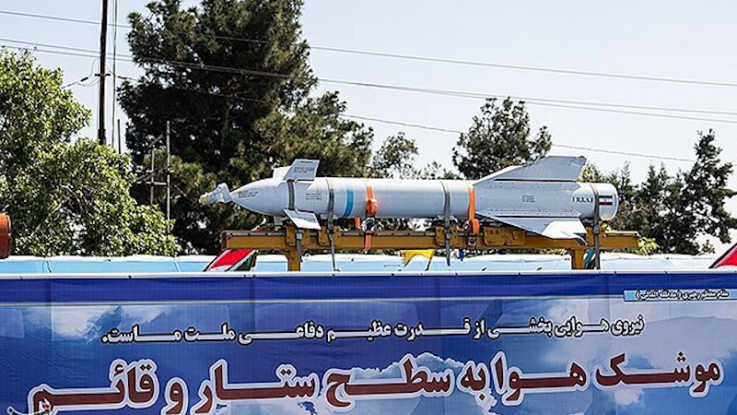
« Iran’s missile industry has achieved remarkable success, » Bernard Hourcade, a geographer and Iran specialist, told TV5MONDE. « Currently, Iranian missiles are capable of hitting a target 2,500 km away with very high precision. »
This capability is rooted in the country’s painful history. « Iran is one of the few countries in the world to have suffered a missile war in 1987-88 when it had no means to retaliate. Starting in the 1980s, Iranian military officials deemed it essential to develop a domestic missile industry capable of defending the country, » the expert detailed.
Iranian television regularly broadcasts images of mobile missile systems transported by trucks, stationed in large unidentified tunnels, demonstrating a strategy of dispersion and concealment.
Persistent Weaknesses in Air Defense
However, these missiles constitute « the only weapons they have, their only means of defense, » Bernard Hourcade noted, pointing out the weakness of their air defense and anti-missile systems. These shortcomings were exacerbated after the twelve-day war waged by Israel and the United States in June 2025.
The Israeli army announced this Saturday that it had struck « hundreds of Iranian military targets, including missile launchers in western Iran. »
« Over a six-month period, Iran was intensely aided by China, which supplied them with missiles, anti-missile and air defense systems, etc., » the geographer explained. « Despite this, Iran lacks the necessary radars and sufficiently developed air defense systems to protect a territory two and a half times the size of France. »
Submarines: Tehran’s Discreet Deterrent?
While the Iranian Navy is underdeveloped, it could leverage its submersibles. Tehran has 28 to 30 submarines, although none are nuclear-powered. The country has attempted to « expand and modernize its submarine fleet, but the project has been undermined by problems and delays, » according to the NGO Nuclear Threat Initiative (NTI).
Iran possesses three Kilo-class submarines, built in Russia, 74 meters long, capable of launching anti-ship cruise missiles and torpedoes. « Iran overhauled the three submarines in 2012 but has struggled to maintain them in service since, » the NGO tempered in a September 2025 report.
The country also has a fleet of 23 Ghadir-class mini-submarines, equipped with torpedoes and missiles, which could deter American aircraft carriers from approaching too close to Iranian shores.
The Threat of the Strait of Hormuz
Iran has threatened to block the strategic Strait of Hormuz, through which 1/5th of the world’s oil and gas passes. Tehran could use its submarines and ships to mine the strait. In July 2025, the Iranian military loaded naval mines onto vessels, a few days after the twelve-day war waged by Israel, though the mines were not actually deployed.
Face-off with the American Armada
Opposing them, the United States has deployed a significant force in the Middle East, including the aircraft carrier USS Abraham Lincoln and its escort off the Iranian coast, as well as the USS Gerald R. Ford, the world’s largest next-generation aircraft carrier, positioned in the Mediterranean off the coast of Israel with its flotilla.
Refueling and combat aircraft have been repositioned in recent weeks from the US Air Force base in the United Kingdom, and air defense systems have been shipped to countries in the region, according to CNN. US military units, originally scheduled to leave the region, have had their contracts extended.
Parallel to this military buildup, three rounds of talks took place between the United States and Iranian negotiators, the most recent being held this Thursday, February 26, in Geneva with no notable progress.
Several US intelligence reports provided to Donald Trump in recent weeks stated that « the Iranian government’s grip on power was at its weakest point since the overthrow of the Shah during the 1979 revolution, » according to the New York Times.
The Iranian regime, facing a popular revolt since December 28 that has been bloodily suppressed, appears to be staking its survival on this military confrontation with the United States and Israel.
#Iran #UnitedStates #Israel