According to the report, the situation was brought under control relatively quickly thanks to the measured response from authorities and the return of calm starting September 28. The presence of MINURSO reportedly helped to ease tensions.
Tags: #Western_Sahara #Morocco #Polisario_Front #MINURSO_report football match in #Dakhla
The facts
Violence erupted in Dakhla on the sidelines of a football match held on 25 September between the local team and Chabab El Mohammedia, resulting in the death of seven people — “two police officers, three Moroccans and two Sahrawi civilians,” according to this document leaked from MINURSO.
SUMMARY OF THE MINURSO CABLE ON THE EVENTS IN DAKHLA (3 OCT. 2011)
A MINURSO team traveled to Dakhla from 27 to 29 September 2011 to investigate deadly violence that occurred after a football match.
On 25 September, an altercation following a match lost 3–0 by the local team escalated into intercommunal violence between Moroccans and Sahrawis.
4×4 vehicles were used to ram into crowds. Toll: 7 dead (2 police officers, 3 Moroccan civilians, 2 Sahrawi civilians) and 20 injured. No gunfire was reported.
The police, initially understaffed, were slow to respond. The army intervened the following day to restore order.
Moroccan authorities attributed the events to criminals and unemployed youths, without political motives, potentially linked to local drug trafficking.
The UN team noted a community dimension (separate neighborhoods, forces positioned between them) but found no evidence of involvement by the Polisario Front.
The Polisario minimized the incident (declaring one death), which the cable attributes to a communication strategy linked to international developments.
Morocco reacted with restraint and professionalism, contrasting with its criticized handling of the Gdim Izik camp in 2010. Authorities demonstrated unusual transparency, granting MINURSO full access and communicating rapidly via the MAP news agency.
Conclusion: The situation was brought under control relatively quickly thanks to the measured response of the authorities and the return to calm starting on 28 September. The presence of MINURSO may have helped ease tensions.
U.S. Embassy Intervention
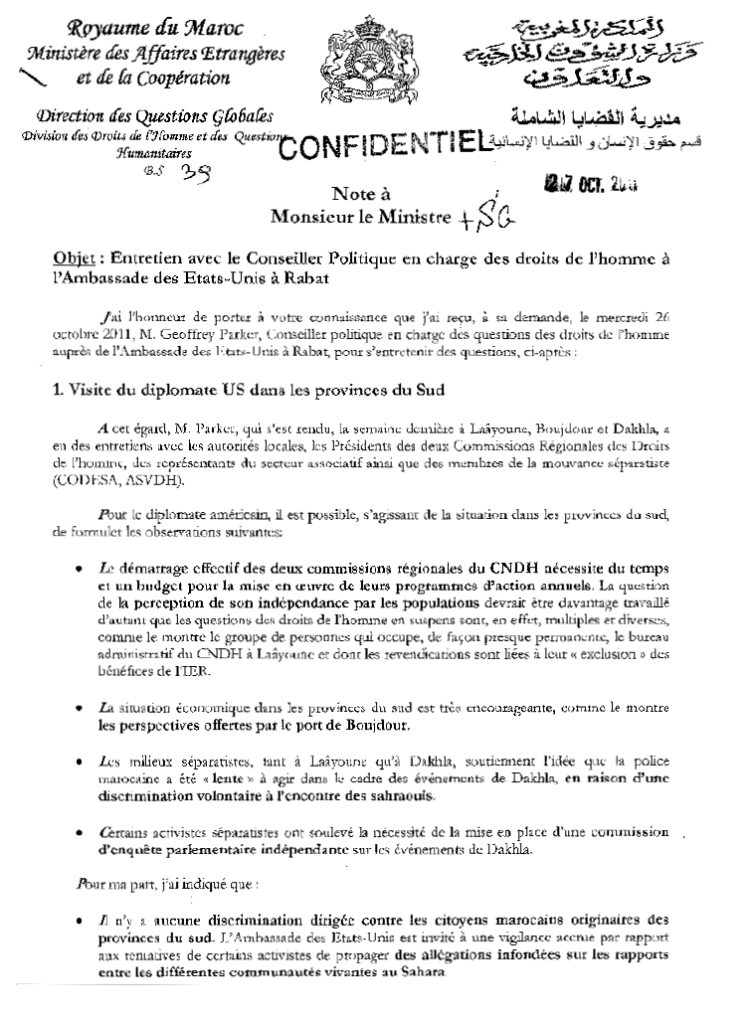
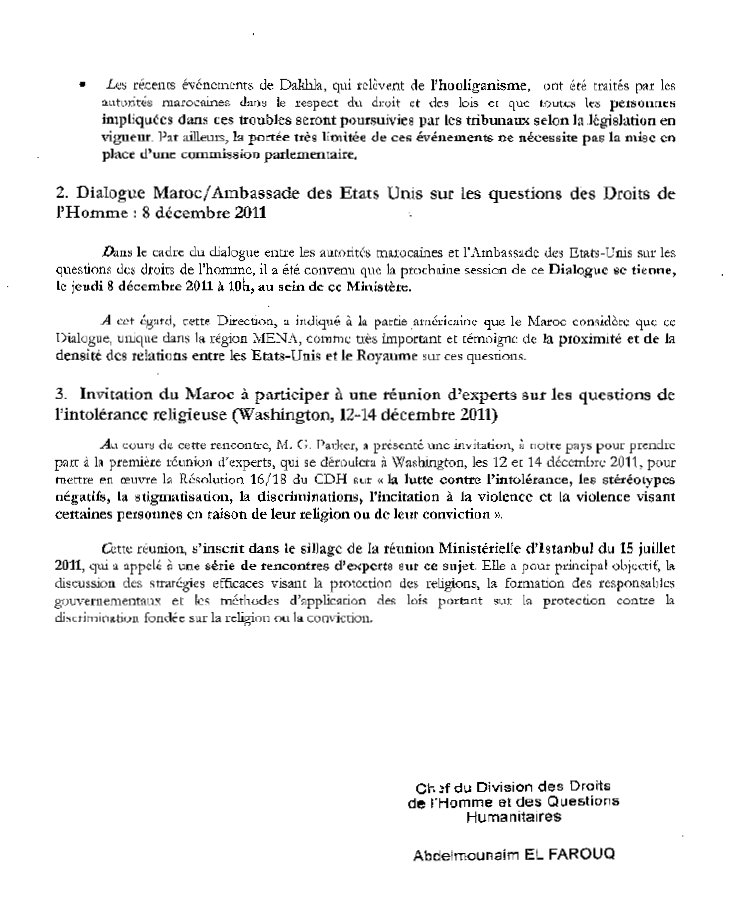
On 26 October 2011, the Head of the Human Rights and Humanitarian Affairs Division met with Mr. Geoffrey Parker, Political Counselor at the U.S. Embassy in Rabat, to discuss three main points:
Visit of the American diplomat to the Southern Provinces:
Mr. Parker shared observations from his visit to Laâyoune, Boujdour, and Dakhla. He noted the need for time and budget to launch the Regional Human Rights Commissions (CNDH), encouragement regarding the economic situation, and allegations from separatist circles concerning alleged discrimination and slow police response during the Dakhla events.
The Moroccan side firmly rejected any accusations of discrimination, described the Dakhla events as acts of hooliganism handled in accordance with the law, and deemed the creation of a parliamentary inquiry commission unnecessary.
It was agreed that the next session of this bilateral dialogue, described as “unique in the MENA region,” would be held on 8 December 2011 at the Ministry.
The United States invited Morocco to participate in an experts’ meeting from 12–14 December 2011 to implement Human Rights Council Resolution 16/18, aimed at combating religious intolerance and discrimination.
In brief: This note reports on an exchange of views with U.S. diplomacy on the situation in Western Sahara (rejection of discrimination allegations, legal handling of incidents), confirms the upcoming structured bilateral dialogue on human rights, and mentions an invitation to an international conference on religious freedom.
Read also : Morocco Leaks : Meeting between Head of MINURSO and El Bouhali (stolen document*)
Text of the note
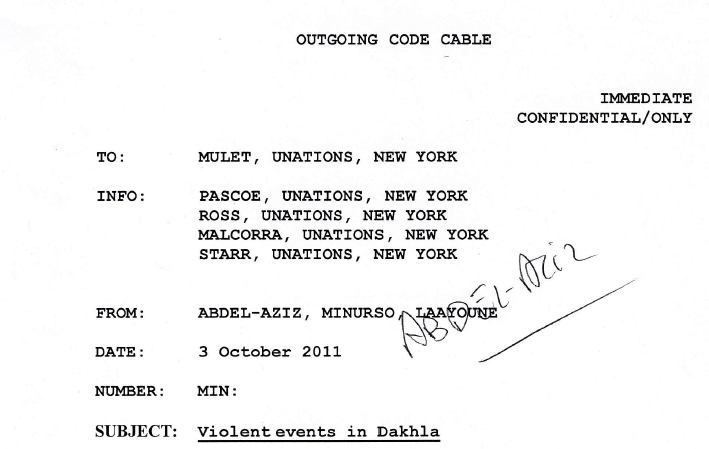
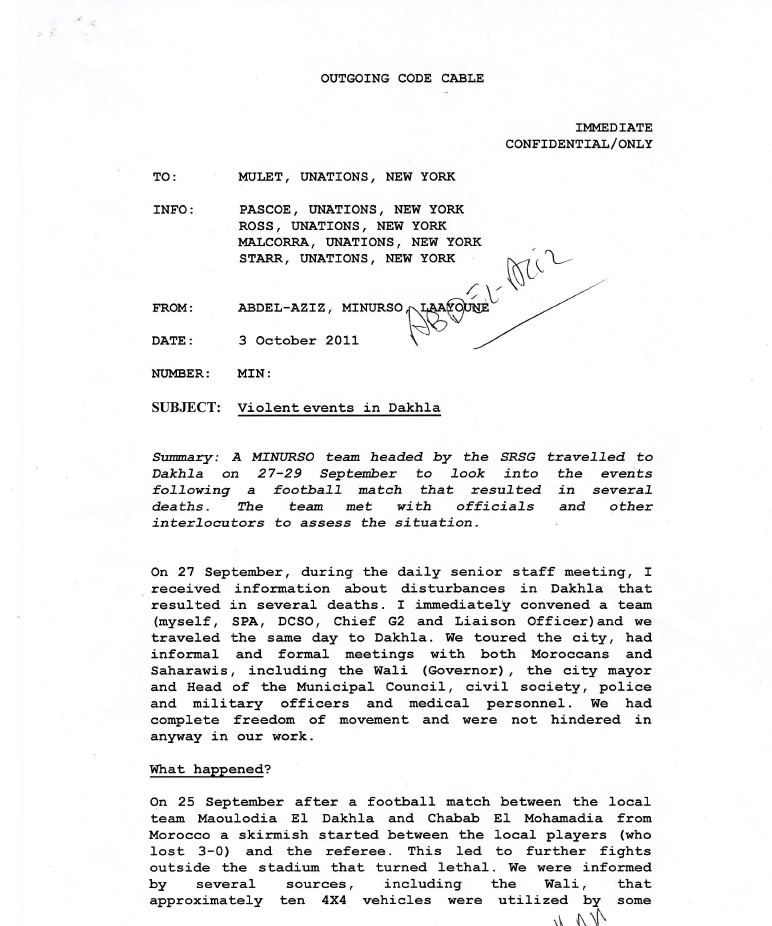
FULL TEXT OF THE MINURSO CABLE (3 OCTOBER 2011)
Outgoing Code Cable
To: MULET, UNATIONS, NEW YORK Info: PASCOE, ROSS, MALCORRA, STARR, UNATIONS, NEW YORK From: ABDEL-AZIZ, MINURSO Date: 3 October 2011 Number: MIN: Subject: Violent events in Dakhla
Summary
A MINURSO team headed by the SRSG traveled to Dakhla on 27-29 September to look into the events following a football match that resulted in several deaths. The team met with officials and other interlocutors to assess the situation.
The Events
On 27 September, during the daily senior staff meeting, I received information about disturbances in Dakhla that resulted in several deaths. I immediately convened a team (myself, SPA, DCSO, Chief G2 and Liaison Officer) and we traveled the same day to Dakhla. We toured the city, had informal and formal meetings with both Moroccans and Saharawis, including the Wali (Governor), the city mayor and Head of the Municipal Council, civil society, police and military officers and medical personnel. We had complete freedom of movement and were not hindered in any way in our work.
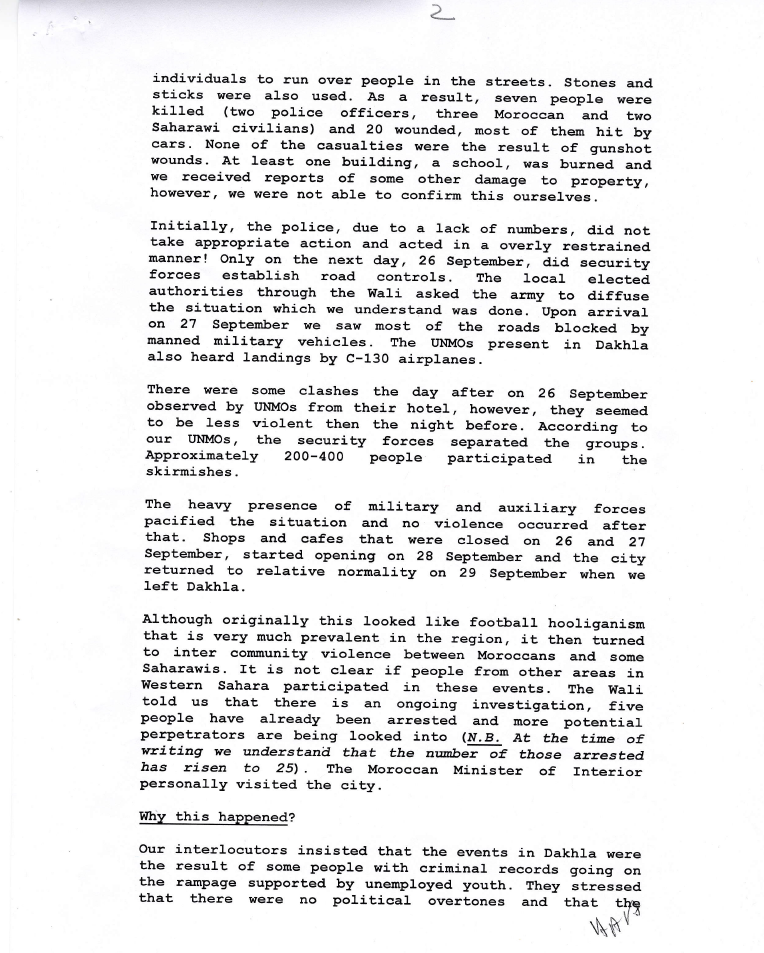
What happened? On 25 September, after a football match between the local team Maoulodia El Dakhla and Chabab El Mohamadia from Morocco, a skirmish started between the local players (who lost 3-0) and the referee. This led to further fights outside the stadium that turned lethal. We were informed by several sources, including the Wali, that approximately ten 4X4 vehicles were utilized by some individuals to run over people in the streets. Stones and sticks were also used.
As a result, seven people were killed (two police officers, three Moroccan and two Saharawi civilians) and 20 wounded, most of them hit by cars. None of the casualties were the result of gunshot wounds. At least one building, a school, was burned and we received reports of some other damage to property, however, we were not able to confirm this ourselves.
Initially, the police, due to a lack of numbers, did not take appropriate action and acted in an overly restrained manner. Only on the next day, 26 September, did security forces establish road controls. The local elected authorities through the Wali asked the army to diffuse the situation, which we understand was done. Upon arrival on 27 September, we saw most of the roads blocked by manned military vehicles. The UNMOs present in Dakhla also heard landings by C-130 airplanes.
There were some clashes the day after on 26 September observed by UNMOs from their hotel; however, they seemed to be less violent than the night before. According to our UNMOs, the security forces separated the groups. Approximately 200-400 people participated in the skirmishes. The heavy presence of military and auxiliary forces pacified the situation and no violence occurred after that. Shops and cafes that were closed on 26 and 27 September started opening on 28 September, and the city returned to relative normality on 29 September when we left Dakhla.
Although originally this looked like football hooliganism that is very much prevalent in the region, it then turned to inter-community violence between Moroccans and some Saharawis. It is not clear if people from other areas in Western Sahara participated in these events. The Wali told us that there is an ongoing investigation; five people have already been arrested and more potential perpetrators are being looked into (N.B. At the time of writing we understand that the number of those arrested has risen to 25). The Moroccan Minister of Interior personally visited the city.
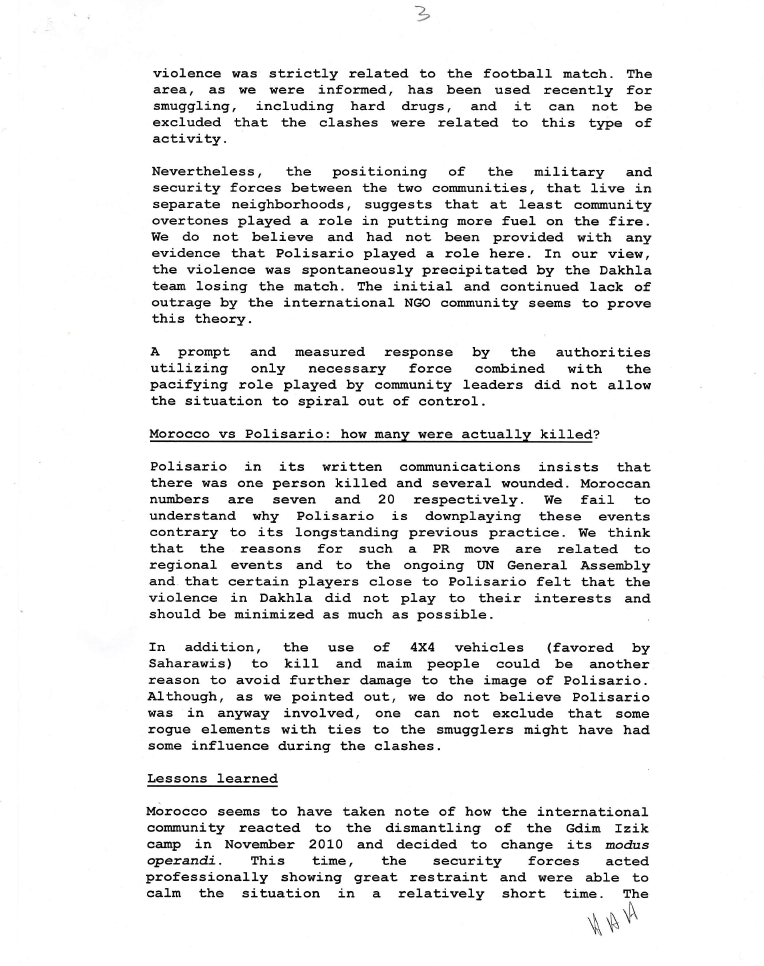
Why this happened? Our interlocutors insisted that the events in Dakhla were the result of some people with criminal records going on the rampage supported by unemployed youth. They stressed that there were no political overtones and that the violence was strictly related to the football match. The area, as we were informed, has been used recently for smuggling, including hard drugs, and it cannot be excluded that the clashes were related to this type of activity.
Nevertheless, the positioning of the military and security forces between the two communities, that live in separate neighborhoods, suggests that at least community overtones played a role in putting more fuel on the fire. We do not believe and had not been provided with any evidence that Polisario played a role here. In our view, the violence was spontaneously precipitated by the Dakhla team losing the match. The initial and continued lack of outrage by the international NGO community seems to prove this theory. A prompt and measured response by the authorities utilizing only necessary force combined with the pacifying role played by community leaders did not allow the situation to spiral out of control.
Casualty Reports: Morocco vs. Polisario
Polisario in its written communications insists that there was one person killed and several wounded. Moroccan numbers are seven and 20 respectively. We fail to understand why Polisario is downplaying these events contrary to its longstanding previous practice. We think that the reasons for such a PR move are related to regional events and to the ongoing UN General Assembly and that certain players close to Polisario felt that the violence in Dakhla did not play to their interests and should be minimized as much as possible. In addition, the use of 4X4 vehicles (favored by Saharawis) to kill and maim people could be another reason to avoid further damage to the image of Polisario. Although we do not believe Polisario was in anyway involved, one cannot exclude that some rogue elements with ties to the smugglers might have had some influence during the clashes.
Lessons Learned
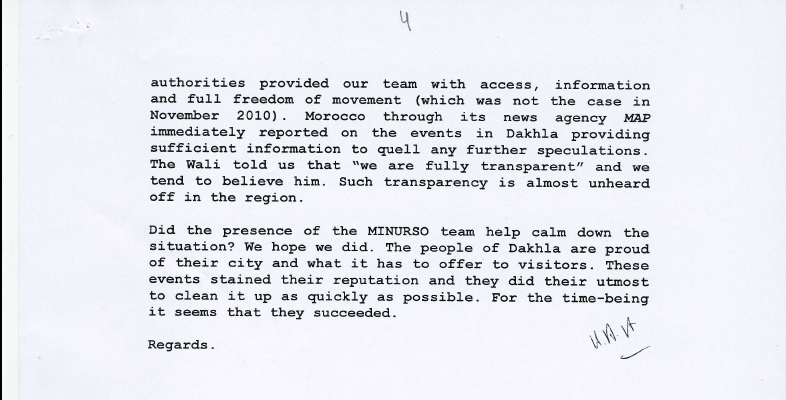
Morocco seems to have taken note of how the international community reacted to the dismantling of the Gdim Izik camp in November 2010 and decided to change its modus operandi. This time, the security forces acted professionally showing great restraint and were able to calm the situation in a relatively short time. The authorities provided our team with access, information, and full freedom of movement (which was not the case in November 2010). Morocco through its news agency MAP immediately reported on the events in Dakhla providing sufficient information to quell any further speculations. The Wali told us that « we are fully transparent » and we tend to believe him. Such transparency is almost unheard of in the region.
Did the presence of the MINURSO team help calm down the situation? We hope we did. The people of Dakhla are proud of their city and what it has to offer to visitors. These events stained their reputation and they did their utmost to clean it up as quickly as possible. For the time-being it seems that they succeeded.
Regards
Meeting with the Political Counselor in charge of Human Rights at the U.S. Embassy in Rabat