
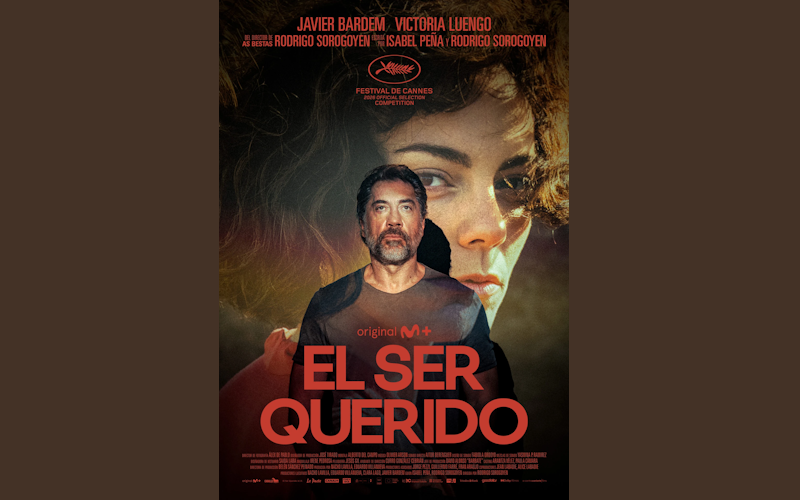
79th Cannes Film Festival 2026 / L’Être aimé by Rodrigo Sorogoyen
The Western Sahara, as a political mirror of the intimate drama
In a memorable scene, where he makes everyone present re-enact the meal, something shifts: the filmmaker becomes a filmmaker again. And Bardem becomes Bardem again.
The opening scene of L’Être aimé is based on an extremely simple situation: a lunch between a father (Javier Bardem) and his daughter (Vicky Luengo) who haven’t seen each other for thirteen years. He is a director who decides to return to Spain, despite the glory he has achieved in Hollywood. The scene lasts about twenty minutes, in a very long sequence shot that unfolds like an emotional and aesthetic cinematic manifesto.
Sorogoyen skillfully concentrates in it everything that will fuel the narrative: distance, guilt, the unspoken, and therefore the impossibility of building a family relationship.
The Iberian maestro takes a risk, potentially provoking a dramatic explosion. Just when the situation verges on implosion. The father tries to occupy the space with an ambiguous gentleness; the daughter resists, maintaining a certain distance. The whole scene functions as a negotiation of affective territory.
Sorogoyen uses certain tools he had already employed in his thrillers: a mix of continuous tension, long takes, and off-screen space.
The device chosen by the filmmaker is perversely rare, based on a mental tripod that prevents the spectator from breathing through editing. This forces the actors to experience the real time of the uncomfortable exchange.
An operation of psychological attrition
Sorogoyen asked Bardem and Luengo to practically not see each other before the shoot. Then, just before the restaurant sequence, Javier Bardem decided to call Vicky Luengo « in character as the father. » This trick creates a real discomfort, a feeling of strangeness. The scene doesn’t just represent distance; it concretely produces it. The framing is very close to the faces, while often maintaining a slight distance. Silence then becomes dramatic, to the point where one could almost hear the void between the two protagonists. The actors’ preparation apparently contributed to the scene’s accuracy.
At the beginning of the film, then, the contrast between the two performances was evident. Bardem acting in an understated mode, almost in a low voice, which is unusual for him. Meanwhile, Vicky Luengo built an inner resistance, relying on physical rigidity and a fixed gaze. It hovers somewhere between Ingmar Bergman and Maurice Pialat.
A true declaration of cinema. Here, Sorogoyen abandons the explosive mechanics of The Beasts for a cinema of duration, of observation. It brings to mind the best of Chabrol, the Chabrol of This Man Must Die.
In a memorable scene, where he makes everyone present re-enact the meal, something shifts: the filmmaker becomes a filmmaker again. And Bardem becomes Bardem again. The voice changes first. It regains volume, rhythm, authority. That « Bardem-esque » ability to fill a space without shouting is recovered.
And this is precisely what makes this central scene so devastating: Sorogoyen builds a gradual progression in which Javier Bardem little by little regains mastery of space, speech, and narrative, until he transforms the filming of the lunch scene into a session of mental staging.
Sorogoyen uses it as a dramatic revelator: the more the director character, played by Bardem, directs the others, the more he regains his narcissistic power.
He is no longer a fragile father: he is a director who regains control of reality. The construction of the sequence is fascinating because it is based on a very simple and deeply violent, manipulative idea: making a lived moment be re-enacted in order to correct emotion, in his own way. Bardem’s character claims to be seeking truth, but he is seeking his own reality.
Sorogoyen films this repetition as a spiral where intonations change, silences become heavier, the boundary between acting and confession disappears.
And that’s where Sorogoyen’s cinema becomes cruel. The daughter’s character (Vicky Luengo) gradually understands the trap. At first, she resists by remaining cold, ironic. But Bardem forces her to return again and again to the same emotional material, until exhaustion. The scene functions as an operation of psychological attrition.
What is very powerful in the actress’s performance is that this does not lead to a melodramatic explosion. It tends more towards a rupture. The body gives way before the words. Her face gradually stops resisting. And Sorogoyen films that over time.
As for Bardem, at the very moment he « reaches » his daughter (at last), his ambiguity oozes out especially when he feels he has obtained what he wanted: a true, real emotion, but through morally questionable means.
The Western Sahara, a moral fault line
The scene is both sublime and disturbing. One is fascinated by the power of the moment while feeling as if witnessing a form of affective predation. Sorogoyen’s talent lies in never completely taking sides.
The introduction of the Western Sahara issue in L’Être aimé proves crucial because it immediately moves the film beyond mere family drama.
Sorogoyen is not only talking about a father and a daughter: he parallels the intimate and the political, personal memory and falsified or buried historical narratives.
The Western Sahara appears very early as a kind of moral fault line. Javier Bardem’s character has filmed in the Sahrawi refugee camps, has politically committed to the Sahrawi cause, and this involvement is part of his public image as a committed intellectual, a humanist artist.
And that’s where the film becomes subtle. The Western Sahara, the film explains, is a territory marked by Spanish colonization, political abandonment, broken promises, a population condemned to waiting.
Now, the film, competing for the Palme d’Or, tells exactly that on a family scale: that of a daughter abandoned by an absent father who returns too late with his own justificatory narrative.
The parallel is discreet but profound: an abandoned territory, an abandoned child, a man who then tells his own version of history.
Sorogoyen thus uses the Sahrawi context as a political mirror of the intimate drama.
The final desert obviously also evokes the Western Sahara. Incidentally, the film being shot within L’Être aimé is titled… « Desert! »
And finally, we reach the last scene of L’Être aimé, where the couple walking in the desert can be read as an image of settling after all the apparatus of manipulation, performance, and confrontation that structured the film.
For Rodrigo Sorogoyen, this passage into the desert is essential. Throughout the film, the father-filmmaker tried to control narratives, emotions, and even memories. In the desert, there is almost nothing left to control. The shot therefore acts first as a formal counterpoint. The couple walks, but Sorogoyen refuses any explanatory resolution. And that is precisely where the strength of the scene lies. After digging into the past to the point of exhaustion, the characters arrive in a bare space where narratives are no longer enough. The film then moves from speech to movement, from a logic of confrontation to a logic of coexistence with the wound. The ending suggests that the relationship can only start over from something else: from imperfect moments, accepted silences, a presence without control. And the desert, in retrospect, would prepare for that. In Sorogoyen’s work, hope never appears as a dazzling emotional victory.
It is even one of the most consistent signatures of Rodrigo Sorogoyen’s cinema: he almost always refuses dramatic consolation. We have seen it already in The Kingdom, in May God Save Us. It is a cinema deeply marked by moral realism, a distrust of narrative catharsis. The most interesting reflection is perhaps John Cassavetes, with whom the Spanish director shares a belief in the emotional exhaustion of actors, long scenes that become dangerous, the idea that characters reveal their truth by losing control, a cinema based on human friction rather than plot. Rodrigo Sorogoyen is a particularly rich filmmaker to analyze because he works as much on what is said as on what circulates physically between characters: silences, rhythms, power dynamics, the occupation of space.
And Sorogoyen has that rare talent of never simplifying his characters into executioners or victims. Everything remains alive, contradictory, moving, right up to the final images.
*Source: L’Expression, 18/05/2026*
#Sahara_Occidental #Marruecos #El_ser_querido #Festival_de_Cannes #Javier_Bardem