


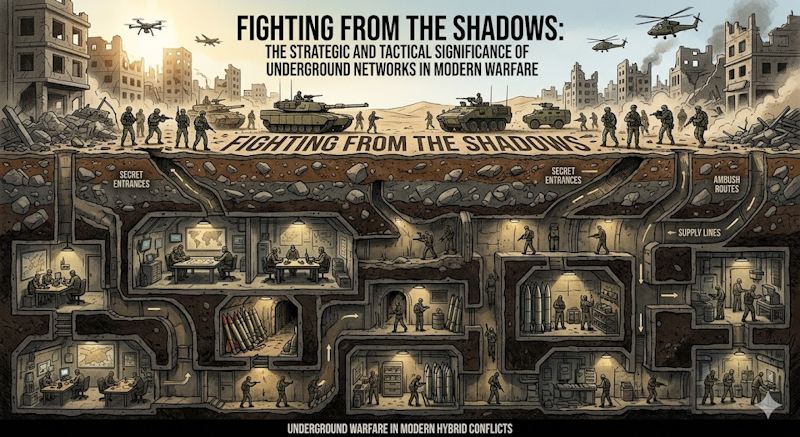
Fighting from the Shadows: The Strategic Role of Underground Networks in Modern Warfare
Summary of Dr. Kristian Alexander’s article
The contemporary battlefield is no longer limited to the surface. It now extends underground, where tunnels, bunkers, and buried infrastructure have become major military tools. For actors with weaker conventional capabilities, these networks offer an effective way to offset the technological superiority of their adversaries.
The military use of tunnels is not new. From ancient sieges to the Vietnam War, tunnels have served offensive and defensive purposes, as well as supply, concealment, and mobility. The famous Cu Chi tunnels used by the Viet Cong illustrate this logic well: they enabled the movement of troops, weapons, and supplies while avoiding American firepower.
Today, this strategy is especially visible in the Middle East. Hamas has developed a vast underground network in Gaza, often referred to as the “Gaza Metro.” These tunnels serve as command centers, movement corridors, weapons storage sites, and platforms for ambush operations. Their location beneath civilian areas makes them especially difficult to neutralize.
Hezbollah in Lebanon has also invested heavily in cross-border tunnels and deep rock-cut bunkers. These infrastructures provide mobility, concealment, and resilience against advanced surveillance systems.
In Yemen, the Houthis have pushed this strategy even further. They have built underground military complexes housing command centers, missile factories, radar installations, and drone production facilities. These structures have enabled them to withstand years of airstrikes.
From a tactical perspective, underground networks profoundly reshape modern warfare. They reduce the effectiveness of drones, satellites, and precision strikes. They help preserve command-and-control systems, facilitate ambushes, and allow fighters to move discreetly. By forcing conventional armies into slow and costly ground operations, they alter the pace of military campaigns.
Underground combat remains extremely difficult. Soldiers operate in narrow, dark, booby-trapped spaces where GPS does not work. Communication is limited, disorientation is common, and psychological pressure is intense. Even highly trained forces struggle in such environments.
To address this threat, militaries are developing new responses. They are investing in ground-penetrating radar, seismic sensors, ground robots, and miniature drones capable of mapping tunnels. Specialized units such as the American “Tunnel Rats” in Vietnam and Israel’s Yahalom unit demonstrate this gradual adaptation.
According to Kristian Alexander, however, the main problem is often strategic: underground networks are frequently underestimated until they create major surprise. He argues that tunnels are no longer a marginal tactic but a distinct operational domain.
In conclusion, underground warfare has become one of the defining features of hybrid conflict. Tunnels allow non-state actors to survive, strike unpredictably, and challenge the traditional advantages of modern militaries. The battlefield is therefore no longer limited to land, sea, and air — it now also extends beneath the ground.
#United_States #Israel #tunnels_strategy #War_in_Iran #Hamas #Hezbollah #Yémen