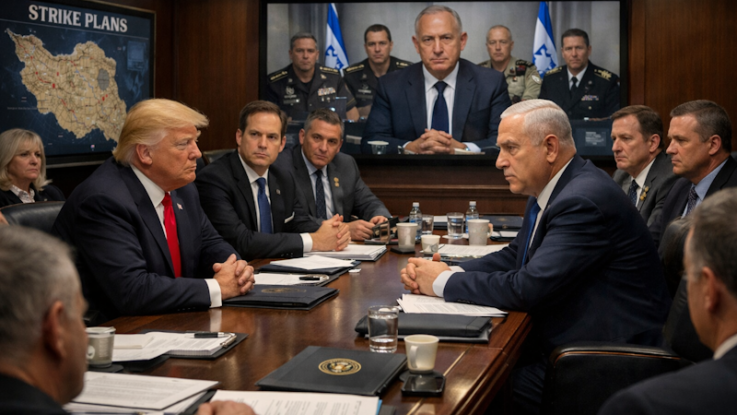
The article by Jonathan Swan and Maggie Haberman reveals the behind-the-scenes process that led Donald Trump to commit the United States to a conflict with Iran, in close alignment with Benjamin Netanyahu.
The turning point came on February 11, during a highly confidential meeting at the White House. Netanyahu presented an ambitious plan to weaken—and potentially overthrow—the Iranian regime. He argued that Iran’s military capabilities could be quickly dismantled and that internal unrest could lead to regime change. This optimistic assessment appeared to resonate with Trump, who reacted positively.
However, the following day, U.S. intelligence officials raised serious doubts. While they agreed that military strikes against key Iranian targets were feasible, they strongly questioned the likelihood of regime change, describing such expectations as unrealistic. Despite these warnings, Trump remained focused on more limited objectives, such as eliminating top Iranian leaders and crippling military capabilities.
Within the administration, opinions were divided. Vice President JD Vance emerged as the most vocal opponent of a large-scale war, warning of severe human, economic, and political consequences. Other officials supported military action, while many advisers, though cautious, ultimately deferred to the president’s judgment.
Key concerns included the risk of disrupting global energy markets—particularly through the Strait of Hormuz—the depletion of U.S. military stockpiles, and the unpredictability of Iran’s response. Nevertheless, Trump remained confident that any conflict would be swift and decisive.
By late February, new intelligence suggesting an opportunity to strike senior Iranian leadership accelerated the timeline. After a final meeting in which all advisers presented their views, Trump decided to proceed. The next day, he formally approved the military operation.
The account highlights Trump’s decision-making style: strong reliance on instinct, selective attention to advice, and a willingness to act decisively despite uncertainty. It also underscores internal divisions within his team and the significant influence of Netanyahu.
Ultimately, the decision to go to war appears to have been driven by a combination of personal conviction, strategic pressure, and perceived opportunity—rather than a clear consensus within the U.S. administration.
With The New York Times