
#DonaldTrump_speech #United_States_Israel_war_against_Iran
In a nationally broadcast address, former U.S. President Donald Trump delivered a measured yet ambiguous update on the ongoing U.S. military campaign against Iran, leaving critical questions unanswered about the trajectory and objectives of the conflict.
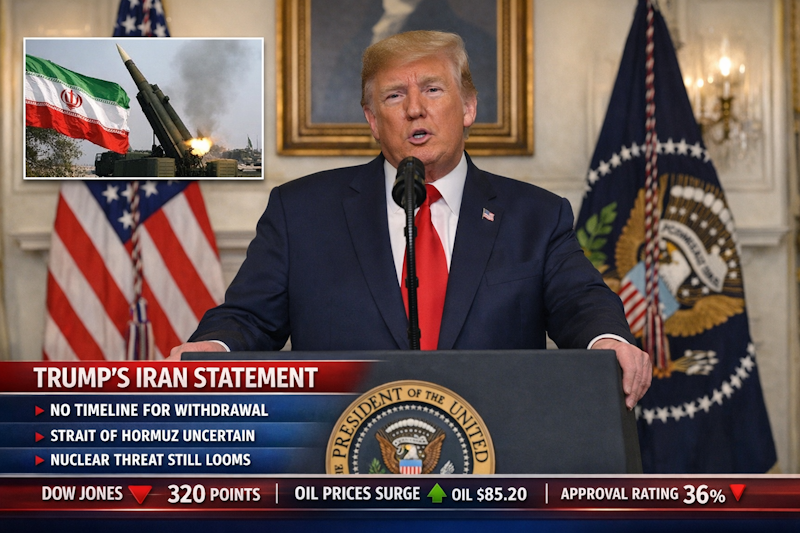
Trump asserted that American forces are nearing the completion of their mission, though he stopped short of providing any definitive timeline for withdrawal. Instead, he suggested that military operations could extend for several more weeks and potentially intensify if Tehran fails to meet U.S. demands. This dual messaging—projecting confidence in imminent success while warning of escalation—has contributed to a climate of uncertainty both domestically and internationally.
A central ambiguity in the speech concerned the strategic importance of the Strait of Hormuz, a vital artery for global oil shipments. Trump declined to specify whether U.S. military actions are contingent upon reopening or securing the strait, instead calling on allied nations to assume greater responsibility for safeguarding global energy flows. His remarks appeared to shift part of the burden onto international partners, despite the strait’s outsized role in the stability of energy markets.
While emphasizing the significant damage inflicted on Iran’s military infrastructure, Trump did not clearly articulate whether the campaign has achieved its primary objective: curbing Iran’s nuclear ambitions. Analysts note that Iran is still believed to possess stockpiles of enriched uranium, reportedly stored underground and under surveillance, raising doubts about the long-term effectiveness of the operation.
Moreover, despite sustaining heavy losses, Iran retains the capability to carry out missile and drone strikes, underscoring the persistent threat of retaliation. The speech also made no indication of political change within the Iranian leadership. The current regime remains firmly in place, with indications that hardline figures continue to hold significant influence.
On the domestic front, Trump acknowledged rising fuel prices but characterized them as a temporary consequence of the conflict. However, the economic strain appears to be weighing on public sentiment. Recent polling places his approval rating at 36%, signaling mounting political pressure as the U.S. approaches its next electoral cycle.
Financial markets reacted swiftly to the speech. U.S. equities declined, oil prices climbed, and the dollar strengthened—movements that analysts interpret as signs of investor unease amid the lack of strategic clarity. The response highlights broader concerns about the potential for prolonged instability in both geopolitical and economic spheres.
Notably, the tone of the address was subdued, lacking the rhetorical force that has often defined Trump’s public communications. Observers suggest the speech missed an opportunity to reshape public perception or provide a clearer justification for continued military engagement, leaving both supporters and critics with lingering doubts about the path forward.
With Reuters, 02/04/2026