#Françafrique #AfricanUnion #MackySall #Senegal #UN_Secretary_General_candidate
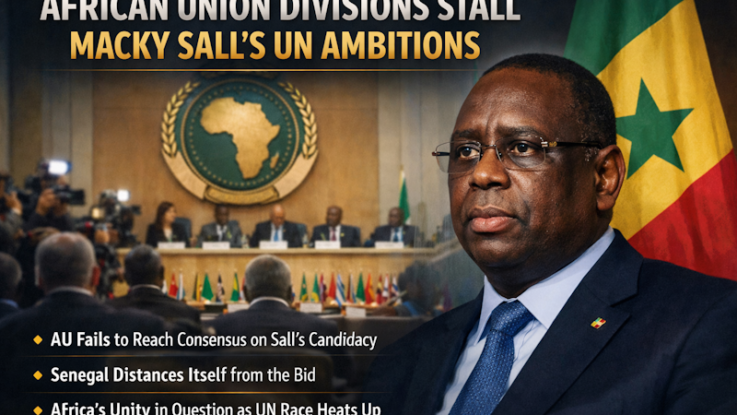
African Union Divisions Stall Macky Sall’s UN Ambitions
The African Union’s failure to endorse former Senegalese president Macky Sall as its candidate for United Nations Secretary-General has exposed significant internal divisions within the continental body, raising concerns about Africa’s ability to project unity on the global stage.
A draft decision backing Sall’s candidacy collapsed on March 27, 2026, after at least 20 member states formally objected under the African Union’s “silence procedure,” a mechanism that allows proposals to pass unless opposition is raised within a set deadline. The objections effectively blocked consensus, preventing the AU from presenting a unified candidate for one of the world’s most influential diplomatic positions.
A Candidacy Without Consensus
Sall’s bid, initially submitted by Burundi, had already stirred unease among member states before the vote. Critics questioned both the process and the lack of broad consultation, arguing that the nomination did not emerge from a transparent or competitive AU selection framework.
Behind the scenes, concerns ranged from regional balance to institutional precedent. Some governments were wary of endorsing a candidate without clear procedural legitimacy, while others hesitated over the timing and political implications of the bid. The result was a gradual erosion of support, culminating in the failure to reach agreement.
Although Sall retained backing from influential figures within African diplomacy, this support proved insufficient in the absence of collective endorsement. In the consensus-driven environment of the AU, even strong individual advocates cannot substitute for bloc-wide unity.
Senegal Distances Itself
Complicating matters further, Senegal itself formally distanced from Sall’s candidacy. In a note issued by its Permanent Mission to the African Union, the government stated it had “at no stage endorsed” the bid and had not been involved in promoting it.
This unexpected disavowal underscored a deeper disconnect—not only within the AU but also between Sall and his home country’s current leadership. Senegalese officials indicated they were not consulted, raising questions about how the candidacy was advanced in the first place.
Domestically, Sall’s legacy remains contested. His presidency, which lasted from 2012 to 2024, drew criticism in its later years over the handling of opposition protests and allegations related to public finance transparency. These factors may have further complicated efforts to rally unanimous continental support.
Strategic Implications for Africa
The AU’s inability to unite behind a single candidate carries broader implications for Africa’s influence in global governance. Regional endorsements often play a decisive role in shaping early momentum in the UN Secretary-General selection process. Without a coordinated African position, the continent risks entering the race fragmented and less influential.
African leaders have long argued that the Secretary-General role should rotate to the continent, which has not held the position since 1996. However, the current episode highlights a persistent challenge: translating that aspiration into a coherent and unified diplomatic strategy.
An Open Field
With no official AU nominee, the race to succeed the current UN chief remains wide open. Other international figures are already being discussed as potential contenders, and Africa’s lack of a consolidated candidate could create opportunities for non-African hopefuls to gain ground.
At the same time, the absence of consensus leaves room for renewed negotiations within the AU. Member states may yet coalesce around an alternative კანდიდacy or revisit the process to establish a more structured and widely accepted selection mechanism.
A Test of Continental Unity
Ultimately, the episode serves as a revealing test of Africa’s diplomatic cohesion. While the continent continues to advocate for greater representation in global institutions, its ability to influence outcomes depends heavily on internal alignment.
The stalled endorsement of Macky Sall is more than a setback for one individual—it is a signal that achieving unity remains a central challenge for the African Union at a moment when global competition for leadership positions is intensifying.