#Morocco #HassanII #sorcellerie #superstition
There is an aspect of the personality of the late King Hassan II that Westerners found difficult to understand, namely his attachment to certain beliefs tinged with superstition and sorcery.
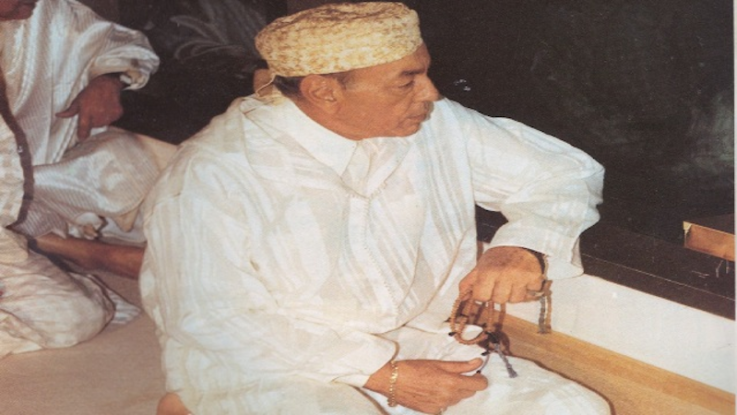
The daily life of the late King Hassan II, alongside his close associates, entourage, court, and harem, was not devoid of practices and behaviors strongly marked by sorcery. Far from the image of a ruler firmly in control and embodying modernity—imbued with Western culture in general and Francophonie in particular—there appear elements of Hassan II as a man sometimes interested in magic, sorcery, and certain superstitious beliefs.
History shows us that power has always resorted to myth, sorcery, and magic alongside the use of force, political cunning, and planning to maintain control.
Although the late King Hassan II was rational and “Cartesian” in his dealings with the West and his handling of modern and economic issues, he demonstrated on several occasions—albeit intermittently—that he did not rely solely on reason. More than once, he turned to the influence of sorcery and magic, especially in matters where reason, cunning, and planning could not determine the future.
Many accounts preserved in collective memory have been reported by individuals who lived inside the palace or were close to the king and aware of what took place behind its walls.
Many Westerners, especially the French, were puzzled in classifying the late King Hassan II’s personality, seeing it as dual, almost contradictory. To them, he embodied modernity more than any Moroccan—he spoke refined French that many French people themselves could not match and had a deep understanding of contemporary culture and knowledge. Yet at the same time, he sometimes appeared more conservative than the most ardent traditionalists, deeply attached to ancient customs and traditions that defy reason, such as belief in various superstitions, reliance on sorcery, or recourse to magic.
Various sources confirmed the late king’s interest in the mysterious worlds of magic and sorcery, as well as his search for religious scholars, fortune-tellers, astrologers, and sorcerers—some of whom sought to offer their services to the court and high-ranking officials.
Political and economic leaders often resort to the services of sorcerers during times of intense competition or conflict. It should be noted that sorcery is not unique to Morocco; it is a global phenomenon. Even powerful rulers and leaders throughout history have turned to it. Napoleon and Hitler, for example, were reputed to have sought the help of magic and sorcery. Likewise, the eye depicted on the U.S. dollar was originally intended to ward off envy in a country considered highly pragmatic and rational.
The Alaouite kings do not cross Oued Massa
Among the unusual beliefs respected by the late King Hassan II was avoiding crossing Oued Massa, as it was believed that doing so could bring harm to the king or a member of the royal family.
According to this belief, if an Alaouite king crossed this river at any time of the year, it would trigger forces of misfortune that could affect the king, his family, or his close circle for the remainder of that year.
It is known that Hassan II never crossed Oued Massa. During visits to southern Morocco, when the royal convoy reached the bridge over the river, the king would leave his vehicle and board a helicopter, flying out toward the sea to avoid crossing the river before landing on the other side.
“Tabaroud”
At the beginning of Hassan II’s reign, there was a belief that his body was protected by a supernatural force making him immune to harm, even from weapons—whether blades or firearms—due to what was called “tabaroud.”
“Tabaroud” is said to be a form of magic composed of talismans and a special mixture, the formula of which was secret and known only to a few religious scholars who passed it down carefully. Its preparation involved specific rituals known only to a select few and was considered by many scholars to be a form of black magic.
It was rumored that this mixture was prepared on a specific night during Ramadan at a precise moment known only to experts in occult sciences. Whoever benefited from it was believed to be immune to injury from any weapon.
According to those knowledgeable in black magic, the effectiveness of “tabaroud” depended not only on the mixture but also on accompanying talismans carried by the individual. Others, however, believed it was merely a rumor spread among the populace to reinforce the sacred image of the ruler as divinely protected.
Up until the coups of 1971 (Skhirat) and 1972 (attack on the royal plane), ordinary citizens often viewed the king as superhuman. This perception changed when events revealed that he could be threatened like any other human being.
“Baraka” and jinn in the service of Hassan II
Among the beliefs that circulated in Morocco during the 1950s, 60s, and 70s was that Hassan II possessed a special “baraka” (divine blessing) protecting him from harm. This belief was reinforced after he survived assassination attempts.
Another related belief held that jinn were at his service, controlled through the help of powerful religious scholars and possibly even Jewish magicians. At one point, this belief was associated with a ring he wore, described as a “ring of wisdom.”
Several sources confirmed that religious scholars regularly visited the palace, some of whom were also consulted by high-ranking officials and ministers.
The Green March and sorcery
Before launching the Green March in November 1975, Hassan II reportedly summoned a religious scholar named Haj Mohamed El Habib. The scholar refused to leave his residence, insisting that the king come to him if he wished to benefit from his blessing.
Unusually, the king complied and visited him discreetly. It is said that the scholar told him: “You will win the Sahara issue, but it will bring you many troubles.”
Coincidence of religious holidays with Friday
During Hassan II’s reign, the royal court was wary of religious holidays coinciding with Friday, as this was believed to be a bad omen potentially bringing misfortune to the royal family.
Haunted places
Stories and legends circulated about certain palaces, mosques, and shrines being inhabited by jinn or requiring special rituals. Some rooms were said to need daily purification with rose water and incense.
Appealing to religious figures in times of danger
In 1988, religious scholars gathered on the coast of El Jadida to pray and recite the Qur’an, seeking protection from a major environmental disaster caused by an oil spill.
Soon after, the oil drifted away from Moroccan waters. Some attributed this to supernatural intervention, while others suggested it was due to natural factors like wind patterns, possibly anticipated by authorities.
A similar situation occurred during a severe drought, when prayers for rain were organized as meteorological services predicted incoming clouds.
Sorcery, myth, and power
Historians generally agree that sorcery, myths, and rumors can function as tools of power. They play a role in shaping the ruler’s charisma and reinforcing authority.
Thus, Hassan II’s association with certain beliefs gave rise to many stories—some strengthening his image, others undermining it. Over time, especially after the coups and social unrest of the late 1970s, the perception of the monarchy evolved.
It is also known that Hassan II admired Machiavelli’s The Prince, a work offering strategies for maintaining power, including the use of illusion—echoing the role that myths and beliefs can play in governance.
Source : Alhiwar Almoutamaddin