#WesternSahara #FrentePolisario #Morocco #USIsraelWaragaintIran
RABAT/ALGIERS – The long-standing territorial dispute over Western Sahara is emerging as a key factor influencing the muted responses from Morocco and Algeria to recent US and Israeli strikes against Iran, according to diplomatic observers.
Despite the attacks targeting a fellow Muslim nation, both North African neighbors have refrained from issuing formal condemnations. Analysts suggest this « selective silence » is a direct result of ongoing, US-brokered dialogue regarding the former Spanish colony, which is approaching its 50th year as a unresolved regional issue.
Diplomatic Calculations Overshadow Regional Solidarity
While Algeria has reportedly softened its initial rejection of the offensive, Morocco has notably avoided criticizing the actions against the Islamic Republic. Instead, Moroccan Foreign Minister Nasser Bourita has utilized platforms like the Arab League to condemn Iran’s « atrocious » attacks on Arab nations. However, these statements have omitted references to Israeli strikes on Lebanon and the operations against Iran itself.
Rabat has previously held Tehran responsible for « creating terrorist entities » and severed diplomatic ties in 2018, accusing Iran of arming the Polisario Front with anti-aircraft missiles via Hezbollah. This proxy dynamic continues to influence Morocco’s geopolitical alignments, as it prioritizes its territorial integrity over broader Muslim-world unity.
Economic Stakes and Rearmament Trends
The conflict in the Middle East presents divergent economic risks for the two neighbors. Morocco, heavily reliant on tourism and a net energy importer, fears rising inflation and a potential exodus of Western tourists, with booking cancellations already impacting the sector. In contrast, Algeria, a major hydrocarbon producer, stands to benefit from potential spikes in oil and gas prices.
The strategic divergence is further underscored by military procurement. A 2025 SIPRI report identifies Morocco as Africa’s leading arms importer, with the US supplying 60% of its hardware and Israel 24%. This alliance is cemented by the Abraham Accords, under which the US recognized Moroccan sovereignty over Western Sahara. Algeria, meanwhile, relies on Russia (39%) and China (27%) for its defense imports, though experts caution that opaque procurement practices may obscure the full scope of its arsenal.
Domestic Dissent vs. State Policy
While the Moroccan state seeks to preserve its strategic assets with Israel and the US, a widening gap has emerged with civil society. Public outrage over images of Palestinian suffering in Gaza has fueled attempted protests against the aggression on Iran, viewed by many as an attack on the broader Muslim umma. Security forces recently deployed heavily in Rabat and Tangier to contain demonstrations organized by opposition groups, including the Justice and Development Party and the Federation of the Democratic Left.
A collective of Muslim scholars and clerics in the region released a statement asserting that, despite ideological differences with Tehran’s Shiite regime, « attacking Iran in an alliance of crusaders and Zionists constitutes an external aggression against a Muslim country. »
Fifty Years of Stalemate
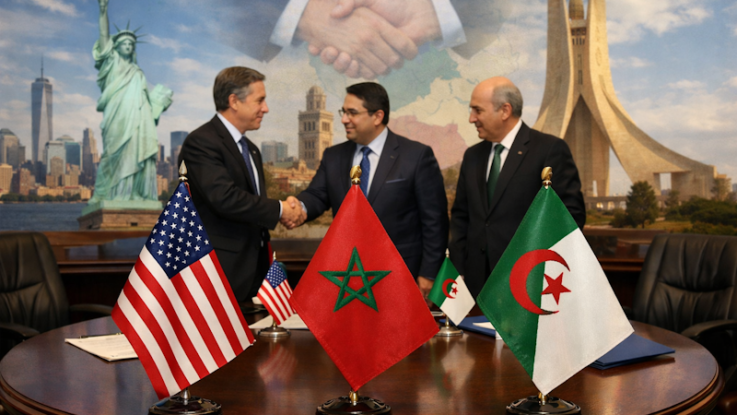
The core issue remains the Western Sahara dispute, which has poisoned regional diplomacy since Spain withdrew from the territory in 1975. The US has convened rounds of dialogue in Madrid and Washington, based on UN Security Council Resolution 2797, pushing for « genuine autonomy » as the most feasible solution. While Algeria has historically backed Sahrawi self-determination, it is now engaging in talks to maintain its relationship with Washington, seeking to counterbalance the growing US-Morocco axis in the Maghreb.
With El Pais