#Morocco #MohamedElBasri #UNFP #Makhzen #WesternSahara #Algeria
Mohamed El Basri: Liberating Morocco from the United States means liberating Morocco from those who brought the United States there.
Interview with Mohamed El-Basri by Simon Malley (AFRIQUE-ASIE in French No 261, 15–28 Mar 82)
He is called El Fqih, the teacher, the wise man. And it is true. He says that the time of « historic leaderships » is past, which is probably completely accurate. But at the same time, it is difficult not to consider Mohamed el-Basri as one of the last representatives of that prestigious race of men whose history, positions and defense of the principles, rights and dignities of nations and men have marked the history of the Arab world, particularly the Maghreb. He says that he is but an « anonymous soldier » of the cause of national liberation and yet, is it possible not to see in him one of the most enlightened consciences of the Arab world today?
An ardent Moroccan, unrepentant Maghrebian, resolute Arab, earnest African and perspicacious Third Worldist, he lays claim to and assumes that multiple conscience as a unique, integrated fact, just as nowadays, the major question of national liberation is one and indivisible.
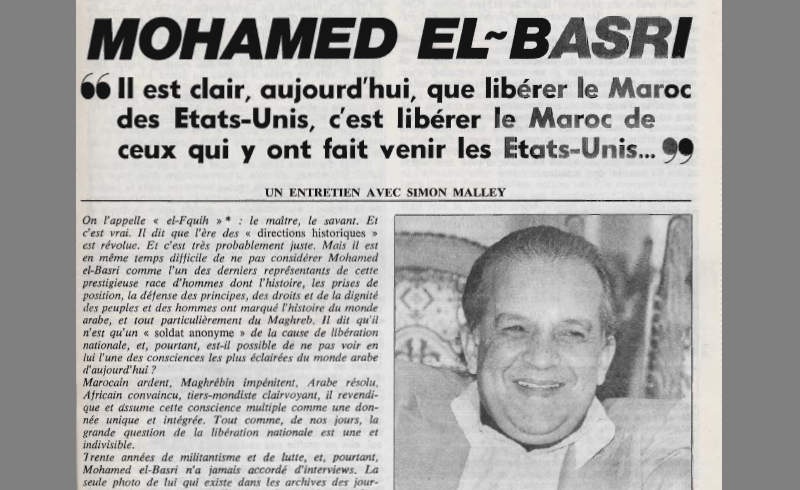
Thirty years of militancy and struggle and yet, Mohamed el-Basri has never granted any interviews. The only picture of him in the archives of newspapers and news agencies is one in which he is seen on the stand, confounding the king’s prosecutor, who in March 1964 accused him of conspiracy against the internal security of the regime, for the mere « crime » of having opposed the arbitrariness of a despotic regime and its repression of public freedoms, its policy of torture.
Then why break a 30-year silence? Why would the founder, organizer and head of the Moroccan army of liberation, who took up arms against the French colonizer and contributed decisively to his country’s independence, now believe that the forms of struggle must no longer be what they have been so far?
More precisely, in the domain of Islamic theology. However, concerning Mohamed el-Basri, this label refers to no religious function. It expresses the respect of all who know him for his moral and intellectual integrity, his political courage, the straightness of his thought, the simplicity and warmth of his personality, his erudition and many other qualities worthy of admiration and cited as an example.
« Because, » he says, « these are extremely grave times. Because King Hassan II has sold out the country. Because the reconquest of Morocco — American this time — has begun. Because every citizen, every group, every party must now set forth before history its attitude in the face of this recolonization. And finally, because the myth of the ‘democratic opening’ has died down and it is now clear that to free Morocco from America means to free Morocco from those who brought America in. »
El Fqih Mohamed el-Basri chose AFRIQUE-ASIE for this exclusive interview. During the meeting he granted Simon Malley — a meeting of exceptional length but of real intensity which we have decided to publish as a separate section so that it may be removed and kept as an instrument of reference for the Arab world and particularly the Maghreb — El-Basri exposes and tries to unravel the intricacies of the many different bonds that either block or promote the liberation impulses of the peoples in the region. He does it simply, without any pretentiousness, but with that moving certainty bestowed by years and years of struggle, prison, living underground and in exile.
Let us listen to him.
Imperialism never ceases entering into relations and agreements with a number of nations in the Arab world, from the Maghreb to the Middle East. In your opinion, how can progressive Arab forces view their response?
First of all, the Arab National Liberation Movement must emerge from the impasse in which it is. Naturally, that impasse has several causes, but in my opinion, the cause of causes, the major cause, is, for Arabs today, the one that springs from the domain of culture, culture in the broad, multidimensional sense, closer to the civilizational destiny of the Arab people than to the mere dissemination of food for the mind. For it has now become essential, in order to move in the right direction of things and history, to have a clear vision of the world or worlds.
Let me explain: By culture, I mean the possession and appropriation of all those objective and subjective elements apt to create a dynamic, to play a role as a catalyst in the coming to awareness of the masses. In my opinion, that is what — that very intense effort of reflection and interrogation — should give rise to rigor and coherence, without which there is no salvation. It is coherence, as we well know, which leads to a clear awareness and vision of things. It also orders phases, defines needs, initiates cadres and trains men in the strict deployment, well-known to everyone, of a true strategy. And I believe that there is not, in what I say, any unbridled, metaphysical pan-Arabism. There are only the hard lessons of immediate history, for it is totally useless at the present time to envisage any patriotic counterstroke in the Gulf, for example, when the other flanks, especially in the Maghreb, are either unguarded or already undermined by the neocolonialist malady. An effective response in Morocco requires resolute, determined, positive support from the other Arab parties for the effort being developed locally by the democratic forces in Morocco. Otherwise, what would we see? A clearly expressed desire for hegemony. It crisscrosses the world. It is integrated. It has its center and its satellites.
Let us take a satellite country such as Morocco. Hassan II has undertaken to do more and to go further than America’s traditional allies in the Gulf, such as Saudi Arabia. He has clearly set the country up as an experimental field, a laboratory, in the matter of the reactivation of American bases in Morocco. At the same time, Saudi Arabia and certain Gulf countries have refused to accommodate analogous bases out of fear of repercussions of different sorts. But that refusal is in no way final. The emirs governing those countries are actually awaiting the results of the Moroccan experiment. And there can be no shadow of a doubt that they will in turn come over, at the proper time, at the time chosen. That choice is exclusively the work of the center right, which, by means of its incessant emissaries, will have woven the plot. Quite often, moreover, this happens in broad daylight. Secretary of Defense Caspar Weinberger, on his visits to the two ends of the Arab world, quite literally has his colleague from the State Department, Alexander Haig, breathing down his neck. Haig tries to give the image of diplomatic respectability to undertakings whose harmful effects on the entire region will soon be seen.
We must also use our memories here, especially recalling the role of intermediary already played by Hassan II in introducing Henry Kissinger to the region. The result of this famous shuttle diplomacy has been the near conflagration of the region, exacerbation of the conflict between Syria and Iraq, the conflict between Algeria and Morocco, the conflict between the different members of the Palestine Liberation Organization, and so on. However, quite obviously, this is not a matter of fate either. The means to respond do exist. Correctly used, they could be formidably effective. Our absolute weapon is our peoples. Without their irruption into the life of the country, without their participation in decisions, nothing could be done. As you can see, we are already quite far from the time of « historic leaderships » which acted alone, in the name of the people, in the fight to counter imperialist plans. For its part, the spontaneity of the people is incapable of turning the ratio of forces in its favor. Narrow nationalism, not to say chauvinism, also proves that in the final analysis, its essential function was to facilitate the hegemonic task of imperialism and neocolonialism. What then is to be done? First of all, we must make the masses aware of the exact role of the leaders who betray them. Here, the betrayal is not an end in itself; it does not only benefit the native guilty of it. Rather, it is above all the means by which one enchains the entire country. As a corollary to this statement, we must ensure that the vision of the government, its forms and attributes, changes and evolves among the masses. « The sovereign people » is not a slogan. That must become the absolute, sole source for designing the articulations of power of an authentic national leadership.
There, I think I have answered your question. If I have avoided personalizing situations, it is in no way out of a fear of hurting anyone’s feelings. I quite simply took advantage of an opportunity to say what I believe constitutes the new aspects of a truly legitimate, advanced movement or government: in the countries of our region.
What are your first reactions to the announcement of negotiations between Rabat and Washington on the reactivation of the old American bases in Morocco?
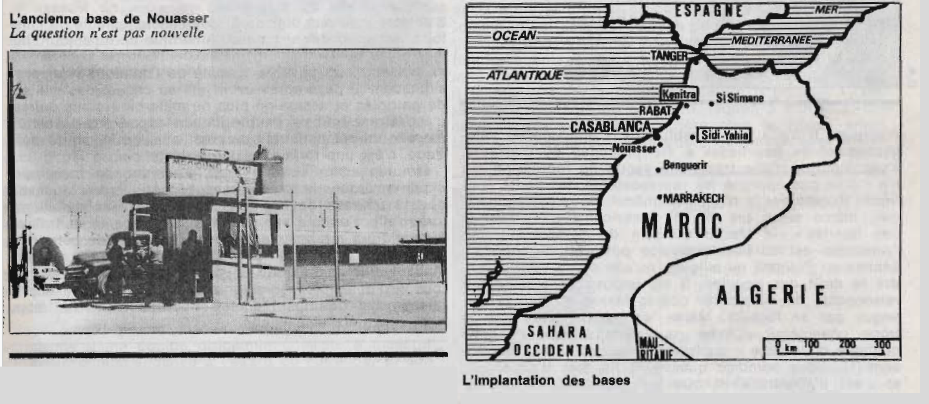
Actually, it is not a new question. Even before independence, within the framework of the national movement, we considered that the presence of American bases on our soil, a presence then « legalized » by French-American agreements, actually constituted a violation of our national sovereignty and a typically colonial intrusion in our country on the part of these two powers. Consequently, fighting that presence was a national duty. That is why, once independence had been acquired and in order to complete the national liberation, the withdrawal of American forces was considered as a prime necessity. What is more, President Eisenhower’s visit in 1960 was for the purpose, among others, and the fact is well-known, of signing an agreement for the evacuation of those bases. That is why we then thought that a phase in sovereignty was coming to a close when, the last of the foreign forces on our soil, the American units left the bases of Bengrir, Nouasser, Bouknadel, Sidi Slimane and the Kenitra naval base, which was actually not completely evacuated until 1976.
You have given me an opportunity here to recall that the withdrawal of all foreign forces and the consolidation of national sovereignty always constituted the backbone of the country’s policy at the time, a policy included in the programs of the government and political parties as well. As you will recall, King Mohamed V and the government of Abdallah Ibrahim were in perfect agreement on this matter and together, had signed accords with the United States along these lines.
Remember this also: We are in the early 1960’s. The great colonial empires began to dwindle. France and Great Britain were withdrawing and the American administration — Secretary of State Foster Dulles, to be more precise — thought the time had come to occupy the ground lost by the Europeans. Dulles’ idea was that the Arab world had not yet come of age. Unfortunately, one has to admit that some leaders shared the idea. I would mention Nouri Said, Faisal II, Emir Abdel Ilah and King Abdallah, all of whom thought that foreign protection was necessary. This collaboration, not to say betrayal, would be paid for with their lives. This fatal destiny would in a way shift the pole of interest of the Americans and it was in Israel and the Shah’s Iran that America would seek the powerful bastions destined to maintain its presence in the region.
The results of that policy are now obvious. The Shah was swept away and the strategic accord with Israel is both an admission of impotence and proof that the peoples of the regions resolutely reject the plans. This clearly amounts to saying that here also, history has relentlessly ruled. It was precisely because he failed to recognize this judgment of history that Sadat met his fate. And today, what could one expect of that same policy which, in order to cut off and encircle the Arab world, uses that same Israel and a newcomer, Morocco? Undoubtedly, the same fate.
That seems to me to answer the political aspect and historical experience part of your question. With respect to the physical or technical aspect, the United States’ need for those bases in no way seems to me to be absolute; far from it. We are in the age of intercontinental missiles and spy satellites capable of detecting anything that moves in regions of interest. In my opinion, therefore, that presence has no true military justification.
What remains? The defense of « freedom »? Let us note in this case that the operation comes at a time when the situation is terrible for the regime. On the domestic scene, the regime cannot even claim the legitimacy of the democratic institutions. There are no institutions. The announcement of the establishment of the bases was preceded and is accompanied by a vast wave of repression that has not even spared the representatives of the political parties tolerated by the regime itself. We therefore see that even according to the American canons of the « defense of freedoms, » Morocco is wide of the mark. And that America is in a very poor position to justify, as in Poland or elsewhere, that it is there to defend the right of peoples. It is impossible for a reasonable mind to consider that official Morocco is distinguished by its legality. Even important persons whom the throne considered as representatives of Moroccan political opinion are now rotting in prison. We are almost in a state of emergency and furthermore, that is how the international organizations for the defense of human rights, in the West and elsewhere, view the situation in Morocco. Actually, the American presence responds to motives of Moroccan domestic policy and regional considerations.
The argument of domestic policy is that the regime needs an agreement of this nature to protect it from its own instruments of power and ensure its survival. The American presence would then be explained as an internal security operation making the support of foreign experts necessary. If this should be the case, and I think it is, this means that the regime is not sure of itself, that it has lost all support of the people or even of the administration and that more than ever, it fears and dreads any popular initiative. Does this not remind you of the final days of Sadat, fleeing everyone and entrusting his own safety to foreign experts?
But it was illusory: No expert, no arrangement, even the most sophisticated, could protect a man or regime from the anger of an entire people. It is illusory and contradictory as well: One cannot sell off the rights of the nation. One cannot mortgage the entire country when makes the recovery of provinces one’s main warhorse.
On another level, it is said that the purpose of the American presence in Morocco is to counterbalance Soviet influence in Libya. Fine! But what interest does Morocco have in restoring a balance at the cost of its sovereignty? Does the sovereign policy of a country not first of all consist in defending itself, its own territory, its dignity? There is definitely something bizarre about the kingdom of Hassan II. Obstinately refusing to heed the lessons of history, agreeing to do for America what even the Allied governments in West Europe can no longer do out of fear of public opinion, physically turning over the country after throwing thousands of patriots into prison and murdering over 1,500 others: This is to throw at an entire people the insult of not knowing where its national interest lies. This is no longer political blindness. It is a crime, a betrayal.
For its part and considering its own experience in the Arab region, America should know that the defense of its interests is always flawed when it bases that defense on local potentates, agents and traitors. For my part, I remain absolutely convinced of this certainty: The peoples of the Maghreb are and will always be vigilant and they will foil all maneuvers, all neocolonial plots found along the path leading them to edification, brotherhood, peace and unity.
Do you believe that the Moroccan people, despite the repression perpetrated on them by a regime not of the people, have the means to fight this new American domination?
Let us observe, first of all, that this operation (the bases), took place at a particularly bloody time of the repressive phase. Reaction to the repression cannot come at one blow and all at the same time. It will be slow in being articulated, but what is sure is that the people will never pardon the attempt on their dignity and their sovereignty. Whence the difference between an individual reaction and a collective reaction, which obeys much more complex laws. But there can be no doubt on this subject: The reaction of the people is unavoidable and will occur when the conditions exist. The examples are legion. Look at the Shah’s Iran. Elsewhere, they have groped around for philosophical « explanations » for a suicidal approach. I mean Sadat, his obstinacy and the obstinacy of those who used practices in keeping with the, shall we say, Pharaohic specificities of Egypt.
But let us get back to my country. The history of our people in this area is well-known. For me, it is a simple question of time. I am deeply convinced that the Moroccan people will know how to regain their sovereignty and independence from neocolonialism and its agents, just as it will achieve its territorial and popular unity.
You just mentioned the consequences of the new American policy for Algeria and Libya. What are they?
My hope is that the Saharan affair has not, in the eyes of the leaders of those two countries, concealed the crux of the problem. I repeat that the heart of the matter is that for America, it is a matter of protecting a regime totally incapable of guaranteeing its existence and sovereignty. Actually, as for the loss of its sovereignty, the Moroccan regime is rather willing. It remains to be hoped that neither Algeria nor Libya will make the expected faux pas consisting of also securing outside protection.
In order to remain in power, the regime in Rabat may go as far as the destabilization of all the Arab Maghreb.
With respect to the Saharan question, for the Rabat regime, the matter is decided: paralyze national energies, mobilize domestic, regional and world opinion around the question, cut off any possible dissent by giving primacy to the slogan « No voice louder than the voice of battle, » and all for a precise purpose: remaining in power. But it is true that, in order to remain in power, the regime in Rabat may go as far as the destabilization of all the Arab Maghreb.
You know that one infallible way of judging the patriotism of a team of leaders consists of measuring its degree of independence from foreign countries and its attachment to achieving the people’s will. Our opinion has always been that one must guard against undertaking anything in one’s country that might strengthen or give rise to foreign control over the country or region. In the Maghreb, the future is for unity, unity of the peoples serving their interests and aspirations. But the greatest obstacle to the achievement of that goal has always been the Moroccan regime itself, which appears to be structurally and fundamentally different from, even the opposite of, the other regimes in the region. But this is not a matter of destiny. In my opinion, Algeria’s role is very important here. Algeria must give the best example. It must constitute the rear base and the natural depths of the Moroccan people until they free themselves from neocolonial domination and the hold of its agents. The Moroccan people will then in turn be able to make their decisive contribution to the building of unity.
Ronald Reagan’s new policy is obviously marked by a will to counter Soviet influence everywhere in the world, mainly in North Africa and Black Africa. That could well lead to the war, the possibility of which you seem to discard.
I believe that Algeria will always maintain its independence. Algeria is not the USSR. Moreover, we have noted that even when it is a matter of countries with a stated ideological choice, as in the case of Cuba, the attitude of the two superpowers remains in keeping with rules established by the fear of war. That is the price of peaceful coexistence.
But the Americans are nevertheless in Morocco and some believe that there is reason to counterbalance that presence by signing analogous agreements with the USSR or socialist France, for example. What do you think?
As I have already said, the real response to this situation is to rely resolutely on the masses. In my opinion, it is a mistake to resort to a series of all-points agreements. This would only confirm, both here and there, that we have lost confidence in ourselves, in our people. My belief is that the determination of the Moroccan people to get rid of the bases is real. It is powerful. It goes against the decision of the king. It will win out in the end. That is why I do not see the purpose of contracting alliances in the opposite direction.
During his recent visit to Paris, the king of Morocco tried to convince France to act as a middleman between him and Algeria. It is also said that Hassan II would like to meet with President Chadli Bendjedid. How do you view all these maneuvers?
I believe that there is no true solution to the basic problem except in understanding between the Moroccan and Algerian peoples. I believe that colonialism, old and new, has succeeded in its task. Not only has it established artificial borders that our people did not know before colonization, but it has also succeeded in erecting a psychological wall between our peoples. As I have already said, the question of the Sahara could have provided an opportunity to overturn all obstacles and eliminate all agents standing in the path of legitimate unity between our two peoples, for unity between Algeria and Morocco could truly guarantee the real independence of the Maghreb, which in turn would become a solid rear base for the Arab world as a whole. I believe that the Arabs of Africa, from the east to the west, from Bab el-Mandeb to Gibraltar, are a hinge for anything affecting the rest of Africa, on the one hand, and Europe and the Western world, on the other. From Bab el-Mandeb to Gibraltar, there are the same impulses, the same rhythm, in short, the same civilization that has always lived in perfect harmony with the rest of Africa.
That is the reason why I see no purpose to the creation of a new entity that could only constitute an obstacle to this fluidity in historical relations with countries in the South Sahara. This is very important to take into account, especially when one realizes that imperialism definitely intends to regenerate itself in Africa and to find there the forces and means needed for its fight in other parts of the world. Nature commands us to open up and communicate with Africa through the Sahara, just as it orders us to use the Mediterranean for our trade.
To get back to one of the aspects of your question, I believe that in order to stimulate true cooperation with France, the latter must be totally freed from any neocolonialist complex. I think that France and Europe in generally have everything to gain as soon as that cooperation becomes truly profitable for nations. Consequently, socialist France, Mitterrand’s France, must set itself apart from the intentions of a monarch who acts more like a courtier concerned about his own interests and those of his throne and the real interests of Morocco and its people. How can one credit Hassan II with knowing the interests of France and of Algeria when he does not know where his country’s interests lie? Actually, the only prospects that Hassan II and his regime can offer are those of enslavement and dependency. That serves neither the interests of the Moroccan people or those of the French people. A socialist France, once rid of the temptation of neocolonialism, can have a place in the region, just as it would gain another in the Arab world as a whole if its position would evolve with more fairness and justice with regard to the Palestinian cause.
It has been hinted that Hassan II would like to go to Algiers. What do you think?
The route leading from Morocco to Algeria goes through Oujda, not Paris or Brussels. I do not have enough elements to judge the possible position of the high spheres of the Algerian Government. Nevertheless, given the long past of common militant life between the Moroccan and Algerian peoples, it is inconceivable that such a trip could take place, given the fact that what Hassan would go to Algeria for would be support for remaining on the throne and means to hold his people in check. That would be perfectly illogical.
Let us get back to the question of the Sahara. Why do you never speak of the Saharan people, who are fighting with exemplary heroism and who are demanding that their voice be heard? If the idea and need to unite the peoples of the region are proper, then in my opinion, this would in no way prevent the Saharan people’s right to self-determination from being recognized.
I believe that we have to be frank with ourselves and with the Saharan militants: Self-determination with respect to the monarchic regime, agreed. That is proper. This is true for the Saharans as well as for all Moroccans who have never ceased rising up against monarchic oppression, as shown by the years 1965, 1971, 1972 and 1981. The establishment of a Saharan national entity has come precisely at a time when the entire Arab world is enduring imperialist attempts at Balkanization and when the people’s aspiration to unity is the strongest. For my part, I believe that the path of unity between peoples in the region in order to wipe out the existing borders is proper.
Look at the number of flags in the Gulf region alone. Do you believe that these are all expressions truly formulated by the peoples in the region? Let us take the case of Jordan, to be precise. It has all the attributes of a nation: a flag, an army, an administration, and so on. But what does Jordan mean historically speaking? It is a geographic anomaly. Its main function is to be a buffer state for Israel, a barrier to the action of the Palestinian fedayeen and finally, an obstacle to Iraq’s rapprochement to the field of battle. Far be it from me to underestimate the sacrifice or fighting ability of the Saharan militants, but I wonder: Is the path they have chosen the right one? Would it not be better to see that the time has come for a radical reconsideration of the question, more in keeping with our common future? In other words, make the Sahara a rear base in order to free Morocco and an avant-garde army for that liberation? Furthermore, would it not be better to avoid the worst — that is, a break and injuries between militants for the same cause? I believe that all of this is possible. And this can spare us the difficulties of a reunification that I believe to be inevitable in the long run.
But the struggle of the Saharan people has contributed and is still contributing to a weakening of the monarchic regime. In addition, why not recognize the former Spanish Sahara as a separate country, like Tunisia, Algeria, Mauritania and Libya, which would not prevent the formation, along with it, as with those countries, of an Arab Maghreb? After all, have its representatives not just been admitted to the OAU?
The Sahara question has weakened the throne. One can debate it. I personally have a tendency to believe that this matter has given the Rabat regime a new wind. The government would not have survived its internal contradictions or withstood the jolts it experienced in the 1970’s if it had not been for the Sahara question. Remember 1973 and 1974. The government was totally isolated, from the army as well as from the political parties. Then came this affair, which was immediately elevated to the rank of a national issue. No more political or economic problems. The « Green March » was undertaken; social peace was demanded. In short, the king broke out of his isolation. To answer your question, I believe that the union achieved in the unity of combat is infinitely easier to obtain than between nations that are already structured. Look at the union between Egypt and Syria. It was achieved in the people’s gaiety and broken by imperialism and its local agents. Closer to us, in the Maghreb, remember the fine fighting unity that existed between our peoples, between the fighting men of the three countries. They began by pulling Tunisia away, then isolated Morocco from Algeria. Today, the results are there for everyone to see.
You refer to the divorce in the 1970’s between King Hassan and the army. Today, some speak of a lassitude and disarray in the Moroccan Army. Should one expect a revolt by the army?
I can definitely tell you about changes in the Moroccan Army. As for the possibility of an uprising, that is another problem.
Immediately after independence, groups were formed around former officers who served in the French Army. The mission of the corps, which had just taken the name « Royal Army, » was clear: to protect the throne from the people. In 1959, the congress of the Union of Moroccan Students, in one of its motions, labeled the corps as an « operetta army. » I was myself convicted of an attack on the army and its dignity after publishing the motion in the newspaper EL-TAHRIR, of which I was the editor. A little later on, in 1965, the army received the order to put down the Casablanca uprising, in a frightful bloodbath. Going from repression to repression, it became apparent to the army that it was being made to play a role not its own. The army therefore began to be transformed and even to seek means of taking revenge for having been frequently forced to fire on their own, a cousin, a relative…. Whence the 1971 (Skhirat) and 1972 (the Boeing affair) attacks. From that time on, the army became a force of opposition to the regime and no longer a faithful protector of the throne. The king perceived the danger and made drastic decisions: retirements in the reserve, transfers in the gendarmerie, the sending of troops to the Golan and Sinai. In the meantime, major transformations were taking place in the armed forces. Former officers from the French Army were replaced by young cadres from the peasantry and the middle class and trained in the military academies after independence. That is why, when I say that the Americans returned to protect the throne, I am referring to the protection of the throne from the people, naturally, but also from the Moroccan Army, which has become a national army, solidary with the people from which it springs.
Does this mean that one henceforth has to consider the Moroccan Army as a patriotic force?
Without a doubt, the Moroccan Army has become a national army by virtue of its makeup and structures and it no longer has as its essential function the protection of the throne and the regime. Consequently, the army has become a potential opponent, especially if the war in the Sahara should come to an end. There now exists an intention of sending that army to the Gulf countries and other satellite countries of the United States in order to ensure the protection of local governments in exchange for petrodollars for the king’s personal purse, just as colonialism once used Moroccan soldiers to fight in Syria, Spain or Indochina. And in fact, some regiments have already arrived in Saudi Arabia and the Gulf.
In this operation, the interest of the two regimes (the one that sends and the one that receives) is obvious. For the king of Morocco, it is a matter, on the one hand, of dismantling the army and, on the other hand, of deriving a financial advantage from it by « renting » it. This makes it possible to replace these regiments with American soldiers deemed to be more reliable, especially after what happened in Egypt (Sadat’s assassination). Finally, for the Americans, « reliable » surveillance of the oil fields has no price.
Throughout your life, you have taken a revolutionary path from which you have never deviated. But that conduct has isolated you from some of your comrades, many of whom are now in prison. When you look back, what do you feel?
Throughout my life, my constant attitude has been to help forge a strategy of national union capable of transforming the political, economic and social conditions of my country. I have always concentrated my efforts on the union of national patriotic forces, based on what I have already said, with the conviction that the future belongs to those who now march with all those who struggle. An avant-garde capable of leading the current struggles is generally one that will tomorrow have the clearest vision of the collective future. Furthermore, only the reality of the struggle makes it possible to bring about the real split and shows in a spectacular manner those who take the side of the government and those who are with the people.
For myself, I am not convinced that the different political structures (the parties) truly reflect the real political sensibilities of Moroccan society today. I would even say that the people here are totally absent, both with respect to their representation and the objectives which those structures have chosen. The leaders of these parties are often hesitant and do not always know which side to pick at crucial times. Even better, these vacillations sometimes push them to the brink of crime, preventing them from making a resolute choice and in the end, allowing them only the possibility of pleading with the regime for moderation in the pressure put on or repression used against the people, which also guarantees that its positions and privileges will be safeguarded. These are incorrect positions! The government has another view of things. It knows that its interests are in violent contradiction with those of the people. Consequently, it leaves these elites but one choice: immobility or cooperation. That is the situation which, through constant work of clarification, must be made perceivable to the masses.
We must also show why this type of compromise contributes absolutely nothing to the solution of problems. And it is through this long-range work that we shall finally force cadres to choose between patriotic action, which depends on the loss of privileges, and the clear, declared position on the side of the regime. The position of these elites is, indeed, curious. Because they were trained in the West or locally, but in a Western-type school, they operate in their way, once on the job. They totally conceal the difficulties and realities of the milieu in which they nevertheless live, to such a point that they often resort to the media or European opinion in order to try to change a given position of the king. But the king has a different opinion of the West, with which he maintains utilitarian relations. He takes from it only that which is necessary to remain in power and survive: money, weapons, military experts. He then turns his back on it, handling his affairs and the country in keeping with the practices of another century.
Do you see, I should not like to remind you of what I said earlier concerning culture, but one must nevertheless not lose sight of the profound disarray born of the alienation that affects most of our cadres. The truth is that we have to find other more suitable forms in which we may handle the true concerns of our society. In Morocco, society is predominantly agricultural. It is removed from the political and ideological currents of the modern West and is scarcely permeable to them. And yet, it is precisely those currents which our elites try — generally, very awkwardly — to indiscriminately impose on that society. Naturally, there are the cities and the mass of educated people, among whom one can always try to build a few political and ideological cliques, otherwise antagonistic. How much energy is wasted when things are actually obvious to everyone: The real country is missing, whence the clear interest which the regime derives from this absence of roots among our people of most existing political groups.
To get back to an underlying theme of your question, I would tell you this: No, I have not been guilty of intransigence. I have quite simply avoided group struggles, convinced, for my part, that political reality, which truly deserves being fought for, is elsewhere. That is what I am doing.
It is true that another generation of militants, younger now, is beginning to emerge within the national movement and to view things differently. That is positive. The history of the national movement is rich in heroic figures, in examples of honest patriots who sacrificed themselves for the country. The younger generation must be imbued with the high virtues of those of their elders who inscribed golden pages in the militant past of our people, but it must also be careful of all those old venders of sweat, blood and tears who, in the name of the past of the others, would try to retain control over the movement.
Do you believe that some of the leaders of the political structures of which we were speaking have had their day?
The regime itself has answered your question. It has put an end to the democratic illusion.
And EL-IKHTIAR EL-THAOURI,1 which you head?
It is a platform from which we can explain our positions. It is not an autonomous organization.
And therefore, within the national movement?
Yes.
And not only within the USFP?
The USFP is but one part of the national movement.
1 « Revolutionary Option » is a current that fits into an overall strategy integrating both cultural and historical elements and political practice.
Who now makes up the national movement?
The UNFP [National Union of Popular Forces] of Abdallah Ibrahim, the USFP, the Istiqlal, the PPS [Party of Progress and Socialism] and other groups, with the exception of prefabricated parties such as the so-called « independents » and the « People’s Movement. »
It is said that the conflict between you and the USFP has to do with the role of the monarchy. That party still believes in the role of unifier of the nation played by the throne.
The basic question is that of knowing how to bring about positive changes in our country. If the Moroccan monarchy were comparable to the British, Belgian or Norwegian monarchy, I would see no problem. The problem is that it is not at all like it. The Moroccan monarchy is feudal. Everyone knows what feudalism is. It is not a state of mind; it is a form of complete organization of society. How can you then work toward socialism and progress without running up against that obstacle, which constitutes the very basis of the current regime?
One last question: How do you view the evolution of the Palestinian question?
Traditionally speaking, there are two ways of asking that question. There are those who believe that it is a Palestinian problem. The truth is that Palestine’s situation — that is, the situation of Israel and the rest of Palestine — is a reality made from the outside by foreign countries. The creation of Israel is not the work of the Jews in the Arab countries. It is the work of imperialism and destined to isolate the Arabs in Africa from the Arabs in Asia. Israel was built on Arab land by the guilty European conscience and in order to contain the thrust of the Arab national movement. That is why the Palestinian question looks like an Arab question, especially because the massive and successive expulsions of the majority of the Palestinian people have led to the establishment of a strong Palestinian colony in bordering Arab countries.
Until 1960, the Arab countries felt concerned by the liberation of that country, but experience has shown that the Arab states were incapable of it. The emergence of the Palestinian revolution was the most tangible reaction to the inability of the Arab regimes, not only to free Palestine, but also to lead the national emancipation movement in their own countries. That is the reason why that revolution was hailed with enthusiasm by all nations and received with fear by the existing regimes. The takeover of the destiny of the Palestinians’ revolution by its own sons will bring into a league against it not only Israel, Zionism and imperialism, but also the Arab regimes now deprived of the main cause which had always brought them to power in the eyes of their peoples, as well as of a convenient platform from which they could speak to the West.
Today, we can say that the nature of the struggle has changed. It is for a true revolutionary climate that we must work, in order to free the will of peoples to confuse the regimes that have joined hands with imperialist interests in the region and thereby make it possible for the Palestinian revolution to remain a revolution and follow its path. We must also do everything to convince the Jews in Palestine that the situation they are living through is not being imposed on them because they are Jews, but because, like the Palestinians, they are the victims of an order and a plan hatched by imperialism. It is also true that the Arab regimes are not the product of the will of their peoples and Israel is not the making of the Jews of Palestine. And the current situation can only move toward these objectives through an authentically revolutionary climate.
COPYRIGHT: 1982 Afrique-Asie
(1) Three of them, including the secretary general of the USFP [Socialist Union of Popular Forces], Abderrahim Bouabid, were freed on 27 February.