


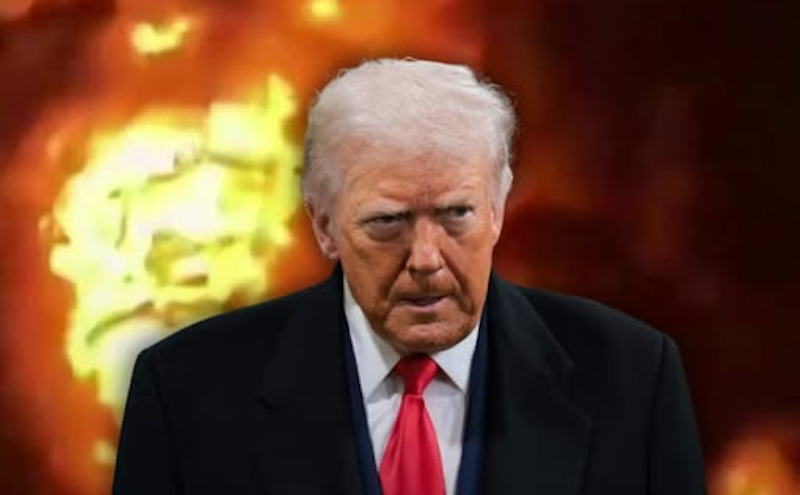
The United States launched a large-scale attack on Iran on Saturday, marking a major turning point in American foreign policy. The offensive, ordered by President Donald Trump, followed weeks of behind-the-scenes pressure from two key Middle Eastern allies: Israel and Saudi Arabia.
According to several sources familiar with the matter, Saudi Crown Prince Mohammed bin Salman held multiple private exchanges with the U.S. president to advocate for military action, despite publicly supporting a diplomatic solution. Meanwhile, Israeli Prime Minister Benjamin Netanyahu continued his long-running campaign calling for strikes against Iran, which he views as an existential threat to his country.
An attack with immediate consequences
The operation, carried out jointly by U.S. and Israeli forces, took the form of a massive aerial campaign targeting Iran’s leadership centers. Within the first hours, it reportedly led to the death of Supreme Leader Ali Khamenei, who had been in power for nearly four decades, along with several senior officials.
This intervention marks a break from decades of American restraint regarding efforts to overthrow the Iranian regime. It also represents a sharp departure from Donald Trump’s previous military actions, which had been far more limited in scope.
A contested decision
The attack was launched despite U.S. intelligence assessments indicating that Iran did not pose an imminent threat to the American homeland. This contradiction has fueled criticism, particularly among Democrats.
Senator Mark Warner publicly questioned the administration’s rationale: “What was the imminent threat to America? I don’t know the answer.”
Privately, some U.S. officials acknowledge that the decision was also influenced by the desire not to let Israel act alone.
Failed diplomacy and a risky strategy
The offensive came as negotiations with Tehran over its nuclear and missile programs were still underway, led in part by Steve Witkoff and Jared Kushner. Those talks ended in failure, with U.S. officials accusing Iran of seeking to preserve its nuclear enrichment capabilities.
Donald Trump has justified his decision by pointing to decades of tensions with Tehran, dating back to the 1979 revolution. He also claimed the United States faced “imminent threats,” a statement disputed by several agencies, including the International Atomic Energy Agency.
A region on the brink of escalation
In response to the strikes, Iran quickly retaliated, including against Saudi interests, raising fears of broader regional escalation. The long-standing rivalry between Iran and Saudi Arabia could now enter a more direct and dangerous phase.
Despite this, the White House insists it aims to avoid a prolonged ground war. Vice President JD Vance stated there was “no chance” the operation would lead to a drawn-out conflict.
An uncertain strategy
A key question remains: can airstrikes alone bring about regime change? Many experts are skeptical. Former diplomat Aaron David Miller noted that “history is not kind” to attempts at political transformation relying solely on air power.
Donald Trump, for his part, has called on Iranians to rise up and has vowed to continue the bombing campaign “as long as necessary.” A high-stakes gamble whose consequences could reshape the Middle East for years to come.
With The Washington Post, February 28, 2026
#US_IsraelwaronIran #DonaldTrump #SaudiArabia #UnitedArabEmirates