


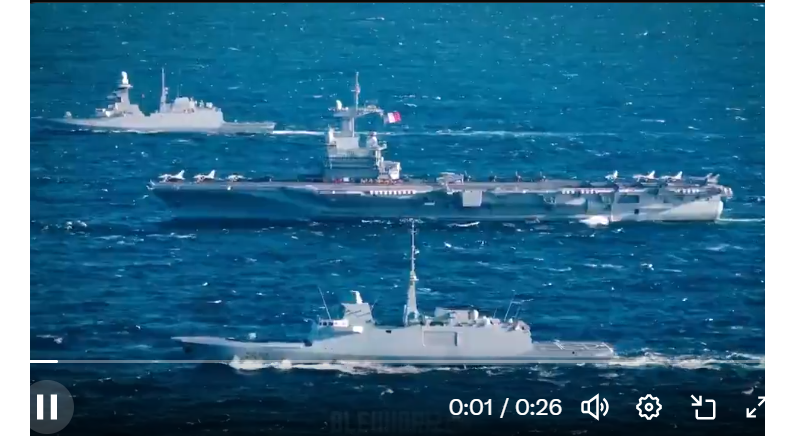
A significant concentration of naval forces is emerging in the Persian Gulf, raising concerns about a new phase of military escalation around the Strait of Hormuz, the strategic passage through which nearly one-fifth of the world’s oil supply transits. Several major maritime powers appear to be coordinating efforts to respond to threats against freedom of navigation in this critical area.
According to political statements and military analyses, France has reportedly deployed around ten warships to the region. This force likely includes FREMM multi-mission frigates, considered among the most advanced surface combatants in Europe. These ships are equipped with Aster 15 and Aster 30 anti-air missiles, Exocet anti-ship missiles, and MU90 torpedoes, enabling them to carry out air defense, anti-submarine warfare, and naval strike missions.
The French Navy also possesses a major strategic asset: the aircraft carrier Charles de Gaulle, the only nuclear-powered aircraft carrier operated outside the United States. If deployed with its carrier strike group, it could launch Rafale Marine fighter jets capable of conducting long-range precision strikes using cruise missiles.
A Naval Coalition Taking Shape
The situation increasingly appears to extend beyond a bilateral confrontation. U.S. officials have suggested the possibility of coordination with several major naval powers, including the United Kingdom, France, and other countries heavily dependent on maritime trade through the Gulf.
The United Kingdom is already participating in regional military operations and hosts U.S. strategic bombers capable of conducting missions in the area. At the same time, several Asian countries are closely monitoring developments: Japan and South Korea import a large share of their oil through the Strait of Hormuz and therefore have a direct interest in keeping the shipping lane open.
In this context, discussions are underway between European and non-European partners to coordinate maritime security operations. Some observers even suggest that existing naval missions in the Red Sea could expand toward the Persian Gulf.
The Strait of Hormuz: A Strategic Flashpoint
At its narrowest point, the Strait of Hormuz is only about 21 miles wide, making it one of the world’s most critical energy chokepoints. Any disruption in this area can immediately trigger turbulence in global oil markets and alarm major importing economies.
Iran, which controls part of the coastline overlooking the strait, has developed asymmetric military capabilities suited to such an environment: fast attack boats, submarines, naval mines, and shore-based missile batteries. Historically, this strategy has aimed to complicate operations for foreign navies in the confined waters of the Gulf.
However, if a multinational naval coalition composed of several leading maritime powers becomes fully operational, the strategic balance could shift. The growing presence of warships and surveillance assets would significantly reduce the margin for any sustained blockade attempt.
Toward Armed Tanker Escorts?
One scenario under discussion is the introduction of armed escort operations for oil tankers transiting the strait. This approach—used in previous maritime crises—would involve military vessels accompanying commercial ships in order to deter or repel potential attacks.
Such operations, however, carry substantial risks. Escorting civilian vessels through a high-tension zone means accepting the possibility of armed incidents and even direct confrontations between naval forces.
A Situation Under Close Watch
For now, Western governments continue to emphasize diplomatic coordination and de-escalation. Nevertheless, the growing concentration of military assets in and around the Gulf echoes earlier periods of severe tension in the region.
If the buildup continues, it could represent the largest multinational naval deployment in the Persian Gulf since the 1991 Gulf War.
In a fragile geopolitical and energy landscape, the security of the Strait of Hormuz has once again become one of the central strategic issues on the global stage.
#USIsraelwaronIran #StraitofHormuz #NATO