


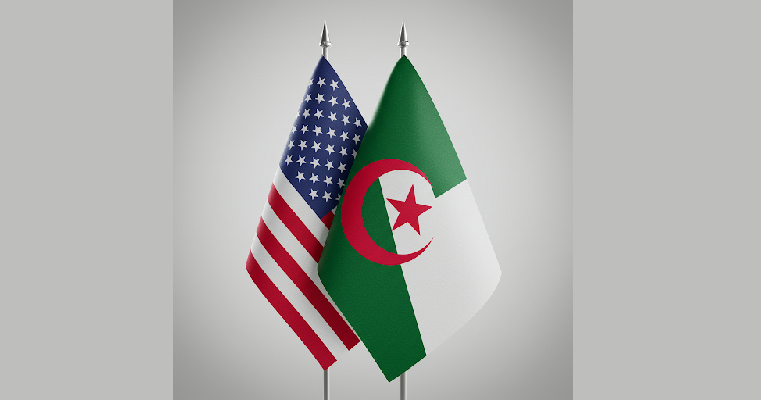
In Washington’s crowded mental map of the Middle East and North Africa, Algeria occupies an unusual space: neither ally nor adversary, neither client state nor crisis theater. Some analysts interpret this relative absence as neglect. In reality, it reflects a durable equilibrium. For the United States, Algeria’s strategic value lies precisely in its distance from American power.
Unlike countries such as Morocco or Egypt, Algeria has never sought proximity to Washington. It hosts no U.S. bases, receives no American security aid, and remains outside Western security frameworks. Yet relations have remained stable for decades. Rather than attempting to draw Algeria into its alliance system, the United States has largely respected its independence — and the result has been a quiet but effective partnership.
As Washington recalibrates its role in Africa and the Mediterranean amid renewed great-power competition, Algeria’s value may lie less in becoming another ally than in remaining an autonomous stabilizing force.
A regional shock absorber
Algeria’s most underappreciated contribution to regional security is its ability to absorb instability without transmitting it outward.
The collapse of Libya after the Libyan Civil War illustrates this dynamic. Neighboring states became deeply entangled in the conflict: Egypt and the United Arab Emirates intervened militarily, while external powers such as Russia and Turkey entered the battlefield. Algeria chose a different approach. It reinforced border security, expanded counterterrorism surveillance, and quietly facilitated dialogue between rival Libyan factions.
The result was notable: Libya’s war never spilled into Algerian territory, nor did Algeria become a battleground for proxy competition.
A similar pattern has emerged across the Sahel. As instability spread in countries like Mali and Niger, Algeria resisted calls to host foreign military forces. Instead, it strengthened intelligence coordination and joint border patrols, helping limit arms trafficking and militant movement across its frontiers.
Even in neighboring Tunisia, Algeria has acted as a quiet stabilizer. During Tunisia’s recent economic crisis, Algiers provided financial assistance and electricity supplies, easing pressure without seeking political leverage.
Across these crises, Algeria has neither acted as a regional hegemon nor as a proxy of external powers. Instead, it has relied on self-reliant security policies rooted in its long-standing doctrine of strategic independence.
A tradition of structured non-alignment
Since gaining independence in 1962, Algeria’s foreign policy has been shaped by a consistent principle: engagement without dependence.
Relations with Washington have occasionally included cooperation — from mediation efforts such as the Algiers Accords to intelligence coordination against terrorist networks after the September 11 attacks. But Algeria has consistently rejected foreign bases and formal alliance commitments.
At the same time, it has diversified its international partnerships. Russia remains a major defense supplier, while China has become an important commercial partner through infrastructure investment and trade. Yet these relationships do not represent ideological alignment. Rather, they form part of a broader balancing strategy designed to preserve freedom of action.
Europe has adapted to this reality. Following the disruption of global energy markets after the Russian invasion of Ukraine, Algerian gas exports became increasingly important for European energy diversification. Yet this interdependence has remained pragmatic rather than political, reinforcing Algeria’s economic relevance without transforming it into a security client.
Stability at home, flexibility abroad
Algeria’s independent foreign policy also supports its domestic agenda.
The government of Abdelmadjid Tebboune has launched several major industrial initiatives aimed at reducing dependence on hydrocarbons. Projects such as the development of the Gara Djebilet iron ore deposit and large phosphate complexes are intended to diversify the economy and create employment opportunities for a young population facing significant joblessness.
These initiatives remain works in progress, but they illustrate how Algeria’s external balancing strategy creates room for domestic economic restructuring.
Why Washington should resist turning Algeria into an ally
Given Algeria’s military capacity and strategic location, some observers argue that Washington should seek a closer partnership. Yet turning Algeria into a conventional ally could prove counterproductive.
Algeria’s diplomatic credibility in regional mediation stems precisely from its independence. Formal alignment with the United States would narrow that space and risk transforming a stabilizing actor into another arena of geopolitical competition.
Domestic considerations matter as well. Algerian political culture places strong emphasis on sovereignty and anti-colonial independence. Visible military alignment with Western powers could trigger nationalist backlash and undermine internal stability.
For Washington, the current arrangement already delivers significant benefits at minimal cost. Algeria contributes to regional stability without demanding security guarantees, military protection, or large-scale aid.
In an era when the United States faces growing global commitments, this type of relationship may be more valuable than another alliance.
Sometimes, strategic distance is not a weakness. In Algeria’s case, it is precisely what makes the relationship work.
#Algeria #UnitedStates #Sahel #Libya #security #bilateralrelations