


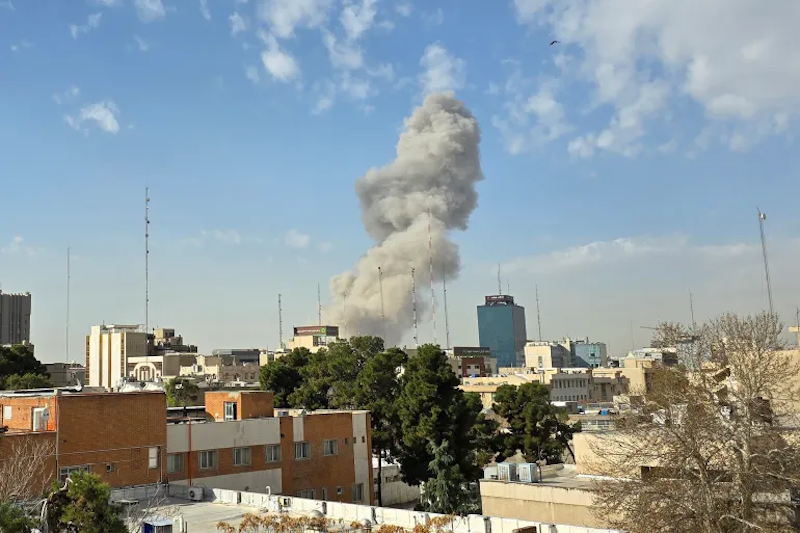
Eight months after the 12-day war, Washington has launched an air campaign against Iran, and the results of this action could be dramatic.
The world woke up this morning to the spectacle of a dramatic escalation in tensions in the Middle East, with confirmed reports of a joint military attack carried out by the United States and Israel against Iran.
This operation, described as a “preemptive strike” by Israeli authorities and code-named “Lion’s Roar,” targeted several strategic sites in Iran, including centers of power in Tehran and other cities such as Tabriz, Kermanshah, Karaj, Chabahar, Isfahan, and Qom. The reported explosions sparked panic and led to a state of emergency declaration in Israel, with the closure of airspace and calls for the population to take shelter near bomb shelters. This action comes while nuclear negotiations were underway, underscoring a blatant diplomatic failure and raising the risk of a broader regional conflict.
Background and Course of the Attack
Initial information about the attack emerged through posts on X (formerly Twitter), relayed in multiple languages, including English, French, Arabic, and Persian. According to sources such as The New York Times and U.S. officials, the United States actively participated in the operation despite the absence of authorization from Congress. Republican Representative Thomas Massie criticized the intervention as an “unauthorized act of war,” highlighting the constitutional implications for the United States.
For its part, Israel announced that it had launched a preemptive strike against more than 30 Iranian sites, potentially including the residence of the Supreme Leader and leadership offices. Videos circulating on X show columns of smoke rising above Tehran, confirming massive explosions in the capital and its surroundings. Other footage broadcast by the Kurdish agency Rudaw shows a salvo of cruise missiles flying at low altitude over Iraq, which could indicate the route used by the Americans to strike Iran.
Reports in French media outlets such as Le Figaro and Sputnik Afrique emphasize close coordination between Washington and Tel Aviv. According to analysts, the attack had been prepared for months and paradoxically took place during ongoing nuclear talks. An Omani minister had recently expressed fears of a preemptive Israeli strike in an interview published just before the event, illustrating underlying tensions.
In Arabic, posts from channels such as CGTN Arabic and Roya News report that the attack aims to “dismantle Iranian security” and target the entire leadership, with speculation about a decapitation strike against the Iranian Minister of Defense.
In Persian, firsthand accounts describe widespread explosions that woke millions of Iranians in the middle of the night. Users report that Iranian defenses were ineffective and criticize the ongoing negotiations as naïve, asserting that “Israel is not separate from the United States.”
Bombings struck Tehran, Qom, Lorestan, Kermanshah, Karaj, and Tabriz. The Americans and Israelis reportedly used cruise missiles such as the Tomahawk and ballistic missiles such as the Golden Horizon. There is no indication of American or Israeli aircraft overflying Iranian territory. The selected targets were mainly linked to Iran’s power structure, the Revolutionary Guards, and the nuclear program. The Ministry of Intelligence, the residence of the Supreme Leader, the Parchin military complex, and the headquarters of the Iranian Atomic Energy Organization were struck. Iran showed limited resistance; there was no massive use of surface-to-air defenses, and only a single fighter jet (a MiG-29) was observed conducting an interception mission over Tehran.
President Trump announced the start of a military operation against Iran, justifying the war by Tehran’s conduct. He described Iran as the “number one state sponsor of terrorism” and stated that the Iranian regime “will never be allowed to have a nuclear bomb.”
International and Regional Reactions
International reactions have been intense and varied. Analysts from Al Jazeera and The Wall Street Journal warn of the risk of a regional conflict, noting that this is the second war against Iran in eight months. Some suggest that Iran could retaliate by targeting Gulf countries to force American intervention, while others speculate about market impacts, such as the liquidation of Bitcoin positions in anticipation of the attack.
Media outlets such as Senego and RMC Info report that the operation is not solely Israel’s undertaking but involves active U.S. participation, risking plunging the region into chaos.
Israel has declared a state of maximum alert, with schools closed and expectations of Iranian retaliation via drones and missiles. Tel Aviv is on full alert, and sources such as CNN confirm coordination with the United States, although Washington’s exact role remains unclear in some reports.
Geopolitical Implications and Outlook
This attack marks a potentially dangerous turning point, occurring in the context of fragile nuclear negotiations. Experts emphasize that the operation appears aimed not only at infrastructure but also at eliminating key figures of the Iranian regime as part of a “decapitation” strategy. No official confirmation of casualties is available at this time, but an Iranian response is widely expected, potentially involving regional proxies. Early indications, however, suggest that the Supreme Leader of the Islamic Revolution is still alive.
This article is based on real-time reports reflecting a diversity of perspectives. Updates are expected as developments unfold.
Akram Kharief
MENADEFENSE, Feb 28, 2026
#Iran #UnitedStates #Israel