The Rabat text leaked to the press proposes a national referendum rather than one limited to Saharan territory, and excludes an autonomous flag.
Morocco acknowledges that it has drawn inspiration from Spain’s autonomous communities model in the autonomy statute proposal it presented last weekend in Madrid to the Polisario Front, but it retains broad control over political power and symbols of sovereignty. It even includes an equivalent of Article 155 of the Spanish Constitution, through a safeguard clause allowing the suspension of autonomous powers. According to the main points leaked this Thursday to Moroccan media, the text establishes an autonomous government and parliament, and even an autonomous police force, though with distinctive features. The Sahara statute must be approved by referendum, but Morocco believes it should be voted on by all Moroccans, not only by inhabitants of Saharan territory, thus preventing it from being interpreted as a self-determination vote.
Under the proposed statute, the King of Morocco reserves the right to invest the president of the Saharan executive on the basis of regional parliamentary legitimacy. The legislative chamber would include both deputies elected by popular vote and members appointed to represent traditional Saharan tribes, according to information published by the digital outlet Le Desk.
Regional officers would limit their functions to administrative and local judicial policing missions, under coordination with state security forces. The Cherifian kingdom, a vigilant guardian of its unity and identity, also prohibits the autonomous Sahara from flying its own flag—only the national red-and-green banner would be allowed—and from opening delegations or representations abroad.
Rabat’s central authority reserves powers in matters such as defense, foreign relations, nationality, and currency issuance, as in any federally inspired system, while offering the autonomous Sahara management of health care, education, urban planning, regional economy (fishing, tourism…), and culture, among other responsibilities. It also provides for its own taxation and judicial system (for autonomy-related matters). However, the draft statute assigns to the State any other matter not detailed in the articles, an interpretation that reverses the usual subsidiarity principle, which in cases of legal gaps typically grants authority to the administration closest to citizens.
The 40-page proposal from Rabat was presented in Madrid as part of a direct dialogue initiative sponsored by the United States, based on UN Security Council Resolution 2797, adopted last October 31 without opposition, which identified “genuine autonomy” as the “most feasible” objective for a political solution to the dispute over the former Spanish colony. Massad Boulos, the envoy for Africa and the Arab world of President Donald Trump, along with the U.S. representative to the UN, Mike Waltz, coordinated the meeting—held in the presence of Staffan de Mistura, the UN envoy for Western Sahara—between the foreign ministers of Morocco, the Polisario Front, Algeria, and Mauritania, in an unprecedented encounter since 2019.
According to what is known so far, the State also requires the new autonomous authority to demonstrate constitutional loyalty and respect for national unity. Any interpretation that might open the way to Western Sahara’s right to secession is explicitly excluded, and the head of the regional government would also become the State’s representative in the autonomous territory.
For its part, the Polisario Front continues to reject negotiations focused exclusively on Morocco’s autonomy plan and insists that the Sahara should achieve self-determination through a referendum including the option of independence. It also firmly opposes the investiture of the autonomous president being placed in the hands of the Moroccan monarch under a supervised institutional system.
Natural Resources
Disagreements between the parties are also evident regarding foreign investment in the region. The exploitation of Western Sahara’s natural resources—such as fishing, mining, and renewable energy—would represent the main source of revenue for the autonomous treasury. Consequently, Rabat’s statutory text imposes dual oversight—state and autonomous—to authorize the presence of foreign companies. Under a quota-like arrangement, the autonomous Sahara would contribute part of its tax revenue to cover state expenses, while also gaining access to Morocco’s interterritorial solidarity fund.
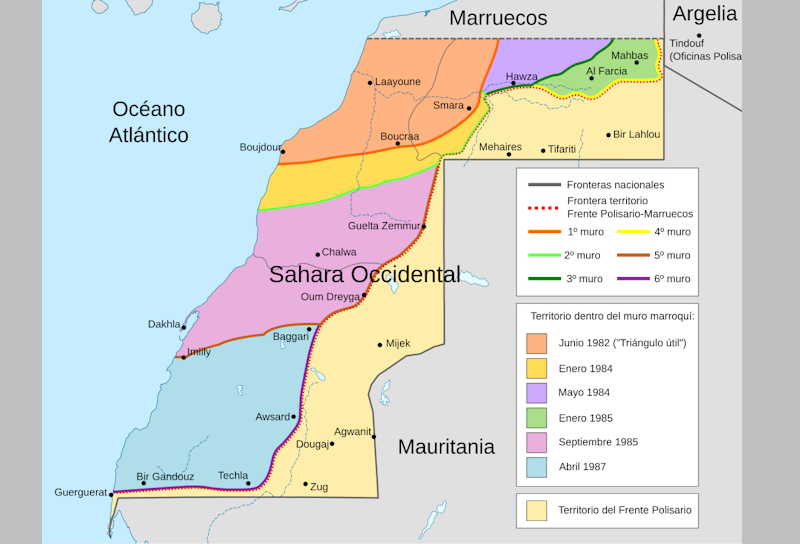
The Moroccan legal text also creates a commission to organize the voluntary return of thousands of Sahrawi refugees who have lived for more than 50 years in Tindouf (southwestern Algeria), as well as to verify their identity. Polisario fighters would be granted amnesty following a process of disarmament and demobilization, excluding those responsible for war crimes and crimes against humanity.
The autonomy statute project is not yet a finalized document. The United States has again convened the parties who recently met in Madrid for a new round of talks next May in Washington, with the intention of sealing a framework agreement that would lead to direct negotiations. Before that, the functions of the so-called permanent technical committee (legal experts and specialists from the parties) must be agreed upon. This body is tasked with evaluating Morocco’s autonomy plan under the supervision of the United States and the UN.
The UN Security Council may review in April the functions of the United Nations Mission for the Referendum in Western Sahara (MINURSO). Rabat advocates its dismantling after it has apparently lost its initial mandate and has effectively become an observer mission on the ground, following the resumption of hostilities between the parties in 2020, after nearly three decades of ceasefire.
Source : El Pais, 12/02/2026