


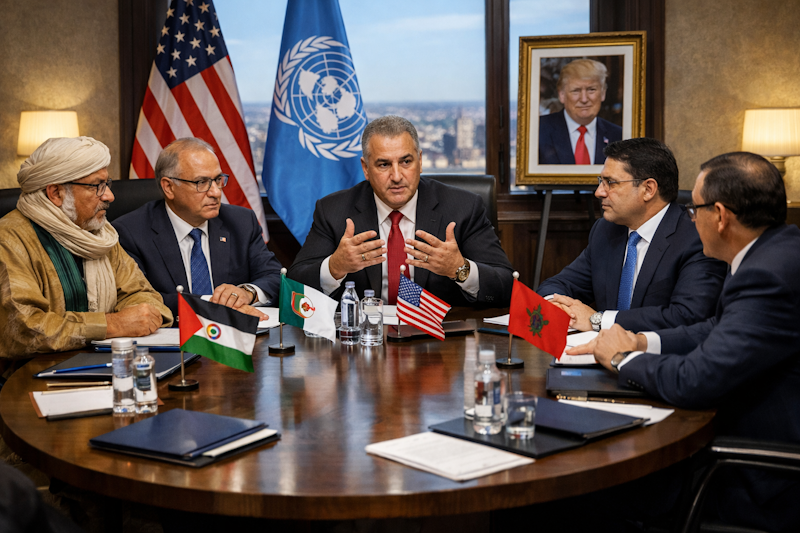
In his analysis of the process launched by Washington in Madrid to resolve the Western Sahara conflict, the Franco-Algerian journalist draws attention to “the persuasive power of the United States in this matter and the connections of Massad Boulos, Donald Trump’s special adviser for the Arab world and Africa,” who “achieved the feat of bringing together Algerian Foreign Minister Ahmed Attaf and his Moroccan counterpart Nasser Bourita at the same table—no small accomplishment. Moreover, the diplomatic adviser and the Polisario’s diplomatic representative were also at the same table, which grants the latter the status of a belligerent, a fully-fledged actor and stakeholder who will therefore have a say in the solution, whether it be autonomy within Moroccan sovereignty or self-determination.”
He believes that “the Americans are somewhat in the position of both judge and party. Judge because the United States had already chosen, with Donald Trump in 2020, to recognize Moroccan sovereignty over Western Sahara, disregarding international law and in defiance of the United Nations, which considers the territory still subject to decolonization. Nevertheless, the UN resolution of October 31, 2025… endorses the American thesis and validates the Moroccan proposal of very broad autonomy, to which the Polisario appears to subscribe without renouncing self-determination.”
He adds: “There may be an effect linked to Donald Trump, whom everyone knows does not tolerate opposition or rejection of his proposals. There may also be a sense of fatigue among the four protagonists in a conflict that has lasted 50 years, which has led Algeria and Morocco to keep their land borders closed for 32 years and to sever relations for decades.”
TV5 Monde recalls that “no official photos were taken. The statement issued at the end of the two-day meeting provided no details. A great deal of secrecy, then—but that is not necessarily a bad sign, since the positions of the two sides seem to have moved closer. Morocco on one side, Algeria and the Polisario Front separatists on the other, agreed on a working method.”
According to the French channel, “they accepted the creation of a technical committee comprising the four delegations as well as experts and legal specialists, with the aim of reaching a framework agreement by next spring. While the Saharan separatists and Algeria have not completely abandoned the right to self-determination, discussions are primarily focused on the autonomy plan proposed by Morocco.”
TV5 notes that “the talks over the two days in Madrid centered on this issue. An autonomy plan supported by Morocco, and also backed by the European Union, the United States, and more recently the United Nations.” It adds that “significant disagreements remain over the plan. Morocco seeks the broadest possible autonomy while retaining sovereign powers, and for example demands that the leader of the autonomous region be appointed directly by Rabat, whereas the Polisario would prefer that the position be elected. There are also disputes over the degree of the territory’s fiscal autonomy.”
The channel concludes that “the four delegations are expected to meet again within weeks. The United States hopes to reach an agreement by next May. Donald Trump’s objective is clear: to become the president who succeeded in finding an outcome to a conflict more than 50 years old. He also wants to go further by working toward reconciliation between Morocco and Algeria. The two countries have had no diplomatic relations for five years, and their border has been closed for 32 years.”
#WesternSahara #Morocco #Polisario #UnitedStates #DonaldTrump