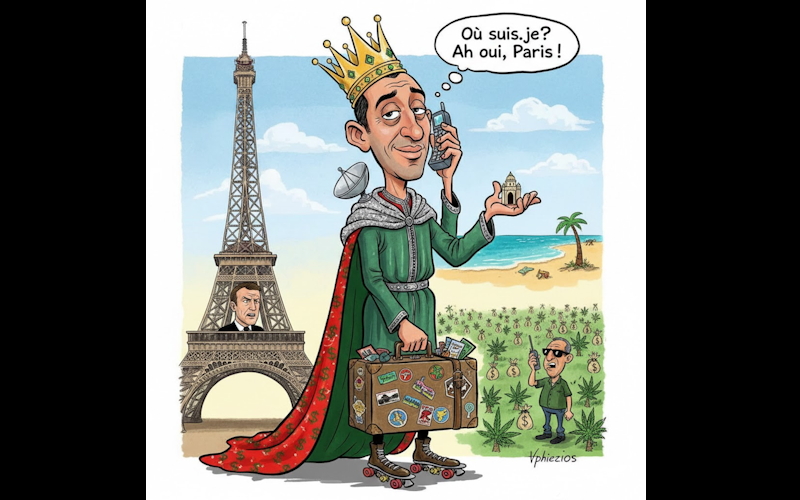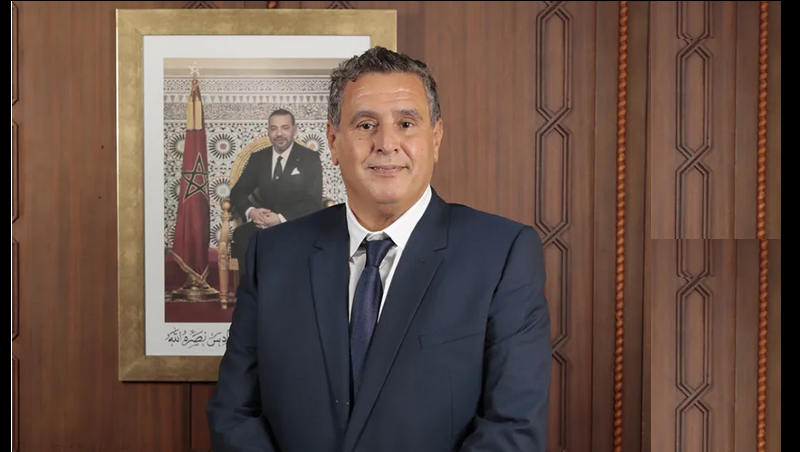
As he begins his fifth year at the helm of the Moroccan government, billionaire Aziz Akhannouch seems to have succeeded in a singular gamble: transforming the management of public affairs into an enterprise of social dismantling and record debt.
Behind the façade of speeches about emergence and major infrastructure projects, the Kingdom’s macroeconomic and social indicators are flashing bright red. An analysis of a record that observers are already calling a « lost decade. »
The Debt Wall: 1,250 billion dirhams in liabilities
This is the dizzying figure that mortgages the future of coming generations. Under Akhannouch’s tenure, public debt has reached the staggering threshold of 1,250 billion dirhams (MMDH), including $68 billion in external debt. This financial runaway is accompanied by an abysmal budget deficit, peaking at 53.7 billion dirhams at the end of July 2025, compared to 35.3 billion a year earlier.
To keep this ship afloat, the government is sacrificing the local entrepreneurial fabric: 40,000 companies officially went bankrupt in 2024, victims of systemic corruption, cronyism, and a deliberate exclusion of small stakeholders in favor of large conglomerates orbiting around power.
Social Collapse: Mass Unemployment and Human Decline
The Morocco of 2024 boasts, according to IMF data, a not-so-glorious 6th place worldwide in terms of unemployment rate (13.2%), following in the wake of countries in deep crisis like Sudan. This economic malaise translates into a brutal fall in international human development rankings.
Occupying 120th place in the HDI (Human Development Index) ranking, Morocco finds itself outpaced by Egypt, Tunisia, and even Syria, despite the years of conflict the latter has endured. Basic public services are no exception:
- Education: 154th out of 204 countries for teaching quality.
- Health: 95th out of 98 countries for access to healthcare.
- Higher Education: Completely absent from the top 1000 of the prestigious Shanghai ranking.
The agricultural sector, once a pillar of Moroccan stability, is now the symbol of incoherent management. While the country is experiencing unprecedented water stress, the government persists in favoring the export of water-intensive products. Morocco exported 100,000 tons of avocados, consuming between 100 and 200 billion liters of water, while ranking as the world’s 2nd largest exporter of tomatoes.
Meanwhile, food sovereignty is collapsing: the Kingdom now imports 10 million tons of cereals (almost all of its needs), half of its sugar needs, and a third of its meat needs, a sector where it was self-sufficient in 2019. Even more serious, fish, of which Morocco is a major producer (10th worldwide), is becoming inaccessible for the average citizen: the sardine, the « poor man’s protein, » now reaches 50 dirhams in local markets.
A Justice System and Freedoms Under Guardianship
On the institutional level, the decline is just as marked. The country has plummeted to 97th place in the Corruption Perceptions Index in 2024 (compared to 73rd in 2018). Recent legislative reforms, carried by Justice Minister Wahbi, are perceived by legal experts as an arsenal protecting corruption and limiting the right of recourse for the most disadvantaged.
The press, meanwhile, is undergoing methodical asphyxiation. Ranked 135th worldwide for press freedom, Morocco sees financial capital taking precedence over journalistic ethics, with laws favoring major media bosses to the detriment of editorial independence.
Head in the World Cup, Feet in the Abyss
To mask this record, the Akhannouch government is betting everything on stadium diplomacy and hosting the 2030 World Cup, a 1,500-billion-dirham adventure that risks widening the social fracture. Between the disappearance of 40% of the argan forest, massive rural exodus (152,000 departures per year), and a record trade deficit of 304.9 billion dirhams, the Morocco of the Akhannouch era seems to have locked itself into a spiral of decline that only aggressive communication still tries to conceal.
For the 42 million Moroccans, reality is not found in official statements, but in the loss of purchasing power and the feeling of a country being sold off to private and foreign interests. The next chapter of this story promises to be particularly bitter for the Moroccan people.
#Morocco #Akhannouch #MoroccosEconomy