


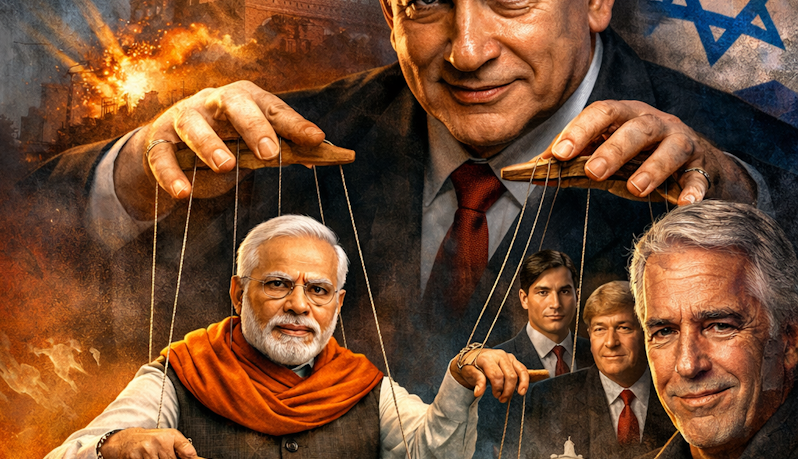
The Epstein scandal reveals that Modi would be Netanyahu’s puppet! These sulfureous ties largely explain New Delhi’s discreet hostility toward Algeria, particularly within the BRICS.
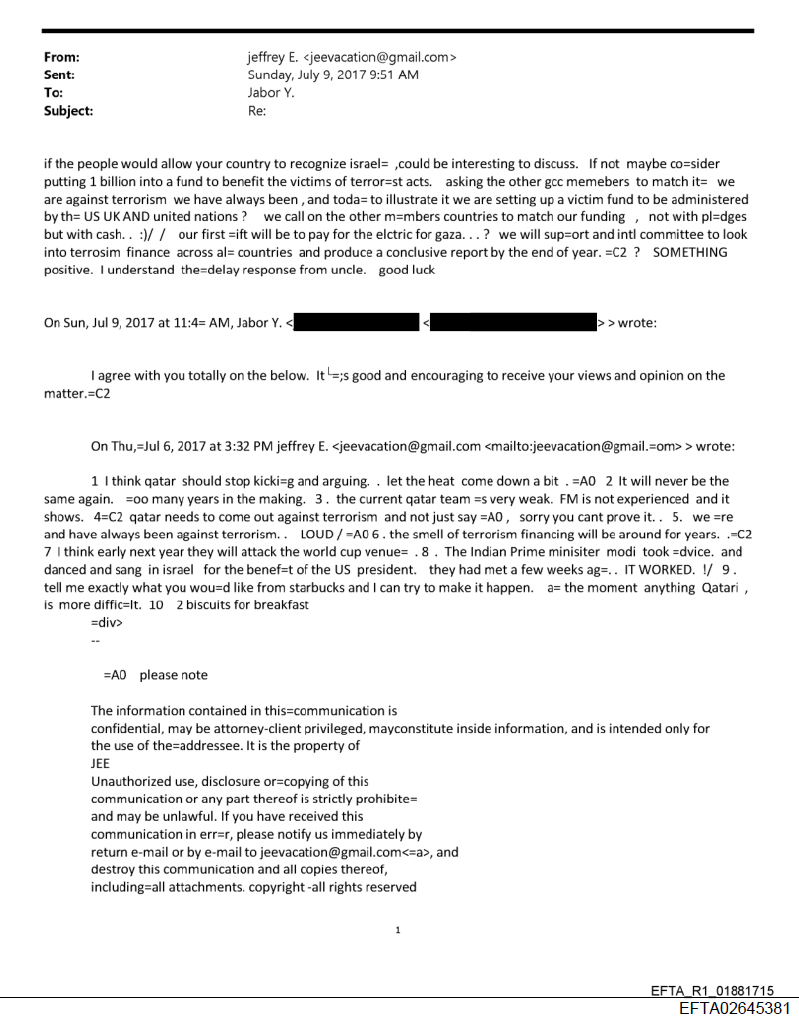
The Epstein files made public in early February 2026—more than three million pages from U.S. court proceedings—contain emails and messages establishing direct exchanges between Jeffrey Epstein and Anil Ambani, an Indian oligarch at the heart of Narendra Modi’s inner circle. These documents explicitly mention the coordination of diplomatic agendas, the organization of contacts with Donald Trump’s entourage, and, most importantly, repeated references to an “Israeli strategy” shaping the Indian prime minister’s travel and political choices from 2017 onward. What is both shocking and astonishing in these revelations is that an emerging giant (but allegedly deeply Islamophobic) like India would be a submissive servant to the whims and orders of the tiny Israeli entity. Further proof, if any were still needed, that the powerful Zionist lobby truly controls the entire planet from the shadows.

The scandal reveals a system of geopolitical manipulation
From this point on, the façade crumbles. What these files reveal is not merely an embarrassing proximity to a controversial figure, but the exposure of a system of geopolitical manipulation in which the Israeli entity plays the role of a discreet conductor, using compromised intermediaries to steer major sovereign decisions. The exchanges show Epstein acting as a facilitator of influence, linking New Delhi to Trumpist circles in Washington while ensuring that this dynamic remained strictly aligned with Tel Aviv’s interests.
The sequence is relentless. In spring 2017, Ambani asked Epstein to open channels with Jared Kushner and Steve Bannon. In June, Modi was received by Donald Trump in Washington. In July, he made a historic visit to Israel—the first by an Indian prime minister—deliberately bypassing the Palestinian Authority. Shortly thereafter, India became the world’s largest importer of Israeli weapons, for more than $700 million in a single year, sealing a military partnership set to deepen despite the genocidal war allegedly waged by the Israeli entity in Gaza. This shift marked a clear break with decades of Indian support for the Palestinian cause.

Epstein’s correspondence leaves no doubt
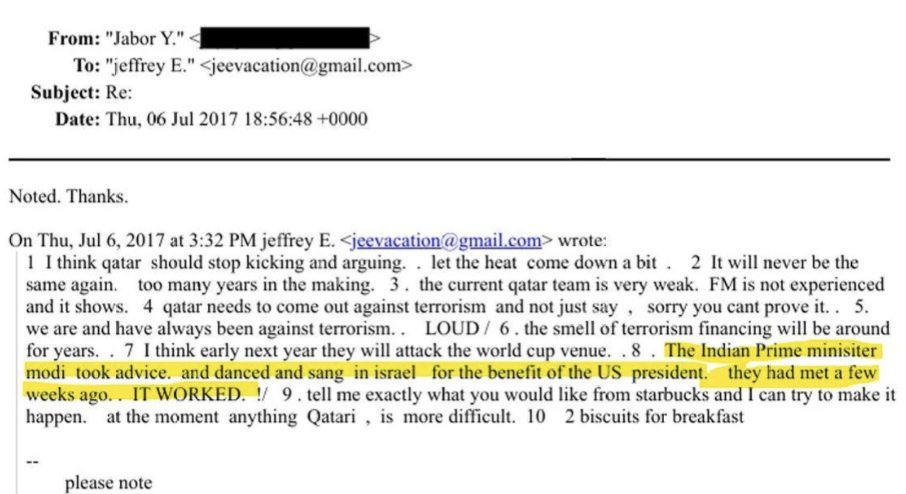
Epstein’s emails leave no ambiguity about the nature of this reorientation. They speak of “discussions on the Israeli strategy dominating Modi’s dates,” a blunt formulation that reduces the diplomatic agenda of a state of more than one billion people to a variable adjusted to external interests. After the July 2017 visit, Epstein congratulates himself that Modi had “taken advice” and that the operation had “worked,” as one would speak of a successful maneuver on a cynical chessboard where morality has no place.
The affair does not end in 2017. In 2019, after Modi’s landslide victory in the general elections, Epstein proposed organizing a meeting with Steve Bannon, a central ideologue of the American far right. Once again, the messages stress ideological convergence, a shared obsession with China, and India’s integration into a security and ideological axis in which the Israeli entity serves as both pivot and model. Epstein writes that “Modi is on board.” The expression is revealing: he is no longer portrayed as an independent leader, but as an actor integrated into a broader strategy conceived elsewhere.
The official reaction from New Delhi, hiding behind the argument of the “ramblings of a convicted criminal,” appears derisory in light of the coherence of the facts. Major political decisions, arms contracts, diplomatic choices, and symbolic breaks confirm point by point what the documents describe. The Indian opposition is not mistaken when it speaks of Modi’s troubling sensitivity to foreign manipulation and directly questions his ties with the Israeli entity.
Large-scale political predation
The Epstein files thus expose a mechanism of political predation in which personal compromise becomes a tool of geopolitical domination. The Israeli entity appears not as a simple partner of India, but as a power acting in the shadows, pulling strings, steering trajectories, exploiting opaque networks to reshape alliances and neutralize long-standing diplomatic traditions. Modi, far from the image of a strong and sovereign leader he cultivates, emerges from these revelations as the product of a system of influence in which ideology, arms, and manipulation advance hand in hand.
These sulfureous ties largely explain New Delhi’s discreet hostility toward Algeria, particularly within the BRICS.
#Algeria #India #Modi #Epstein #BRICS