


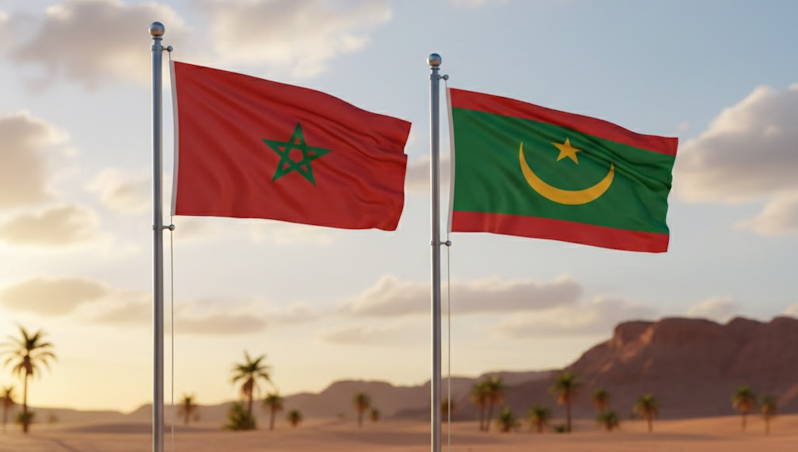
#Mauritania #Morocco #beIN_Sports #borders_conflict #YoussefAlSouhaïli
A Moroccan journalistic report broadcast on “beIN Sports” sparked widespread controversy in Mauritania after referring to Morocco’s historical borders, causing broad discontent among Mauritanians.
A report aired by “beIN Sports” during its coverage of the final of the 2025 Africa Cup of Nations between the national teams of Morocco and Senegal triggered a wave of outrage in Mauritania. In the report, Moroccan journalist Youssef Assouheili stated that Morocco’s borders historically extended to the Senegal River, which many Mauritanian viewers interpreted as a denial of Mauritania’s existence as a geographical entity and of its national sovereignty.
This reference appeared in the context of a sports report, leading many Mauritanians to consider it a historical distortion that harms the image of the national state, especially given the sensitive historical background related to expansionist claims raised in the 1960s regarding Mauritania’s alleged affiliation with Morocco. These claims were later abandoned by Rabat after Mauritania firmly upheld its right to national sovereignty in accordance with international law and historical evidence.
Mauritanian sources recall a similar incident in 2018, when the former Secretary-General of Morocco’s Istiqlal Party, Hamid Chabat, made comparable statements that sparked widespread controversy. This prompted the Moroccan Royal Palace to officially distance itself from those remarks and to dispatch then-Prime Minister Abdelilah Benkirane and current Foreign Minister Nasser Bourita to Zouerate to meet former Mauritanian President Mohamed Ould Abdel Aziz and present official apologies.
Criticism of Editorial Professionalism
Observers and media specialists have emphasized that inserting sensitive historical and political issues into sports reports constitutes a breach of professional standards. They have called on international networks such as “beIN Sports” to ensure content neutrality and respect for national sensitivities, given their large audience and strong influence on Arab and African public opinion.
Experts also stressed the need to separate sports coverage from political or historical matters in order to avoid provoking sensitivities unrelated to sports and to preserve the credibility of media messaging.
Apology from the Moroccan Journalist
In response to the wave of criticism, Moroccan journalist Youssef Assouheili issued an apology on his Instagram page. He explained that his historical reference was intended only to highlight limited historical links between Morocco and the Senegal River basin region in the 17th century, stressing that he did not intend to adopt any nationalist narrative or offend Mauritania and its people.
In his post, he said: “I apologize to my Mauritanian brothers for any anger caused by a sentence in my report. I affirm that the purpose was purely journalistic, far from any political interpretation. Mauritania is a peaceful, neighboring Muslim country that I respect and value, and I would never think of offending it or its brotherly people.”
He added that the report was part of a sports coverage linking Morocco and Senegal historically, and that he had not anticipated that the wording would provoke such widespread controversy among Mauritanian audiences. He also emphasized that he has Mauritanian colleagues and friends from his studies and professional life.
Historical Context
The controversial sentence in the report referred to “historical links between Morocco and Senegal since the time when Morocco’s borders reached the banks of the Senegal River.” This statement drew strong criticism from bloggers and political and historical observers in Mauritania, who argue that sports media should not encroach on issues of national sovereignty and historical sensitivity.