#AFCON2025 #Morocco #referees #CAF #corruption
We were sold a competition; what we got was an administration of results. And when a result feels « administered, » it’s not just a feeling. It’s a scent. The scent of a system. Of money.
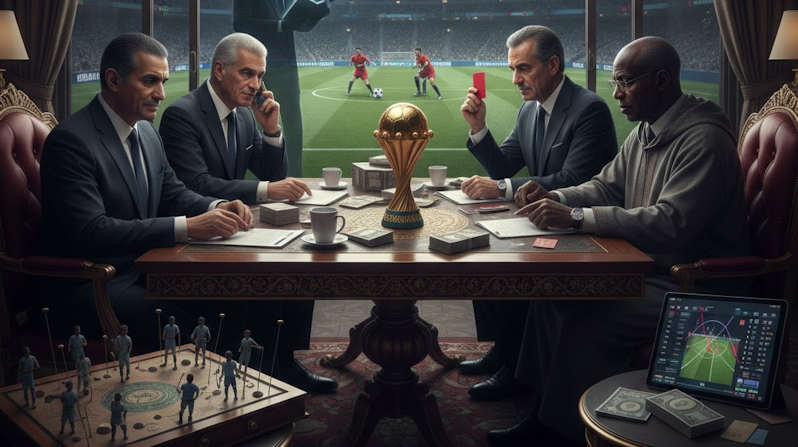
AFCON 2025 was not a tournament; it was a demonstration. Not a demonstration of football, but a demonstration of power. The game served as the backdrop, like background music, while the real action took place elsewhere—in VIP boxes, in hallways, through earpieces. The pitch was no longer the center of gravity, merely the stage.
From the start, a phrase circulated in the wings, dropped by lucid advisors like a dirty truth: « Give them the trophy and leave us alone. » That was the climate. An AFCON where some took to the pitch knowing they weren’t just playing against a team, but against a machine. When such a thought exists before kickoff, it’s no longer paranoia. It’s a diagnosis.
This diagnosis took a sinister turn when Mohamed Soumaré, a Malian journalist and sports consultant—one of the first to publicly question the tournament’s organization and inner workings—was found dead in his hotel room in Rabat. Even if the cause of death is yet to be established, the effect was immediate. The tournament shifted into an atmosphere where asking questions became a high-risk sport.
The Weaponization of the Game
In this machinery, referees ceased to be referees. They became instruments. Obvious penalties ignored, goals dissected to the point of absurdity, and conversely, generous decisions granted to others without the same rigor. VAR did not correct; it filtered. It didn’t illuminate the game; it directed the narrative. It served as a white glove for a dirty hand. We no longer cheat the old-fashioned way. We cheat in UHD, with replays, chosen angles, and that tense silence while waiting for a decision that already seems written.
When refereeing becomes a tool, the nature of the competition changes. It’s no longer about who plays best, but who is best protected. At this stage, speaking of « luck » or « details » is a joke. What occurred followed a repeated logic—a coherence too clean to be accidental. The more one reviewed the footage, the less the decisions made sense. Football knows injustice; here, it had a script.
From the Sinister to the Petty
To this heaviness was added the petty. Ball boys obsessing over the Senegal goalkeeper’s towels, as if fighting their own final against a piece of fabric. A small, ridiculous image, yet a revealing one. This AFCON wasn’t just dirty at the top; it was stingy at the bottom. When you are at war with towels, the competition has lost its sense of grandeur—and even its sense of decency.
Another scene heavy with meaning: Moulay Rachid, present at the ceremony, looks away and ignores the handing over of the trophy. Neither distraction nor caprice—a signal. This victory was meant to serve as an image of continuity and succession. It failed. The absence of the young prince is not trivial. Whether intentional or not, it signifies that the optics were deemed too poor to be passed on. Moulay Rachid’s closed expression acts as a simple realization: that day, he didn’t just lose a stage; he lost a position in the narrative of power.
The Architecture of Control
At the heart of this setup, Fouzi Lekjaa found a wide-open door. He invented nothing. He knew how to enter an existing system, settle in, and use it as infrastructure. When a minister becomes a sports conductor, it isn’t talent—it’s a fusion. Football and State, ball and cabinet, competition and protocol—same table, same networks. The pitch becomes the place where execution happens. And while executing the plan, other nations are « managed. » They are pitted against each other, provoked, and set at one another’s throats, as if football needed permanent enemies to remain standing.
Dissent was methodically stifled. Coaches who questioned or protested received the same treatment: moral disqualification, insinuations, and reprimands. The press conference was no longer a space for explanation, but a tribunal. The Senegal coach was chased out; the Egypt coach was accosted. And then there was the unprecedented scene of Moroccan journalists transformed into a verbal militia, asking questions to strike, not to understand. Grandstand journalism, mic-version. This was an AFCON where some media outlets no longer covered the event; they participated in it as hostile actors.
Added to this were troubling ailments among certain players. Degraded physical states, sudden absences, with no clear communication or transparent explanation. Nothing proven, nothing officially established. But enough to saturate an already distrustful climate. When even bodies become « gray zones, » the tournament ceases to be a simple game.
The Verdict
We must name those responsible without detour. CAF has become a branch office. Patrice Motsepe did not preside over African football; he organized its domestication. And above him, Gianni Infantino plays his favorite role: guardian of the product, not the game. He sanctions the noise, not the fraud. Sporting justice always arrives after the accounting is done.
Finally, it must be said clearly: Morocco could have won without all of this. They were a great team, capable of winning through football alone. But by insisting on locking down the outcome before the ball even rolled, the game was sacrificed. It wasn’t the great Moroccan team that lost. It was the disruptors: Lekjaa, Motsepe, Infantino. They lost because they succeeded in making African football lose a piece of its credibility.
We can’t wait to be rid of them. We can’t wait for African football to breathe again.